State Department report about politics of the United States for the Western Balkans region, published in May, is a short text. And direct, as Donald Trump's regime has accustomed us to.
The document heralds the end of an era. The political project of guardianship after wars and supposed democratization is now being translated into a kind of commercial-security deal.
What we might call a "value dictionary" is also omitted. Human rights and democracy have been passed over as nice words whose essence, let's not lie, has fallen under the wheels of economic interests until now.

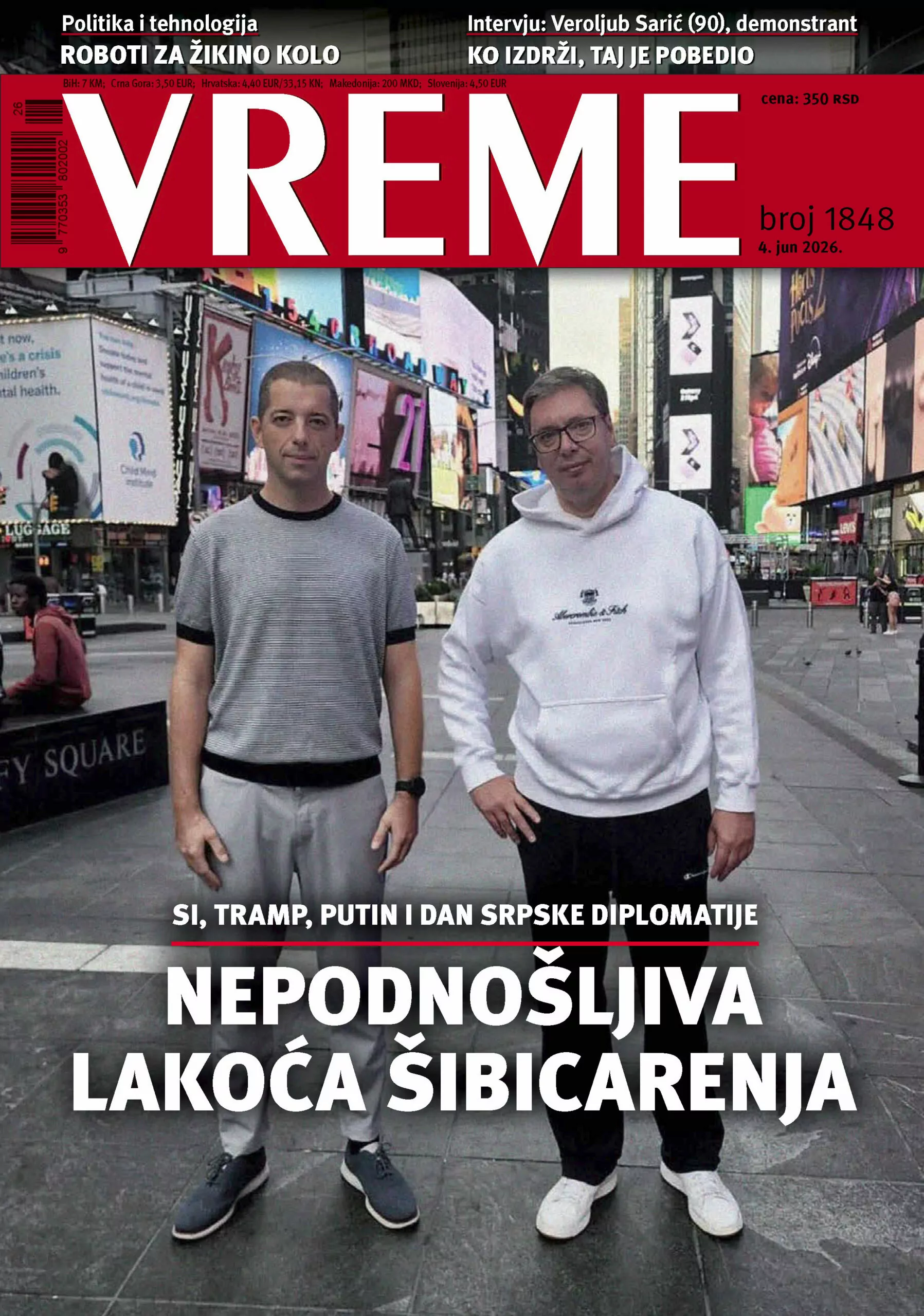
photo: fonet / instagramTHIS COUNTRY IS GOOD TO YOU, PRESIDENT: D. Trump junior and A. Vučić
Three new pillars
The vacancy is occupied by three related pillars: stability, commercial cooperation, and curbing the influence of Russia and China.
Stability was seen as a prerequisite. A positive relationship with everyone in the region is advocated, and Bosnia and Herzegovina and the relationship between Serbia and Kosovo are mentioned as neuralgic points.
Solutions are found in a "joint economic agenda" and "durable agreements acceptable to all parties". The real goal is "competition for US commercial interests."
In this equation, the countries of the Balkans lose any semblance of a political subject and become exclusively a resource. In the case of the US, the region was seen primarily through the prism of "transportation corridors", "natural resources", "skilled labor" and markets for US exports.
In that key, the whole narrative about suppressing the "malign influence" of Russia and China - which, according to the document, "use instability" - serves as an alibi. In other words, "stability" is not a name for peace, but for business conditions and commercial penetration of Washington.
What is the "Rule of Law"
In this connection, the only category of liberal guardianship that survives in the document is the rule of law. However, its content is twisted, if the content of that phrase ever existed.
The rule of law appears not as the government's accountability to citizens, but as a "predictable, transparent environment in which American companies thrive." Democratic content has been removed and replaced with commercial content. "Transparency" has been put in direct relation with public procurement that "favors American companies".
The most prominent deal related to American capital in the region - and that of the president's family - vividly shows what it is all about: the plan of Jared Kushner, Trump's son-in-law, to turn the Belgrade General Staff into a luxury hotel was guided by a secret contract and legal violence that removed protection from cultural monuments, and then a special law to circumvent the regulations. On top of that, there is also a free lease for 99 years.
The same pattern, which implies direct agreements, rewriting of laws, lack of transparency and competition, is followed by Kushner's plan to build a luxury resort in a protected area of the Albanian coast.
In other words, the periphery is expected to service the interests of American companies and buy American products and services.
TANJUG/ PRINT SCREEN YOUTUBE ZND/bsMeeting between Vučić and Trump in 2020
Oh yes, bring on the soldiers too.
The document of the State Department emphasizes the need to modernize the armies in the region and reach the allocation of five percent of GDP for "defense". It is not difficult to guess the purchase of which weapons this money should be poured into.
The periphery is there to fill in the gaps as needed. Albania, Bosnia and Herzegovina and Kosovo are sending personnel to the International Stabilization Force for Gaza. "Transition from user to security provider", as the document puts it, materializes literally.
Those military forces are not the blue helmets of the United Nations, but a structure under direct American command and the personal presidency of the US president, deployed behind Israeli lines.
The army from the Balkans in this transaction, by which the local authorities buy the trust of Washington, is entering a minefield since several UN bodies have characterized the Israeli actions as genocide.
The transformation from "user to security provider" actually means outsourcing the dirty work for the needs of the center.
And gas, and gas
The doctrine defined by the report is perhaps most clearly seen in the field of energy. The region's dependence on Russian energy sources is defined as "strategic vulnerability".
And while the USA persistently maintains sanctions against NIS due to Russian ownership, it signs an Agreement on strategic cooperation in the energy sector with Serbia. The Minister of Foreign Affairs of the Republic of Serbia, Marko Đurić, described this document as something that will "facilitate the green transition in Serbia" and enable "better access to clean energy."
Washington sees the region as a place to market its liquefied natural gas, small nuclear reactors and renewable energy infrastructure. It is sold as an alternative to the Russian monopoly and diversification even though it leads to the establishment of another, American monopoly.
Only their own, in fact - everyone's
Local compradores respond enthusiastically to this strategic setup. Almost at the same time that the State Department report was presented to the public, Fox News published the text of Aleksandar Vučić. "Others are looking for alms, we want deals," says Vučić.
Although Vučić's narrative is wrapped in a sovereignist garb, the adulation of Trump reaches the level of disgust, a piece of paper is being hung all over Serbia that says - "sale".
Serbia advertises its own subordinate function as an advantage: lithium reserves "vital for Western industrial independence", corridors and a government oriented to "action instead of ideology".
Vučić addresses each center using his vocabulary: to Washington in the language of "deals", and to Brussels in the language of the European path. Moscow and Beijing in the language of brotherhood.
The "sovereignty" that Vučić proclaims is actually freedom to be everyone's resource at the same time. The essence of that versatility is that no word is binding.
After all, he offers nothing of his own. It sells the relinquishment of every horizon beyond usability, the consent that the future of the region will no longer be a question of what we want to become, but to whom and at what cost we will benefit. It is not difficult for Vučić, but also for other political leaders in the region.
The author is a sociologist, researcher and editor of the Rupture blog, program coordinator at the Center for Emancipation Politics
Real journalism costs money, and we will not be bought by tycoons and corporations. Support us with a one-time or monthly donation. The time for it is now!