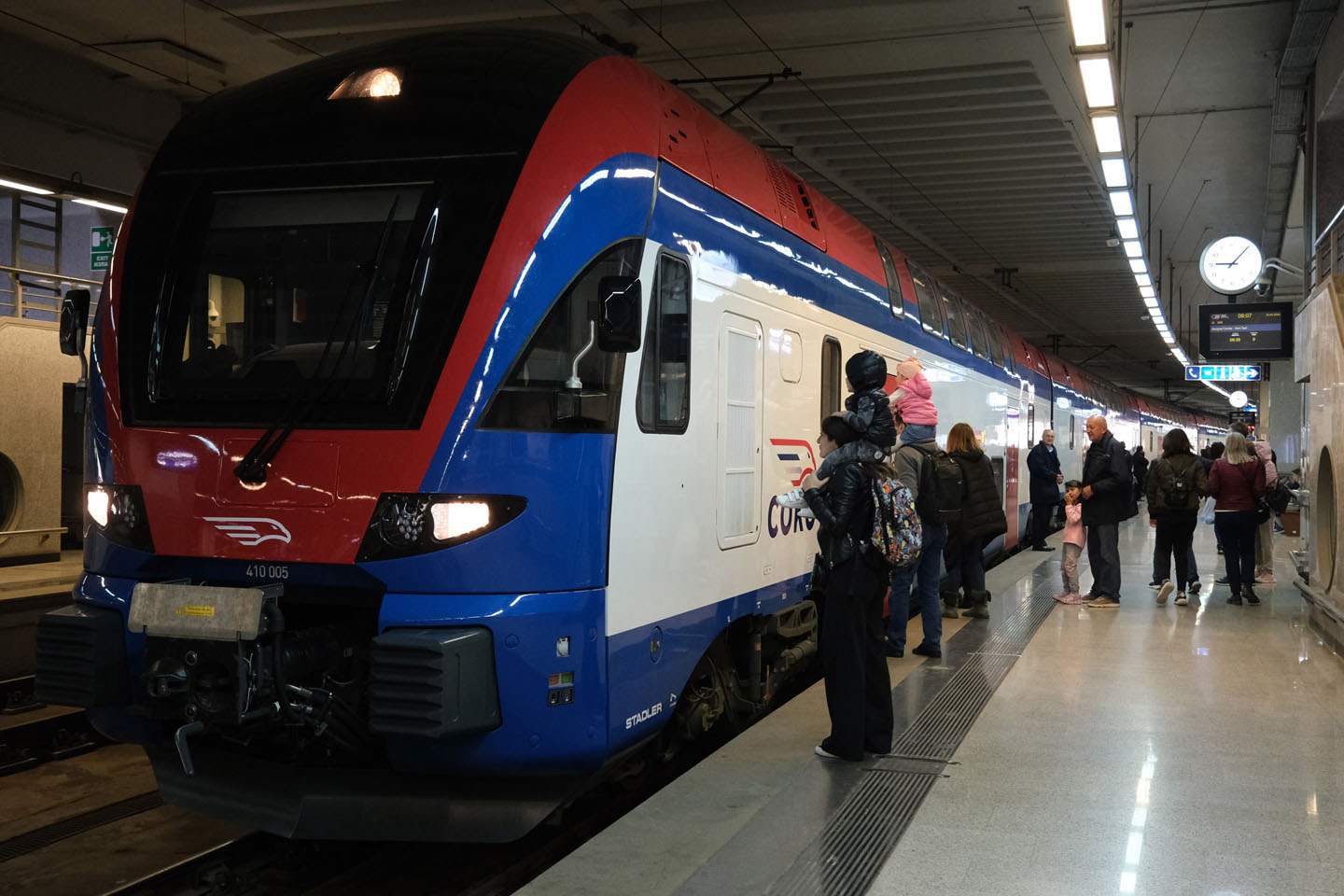
It is increasingly certain that in 2025, it will not take two hundred and 45 minutes to get from Belgrade to Budapest by train, as Serbian President Aleksandra Vučić once announced.
After the Hungarian media announced that the construction of the Belgrade-Budapest railway was stopped because the Chinese could not complete the project, Serbian Trade Minister Tomislav Momirović said that this was not true.
And it is true, he says, that the construction of the railway line between the capital of Serbia and Hungary is "running its course", but the media reports that it has been stopped because the Chinese, allegedly, cannot meet European standards, are not correct.
"Of course, the European Union (EU) does not look favorably on Chinese investments, because some companies from the EU want to realize those projects, just as Chinese companies want to realize them," he said.
The Hungarian portal "Telex" announced that the construction of the railway was stopped because the Chinese contractors could not create a system of insurance and control of trains according to European standards. According to this media, that segment is crucial for the realization of this investment.
There are still problems.
However, now Hungarian experts emphasize that due to the problems with the construction of the high-speed railway on the territory of that country, it is difficult to expect that the project will be completed on time.
"In professional circles, it is considered that there is not much chance of this happening, because basically there is no one who is doing it now." You must know that there is a very high demand for these train control systems in Europe and very few companies can supply them. Although today we do not know who will build it and under what conditions, we cannot seriously expect that it will be completed on time," said journalist Peter Bucski, an expert on railways.
Originally launched with a budget of 2,1 billion euros, the project has been hit by a series of obstacles.
Bucski says that according to a report by the European Court of Auditors, high-speed railways in Europe have been built at a cost of 10 to 15 million euros per kilometer in the last few years.
"There has been considerable inflation since then, but still this development is far from the technical standard of the high-speed line." Because the target speed is 160 kilometers per hour, and there are a lot of railroad crossings that are expensive to replace, so high-speed railroads are more expensive," said Bucski.
As reported by Euronews, the Hungarian company in the RM International consortium withdrew its workforce and machinery from the construction site.
They are reported to be deployed to renovate Hungary's primary railway line between Budapest and Vienna.
In Serbia before the deadline
The deadline for the construction of the part of the high-speed railway in Serbia from Belgrade to Subotica is August 2025, but the Railway Infrastructure of Serbia says that the planned completion of the works is the end of 2024 and that there are no problems in the implementation of the project
For the first section Belgrade-Novi Sad, there are all international permits and international certificates - on the safety of railway traffic and on the management and control of railway traffic on the high-speed railway.
Nenad Stanisavljević from the Railway Infrastructure of Serbia told Euronews Serbia that this is all that is necessary for the high-speed railway to be on the highest European and international level.
"The same situation exists on the part of the railway from Novi Sad to Subotica. That railway is intensively worked on and so far 20 kilometers of high-speed tracks have been laid, i.e. for speeds of 200 kilometers per hour. In addition, construction has begun and a total of 58 new buildings will be built - viaducts, underpasses, overpasses, three new railway stations will be built - Vrbas Nova, Rumenka and Lovćenac. All other stations will be reconstructed," Stanisavljević said.
Postponement of deadlines
"We have to open the Belgrade-Budapest railway by 2018," said the then prime minister of Serbia, Aleksandar Vučić, at the end of 2015.
The Belgrade - Novi Sad railway, as part of the Belgrade - Budapest international railway, was put into traffic in March 2022, but this section was also followed by a postponement of the deadlines for the completion of the works.
According to the site Truth meter, Back in October 2014, the then Minister of Construction, Transport and Infrastructure, Zorana Mihajlović, announced that in two and a half years (in the middle of 2017), the drive from Belgrade to Novi Sad will take half an hour.
Two months later, at the end of December 2014, it signed a Memorandum of Understanding with China and Hungary on the modernization of the railway, and in January 2015, it announced the start of the works by the end of that year, and completion by the end of 2017.
Even then Prime Minister Aleksandar Vučić claimed in March 2015 that construction would start "before the end of the year", while the then President of Serbia, Tomislav Nikolić, had no doubt that the railway would be built in two years.
He said the same thing in March 2017 when he was campaigning for the presidential elections, stressing that in a year and a half (at the end of 2018) the railway will be completed.
Work officially began only at the end of November 2017, on the Belgrade-Stara Pazova section, with a length of 34,5 kilometers, and in August 2019, Minister Mihajlović set the deadline for completion at November 2021.
BG/Euronews Serbia/N1/Istinomer
Read daily news, analysis, commentary and interviews at www.vreme.com