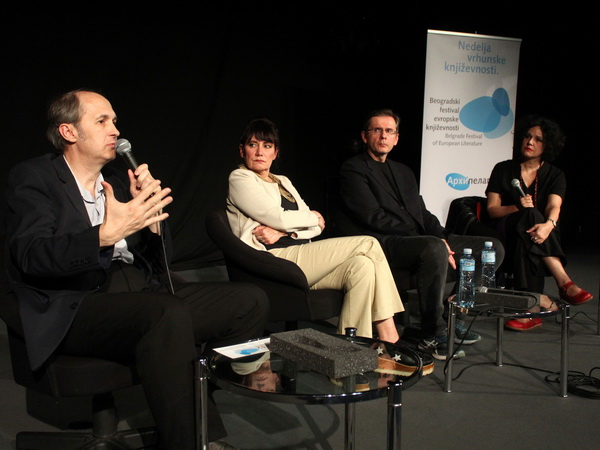
Political correctness in the political sphere is useful in the sense of protecting vulnerable groups, but in literature it is dangerous, limiting and represents a type of censorship - this is the assessment of the participants of the "Literature and Political Correctness" panel at the just concluded Belgrade Festival of European Literature (BFEK), which is in its twelfth year realized by the publishing house house "Archipelago".
Due to the demands of political correctness, the literary works of writers of earlier generations are changing in the world, which, as a consequence, changes the image of classical literature in the eyes of new generations of readers, as well as the literature that is created in the modern moment. What the rise of political correctness means for critical thinking and democracy was one of the topics discussed by Dr. Nebojša Vladisavljević, professor at the Faculty of Political Sciences in Belgrade, poet Ana Ristović, poet and publisher Gojko Božović and literary critic Marija Nenezić.
"If we consistently followed the rules of political correctness, then modern readers would never again be able to read the greatest works of world literature in their original form, nor would publishers be able to publish them," pointed out Gojko Božović. "And if such demands were placed before contemporary writers, then contemporary writers would have to adapt to politically desirable and morally-politically suitable topics, so that - just as we could not read the classics, modern writers would never be able to to become classics. It is not known which of these is worse for readers, literature and culture."
Ana Ristović pointed out that the expression of opinion is inseparable from literature and "if any concept is imposed on it, even with the best intentions to create an ideal society, it is a form of pressure and censorship".
She cited the example of censorship of the famous British fairy tale writer Roald Dahl, in whose books the word dwarf was replaced by the word "little man", because "someone mixed up grandmothers and frogs" and did not understand that gnomes in books and in life are not the same.
It's a similar case with witches who "in fairy tales can no longer be represented with warts, because probably a woman who has warts could find herself injured." Due to political correctness witches have now become "scientists, university professors". And the words "ugly, fat, evil" are thrown out of children's literature, Ana Ristović stated, adding that it is actually a kind of "rape of language and insidious undermining of literature in order to fulfill certain bureaucratic goals".
"Political correctness as the idea of not allowing insulting of anyone's rights and minority rights is a good thing, but I see the world of literature as a world of freedom and I imagine what would happen if we cleansed literature of the individuality and uniqueness of language and reduced it to a mere form," she asked. is a poet.
"What will happen to the individual language of the characters if they are racists, Nazis, thugs or express any opinions that are not appropriate... Imagine if the speech of any of those characters was stripped of individuality? I think it's a lost story and I don't see that it can bear fruit," said Ana Ristović.
She asked "what will happen to the individual language of the characters if they are racists, Nazis, bullies or express any opinions that are not appropriate?" Imagine if the speech of any of those characters was stripped of individuality? I think it's a lost story and I don't see that it can bear fruit."
Gojko Božović warned that censorship and bans are growing in the modern world. "We can see it in a completely radical form of censorship and negation, as, for example, in Iran's attitude towards free artists or towards Salman Rushdie or China, where in recent years the number of books or the number of topics that cannot be written about in the field has radically increased literature, nor in the field of humanities, or in Russia, where there is a presidential decree that excluded any form of swearing or obscene words from movies and books. But it is especially sensitive for freedom when this requirement of political correctness in liberal democratic societies narrows the field of possibilities for literature to bear witness to the world as it sees it."
He reminded that such a tendency exists when it comes to books by Mark Twain, Agatha Christie, Roald Dahl or books about James Bond, and that it mostly affects popular literature, while at the moment it has not yet reached mainstream literature, although there is a danger that it happens.
"It is always very dangerous when we believe that from one angle, perspective or view of the world we can understand the entire history of literature or the history of thought and that, if we want to reduce it to our position, today we have a particularly pronounced crisis of democracy and a crisis of argumentation, and he resorts to norming, because he clearly does not believe in reasoned discussion as much as in provisions, prohibitions and regulations".
The Belgrade Festival of European Literature is a multimedia event in which literature is presented in various forms: from books and public readings, through conversations between writers and the audience, to panels and other events. It is one of the most visited literary events in Serbia.
In previous years, the guests of this festival were David Grossman, Javier Serkas, Peter Esterhazy, Claudio Magris, Florence Nouville, Ingo Schulze, Goce Smilevski, Fiona Sampson, Aris Fioretos, Teresija Mora, Drago Jančar, Dzevad Karahasan, Jani Virk, Peter Salmon, Hatidje Akin, Ray Robertson, Barbi Markovic, Venko Andonovski, Tomas Meinecke, Branko Čegec and Amir Or.
S.Ć./SEEcult
Read daily news, analysis, commentary and interviews at www.vreme.com