While Podgorica accelerates its European path and is considered a favorite for EU enlargement, internal divisions, corruption and the influence of Belgrade remain key challenges for the country's future.
Celebration two decades of independenceMontenegro welcomes him with the reputation of the best student Western Balkans. In recent years, Podgorica managed to unblock negotiations with European Union (EU), accelerates reforms and positions itself as the favorite of the enlargement process at a time when the EU is once again showing interest in accepting new members.
"It's easy to be a star in a class of bad students," he says DW Daliborka Uljarević from the Center for Civic Education in Podgorica.
She warns that behind the image of regional success are hidden problems that have followed Montenegro since the restoration of independence. The current momentum in European integration, he says, is primarily a consequence of changes in geopolitical relations that Podgorica managed to recognize and take advantage of, unlike the rest of the region, which has stagnated or even regressed on the European path in recent years.
"Our absolute interest is to become a member of the European Union as soon as possible, but it is equally important for us that the process be done with quality, and not to enter as a defective state," says Uljarević.
The same obstacles
Reforms in Montenegro were accelerated after the change of government in 2020, when the Democratic Party of Socialists (DPS) lost the elections for the first time since the restoration of independence.
For Aleksandar Popov from the Novi Sad Center for Regionalism, the very fact that the government was replaced peacefully and democratically shows that Montenegro has a greater democratic capacity than most countries in the region.
For Daliborka Uljarević, however, it is disappointing that the change of government was not accompanied by a change in political practices: "Corruption is still ubiquitous today. Some will say even more expensive than before, because there are many more actors in the government trying to satisfy their party and private interests."
Along with corruption, the political scene is still burdened by identity divisions between pro-Serbian and pro-sovereign forces.
"Citizens have ended many of those battles with themselves and among themselves, but unfortunately, we have under-capacitated political structures that insist on these topics in order to cover up their own lack of reforming abilities," Uljarević assesses.
Officially, these two political currents reached a consensus about the country's European path.
Unofficially, warns Popov, that balance is still fragile and susceptible to influences from Belgrade.
"Pro-Serbian forces in the form of Mandić and Knežević can always obstruct the European path at the beck and call of Belgrade, and this is happening now. Knežević is already doing it, but Mandić is not to that extent," says Popov, adding that part of the pro-Serbian bloc still shows more pragmatism than before.
Shadow of Belgrade
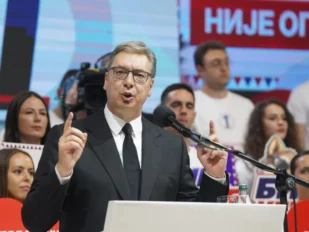
Relations with Belgrade thus remained one of the most sensitive issues for Podgorica. This is best evidenced by the reaction of the President of Serbia, Aleksandar Vučić, to the invitation to participate in the celebration of the anniversary of independence.
"You didn't bother us, we saw you as sisters and brothers and wanted to live in the same country as you. I admit, we are guilty, and I'm sorry that we loved you more than you loved us," wrote Vučić.
Uljarević and Popov believe that official Belgrade has never fully accepted Montenegrin independence, but, as Uljarević says, "treats Montenegro as a temporarily lost territory."
Popov also reminds that with the SNS, the radical idea of unifying the Serbian world came to life again.
"Protests and rallies that eventually led to the fall of Milo Đukanović's regime were conducted from Belgrade, and everyone expected that Montenegro and Serbia would once again become two eyes in one head, but that did not happen," says Popov.
However, Daliborka Uljarević is not so convinced of the Montenegrin leaders' resistance to pressure from Serbia. As an example, he cites the absence of an official reaction to Vučić's words.
"I think it's because one part of them feels loyalty to him, and another part is afraid of getting into any kind of confrontation. Many actors in this government are aware that they are in those positions largely because Belgrade helped them," Uljarević assesses.
Tripping games
In the meantime, official Belgrade will do everything to make Montenegro stumble on the European road, Popov believes and reminds that there have already been such attempts.
"Vučić went to Brussels with the idea that all the countries in the package should be admitted to the EU. He actually knew that this was not possible, but he tried to sabotage Montenegro in that way. And the second attempt was a letter with Edi Ram in which they recommended admission without the right of veto," recalls Popov.
He believes that the accession of Montenegro to the European Union does not suit Belgrade politically, because it would show that the problem is not in the closed doors of Brussels, but in the policy of the authorities in Serbia.
"That would break Vučić's key argument 'they don't want us'. It is not true, but we are constantly faking that path and maintaining an anti-European narrative. Second, Montenegro will escape as a possible prey," adds Popov.
"Once it enters the EU, Montenegro will be beyond Belgrade's reach both in terms of security and law. It will leave the zone of possible blackmail and pressure, and this will cause even greater nervousness in Belgrade, especially since Serbia under this government will never have a chance to enter the European Union," concludes Popov.
What is happening in the country and the world, what is in the newspapers and how to pass the time?
Every Wednesday at noon In between arrives by email. It's a pretty solid newsletter, so sign up!
Columns of citizens headed towards Slavija from six directions - from Novi Belgrade, Zemun and Čukarica, and a little later, columns also started from Studentski trg, from the building of the technical faculty on Bulevar Kralja Aleksandra and from Autokomanda.
The message of the last gathering of the Student List before the elections on October 25 is: It's over! It's a little retro, but considering who it's related to, it hits the spot
The "Students are winning" list held a final pre-election rally on Belgrade's Trg Slavija ahead of the extraordinary parliamentary elections scheduled for Sunday, October 25.
"They tried to destroy our country on an external order. Huge money entered the country and that's why this is the most difficult battle, because they attacked us with billions of euros, and we defended ourselves with purity, our program and love for the homeland," said Aleksandar Vučić at the final pre-election meeting in Belgrade's Hall of Sports
There is, literally, no difference between the one who claims it is day in the middle of the night, or the one who claims to be a giraffe, from the claims we read on billboards: that Vučić is working to unify Serbs and that Serbia is doing better and better day by day.
The pre-election arrests due to the alleged "overthrow of the state" testify to the regime's panic. The bad news for them is - they can't arrest the whole people who decided to defend themselves from progressive beatings and election theft
The ring that tightens around Ćaciland Student list is getting narrower. Because there are more and more spoiled people who see the false prophet for what he is: a street obscener who is fighting Serbia
The archive of the weekly Vreme includes all our digital editions, since the very beginning of our work. All issues can be downloaded in PDF format, by purchasing the digital edition, or you can read all available texts from the selected issue.