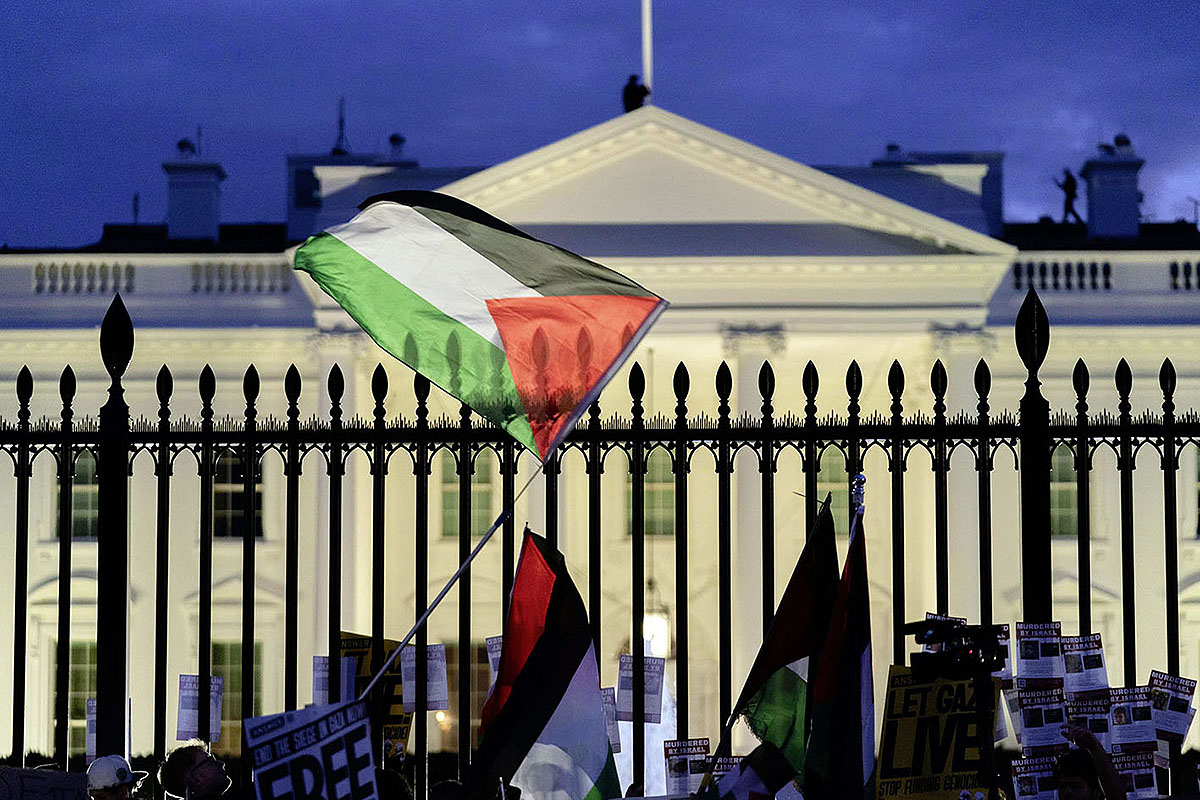
Emanuel Macron posted on his X-line account a letter he sent to Palestinian Authority President Mahmoud Abbas confirming France's intention to recognize the state Palestine.
France will thus become the first Western power to recognize the state of Palestine.
"True to my historic commitment to a just and lasting peace in the Middle East, I have decided that France will recognize the State of Palestine. I will solemnly announce this at the United Nations General Assembly next September. There is an urgent need today to end the war in Gaza and provide aid to the civilian population," Macron said.
The French president has been supportive of Israel since the October 7, 2023, attack by Hamas and has often publicly spoken out against anti-Semitism, but has recently grown increasingly unhappy with Israel's war policy in Gaza.
Who all recognized the state of Palestine?
France is the largest and most powerful European country that has recognized Palestine. With France, Palestinian statehood is now recognized by a total of 147 of the 193 UN member states, although Israel and the United States strongly reject that recognition.
France thus became the first country of the G7 (France, Canada, Germany, Italy, Japan, the United Kingdom and the USA) to recognize Palestine.
On June 4, 2024, Slovenia became the last European country to recognize a Palestinian state.
A few days before Slovenia, more precisely on May 22 of the same year, Norway, Ireland and Spain respectively announced that they recognize Palestine according to the pre-1967 borders with East Jerusalem as the capital.
Mexico is the last country to recognize the State of Palestine, and they did so on March 20 of this year, and since the beginning of 2024, the State of Palestine has been recognized by 10 countries of the world.
In the first year of the declaration of independence in 1988, Palestine was recognized by 80 countries, including Serbia.
Relations between Yugoslavia/Serbia and Palestine
In the period of distancing itself from Israel, after 1967, Belgrade became closer to Palestine, a member of the Movement of Non-Aligned Countries, of which Yugoslavia was one of the founders.
Tito strongly supported Yasser Arafat and the Palestine Liberation Organization. Yasser Arafat was one of the dignitaries who visited Belgrade after Tito's death on May 8, 1980.
Yugoslavia recognized the state of Palestine in 1988 and established full diplomatic relations with it in 1989, even before many Arab countries.
During the wars of the 1990s, Palestine recognized the Federal Republic of Yugoslavia (then Serbia and Montenegro) and all other former Yugoslav republics.
Tomislav Nikolić, the former president of Serbia, visited Palestine at the invitation of President Abu Mazen in 2013.
The Palestinian state is strongly against the independence of Kosovo.
Although the website of the Ministry of Foreign Affairs states that "modern relations are based on traditional friendship", Serbia abstained when the UN General Assembly voted for a resolution demanding that Israel withdraw its troops and end its "illegal presence" in the Gaza Strip and the occupied West Bank.