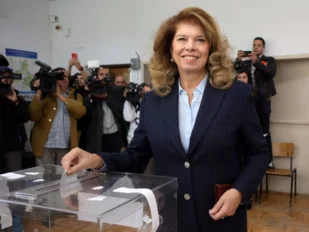
Almost every recent election cycle represented a kind of referendum on Benjamin Netanyahu. This time, many Israelis feel that the election is more important than ever: it's not just about who will lead the country, but also about the direction it's headed, writes CNN.
This is the first national vote since the attack which was led by Hamas on October 7, 2023 - which represents the worst security failure in Israel's history - as well as the subsequent wars in Gaza, Lebanon and Iran. Those events mobilized a large part of the country, but at the same time led to even greater international isolation of Israel.
For many voters, this is the first opportunity to assess the performance of the leadership that was in power during the October 7 lapse, as well as to decide who should lead the country in the face of conflict and who will bear the brunt of the expanded military conscription.
Far right and ultra-orthodox parties
Netanyahu's government - the first in decades to serve a full four-year term - has relied on partners from the far right and ultra-Orthodox parties, who have steered Israel on a more nationalist and religious course than ever before. He became the first Israeli prime minister to face trial on corruption charges while still in office, at a time when his government was implementing judicial reforms aimed at weakening the Supreme Court and other mechanisms of government control, CNN writes. That reform attempt caused mass protests in 2023.
Tuesday's election will decide whether Israel will continue to move in a nationalist, conservative and religious direction - or change course. The answer may not be known for weeks, given the way coalitions are formed in Israel. According to polls, it is unlikely that either Netanyahu's bloc or the opposition will win a majority on their own; this means that these elections could start a new political crisis in Israel, instead of resolving it.
Who is running and who is ahead?
Israelis vote for party lists, not individual candidates. In a society divided on national, religious, ethnic and ideological grounds, this leads to a large number of participants.
In every election cycle, dozens of lists are registered, but only those that pass the threshold of 3,25 percent of the vote win parliamentary seats and enter the Knesset - Israel's 120-member parliament. On Monday, there were 36 parties in the race.
In the current convocation of the Israeli parliament - the Knesset - the Likud party, led by Benjamin Netanyahu, forms the backbone of the ruling coalition. That coalition, in addition to Likud, also includes ultra-orthodox parties, as well as right-wing religious-Zionist parties. The remaining seats are shared by opposition parties of the left, center and right political spectrum.
According to polls, between 11 and 13 parties will pass the census; parliamentary seats are allocated according to the system of proportional representation.
The two largest parties are Netanyahu's right-wing Likud and Yashar, a new party of the center led by Gadi Eisenkot, the former chief of the General Staff, who has emerged as his main opponent.
The latest public opinion poll conducted by "Kanal 12" favors Eysenkot with 23 parliamentary seats, ahead of Likud who would win 21, although other pollsters give different estimates. According to the data of Channel 14, which is favorable to Netanyahu, Likud is predicted to win 30 seats, and Eisenkot around 20. In direct comparisons of who is more suitable for the position of prime minister, Eisenkot consistently has an advantage over Netanyahu.
However, being the largest party is not enough to win. 61 parliamentary seats are needed to form a government, and so far no party has managed to win such a majority on its own. Therefore, election night usually does not bring a final solution. The real fight is through the coalition negotiations that follow, which can take days, weeks, or even months.
Most polls predict that Netanyahu's bloc - made up of Likud, two far-right parties (led by Bezalel Smotrich and Itamar Ben-Gvir) and two ultra-Orthodox parties - will win between 49 and 55 seats, short of the required majority of 61 deputies. The opposition, which appears strong on paper, is deeply divided: on the right of Eisenkot are the parties led by former Prime Minister Naftali Bennett and former Defense Minister Avigdor Lieberman, while on the left is the Democrat Party, led by Yair Golan. Bennett and Lieberman did not support Eisenkot, and both have their own ambitions to become prime minister.
What could decide?
As no single bloc is expected to win convincingly, the outcome could depend on nuances: which small parties will cross the electoral threshold of 3,25 percent, and how many votes will go to parties that do not cross that threshold - effectively destroying those votes.
Turnout is of great importance, because only a few thousand votes can decide.
Someone must report to you independently even after the election. That's why it's in October annual subscription the digital edition of "Vremena" even 2.500 dinars cheaper. Choose now!