RETURN OF ROYAL DUST TO SERBIA: Queen Marija Karađorđević
The remains of Queen Maria Karađorđević, wife of King Alexander, mother of King Peter II, the last Yugoslav king, were transferred by plane from England to Serbia on April 29.
According to the press releases of Crown Prince Alexander i of the Royal House of Karađorđević : "People gathered in large numbers to pay their respects to the blessed late Queen at the gates of her home on Dedinje, where she once lived as Queen, wife, mother and widow. The atmosphere at the reception exuded respect and gratitude towards the person whom the people idealized as a dedicated mother, a respected Queen and sincerely admired her as a great benefactor and founder of numerous schools, hospitals, a patron of the arts and a person always ready to help the vulnerable...
The Royal Chapel within the Royal Complex on Dedinje will be open to all citizens who wish to pay their respects to Their Majesties King Peter II and Queen Mother Maria every weekend, Saturday and Sunday, from 10 a.m. to 14 p.m...."
The process of exhumation and repatriation of the remains of his grandmother Queen Mary is coming to an end thanks to the consent of Her Majesty Queen Elizabeth II and cooperation with the head of the chapel of St. George in Windsor, the Anglican Church, the Ministry of Justice and the Ministry of Foreign Affairs of the Republic of Serbia.
The remains of Prince Andrej, the youngest son of King Alexander I and brother of the last Yugoslav monarch Peter II, were returned to Serbia from the Nova Gračanica cemetery in Illinois on May 15, with the approval of the Gray Lake District Court in Illinois. The memorial service for Prince Andrej was held in the royal chapel of St. Andrew the First-Called in the palace complex in Dedinje.
***
Andrej Kraljević was born on June 26, 1929 in Bled, Slovenia, and died on May 7, 1990 in Irvine, California.
After the exile of the royal family in 1941, he graduated in mathematics from Clare College, Cambridge and built a successful career as an insurance broker.
He had three marriages - the first with Princess Christina of Hesse, daughter of Prince Christoph of Hesse and Princess Sofia of Greece and Denmark, the second with Princess Kira of Leiningen, daughter of Prince Karl of Leiningen and Duchess Maria Kirilovna of Russia, and the third with Milica Anđelković.
(Updated on May 15)
The permission of the British Queen Elizabeth was necessary for the transfer of the body of Queen Maria, who was buried in the royal cemetery near Windsor Castle in Great Britain, because Maria Karađorđević is the great-granddaughter of Queen Victoria and the cousin of King Edward.
The remains of Queen Mary were transferred from the royal cemetery in Frogmore near Windsor Castle to the Church of St. Sava in London on Saturday, April 27, 2013, where they rested until Monday, April 29, when they were officially returned to Belgrade.
On Sunday, April 28 at 10.30:XNUMX a.m. in the presence of Crown Prince Alexander, Princess Katarina, Crown Prince Peter and Prince Philip, as well as Princess Katarina (daughter of Prince Tomislav) and Prince Dimitri and Princess Lavinia (children of Prince Andrej), in the Serbian Orthodox Church in London the Holy Liturgy was served, followed by a memorial service for Queen Mary.
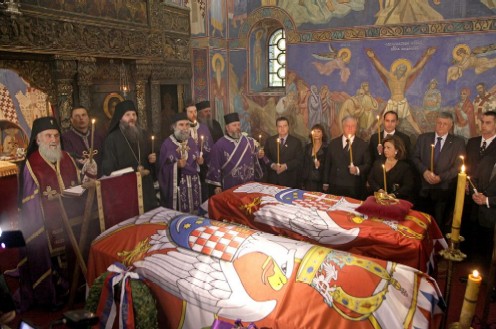
On Monday, April 29, at the airport "Nikola Tesla" in Belgrade, Queen Mary's coffin was awaited by the royal family, Prime Minister of Serbia Ivica Dačić, vicar bishop of Hvostan G. Atanasije with the blessing of Patriarch Irinej, professor Oliver Antić special advisor and Radoslav Pavlović cultural advisor to Tomislav Nikolić, President of the Republic of Serbia. Her coffin, which was carried at the airport in national costume by members of the "Kingdom of Serbia" association, was transferred to the royal chapel of St. Andrew the First-Called, where Serbian Patriarch Irinej served a memorial service and then delivered a short sermon.
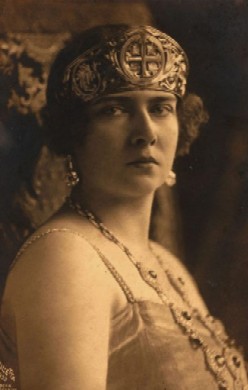
Queen Mary of Yugoslavia was the daughter of King Ferdinand of Romania and Queen Mary of Romania (daughter of Prince Alfred, Duke of Edinburgh, son of Queen Victoria of Great Britain). She was born on January 6, 1900 in Gotha (Thuringia, then the German Empire) and is the second-born daughter of the Romanian King Ferdinand I Hohenzollern-Sigmaringen and Queen Mary, the niece of the British King Edward VII.
Apart from her closeness with the German and Prussian ruling family of Hohenzollern, she was a close relative of the British Windsors and the Russian Romanov imperial family.
In Belgrade, on June 8, 1922, she married King Alexander I, ruler of the Serbs, Croats and Slovenes, and then the king of Yugoslavia, and with him she had three sons - Crown Prince Peter and Princes Tomislav and Andrej. After the assassination in Marseille in 1934, she retired to Great Britain with her sons Tomislav and Andrej.
Her eldest son, Petar Second Karađorđević, remained in Belgrade with the vicarage.
Queen Mary died in London on June 22, 1961 at the age of 61.
The funeral of Queen Maria and Queen Alexandra, the wife of Peter II, whose remains will arrive on May 9, will be held on May 26 in Oplenac. Queen Mary will be buried next to her son, King Peter II and daughter-in-law, Queen Alexandra.
The remains of King Peter the Second were transferred to Serbia from the United States of America at the end of January this year.
It was announced that the funeral on May 26 in Oplenac will be attended by more than 2.500 dignitaries from all over the world, including representatives of the royal families of Great Britain, Greece, Spain and the Imperial Family of Japan.
In front of the casket on Oplenac, the Order of the Star of Karađorđe, made of diamonds and rubies in France, which Queen Maria wore in the 1920s, and which was thought to be lost until recently, will be exhibited.

SHE NEVER STEPPED ON THE SOIL OF YUGOSLAVIA: The Last Queen of Yugoslavia, Aleksandra Karađorđević
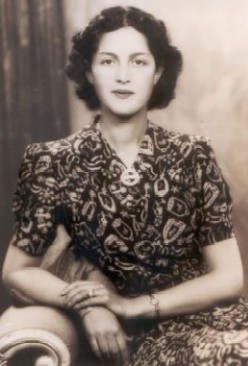
Queen Aleksandra (March 25, 1921 – January 30, 1993), Alexandra of Greece, later known as Aleksandra Karađorđević was the last Yugoslav queen of Alexandra, King of the Greeks, and Aspazija Manos, a middle class Greek.
She was born in the royal residence of Taitoi (15 kilometers from Athens), on March 25, 1925, five months after the death of her father who inherited the Greek throne after his father, Alexandra's grandfather Constantine I, was deposed and expelled from Greece. Constantine returned to Greece and retook the throne a month after Alexander's death. As the government considered Alexander's short reign a regency, which meant that Alexander's marriage, entered into without his father's permission, was invalid and the child born of it was illegitimate. Had she not been declared illegitimate, Alexandra would have been her father's legal heir and queen of the Greeks from the moment of her birth.
She was educated at Westfield and then at Heathfield School, after completing her education in England, Alexandra lived with Mrs. Ozan in Paris.
She met King Peter II of Yugoslavia in London in 1942, and married him on March 20, 1944.
She gave birth to Prince Aleksandar Karađorđević on July 17, 1945, in suite number 212 of the Claridges Hotel in London, which was declared part of Yugoslav territory for the occasion.
Aleksandra never set foot on the soil of Yugoslavia, the country whose queen she was, because in November 1945 the monarchy was abolished and all Karađorđevićs were forbidden to return to the country. After the war, she lived in London, in exile with her husband and son.
She spent the last years of her life in Great Britain.
She died on 30 Jan 1993 in East Sussex, England. She was buried at the Tatoi cemetery in Athens.
The remains of Queen Alexandra, the wife of the last Yugoslav king Peter II Karađorđević, are transferred from Athens to Belgrade on May 9.
(Updated on May 9)