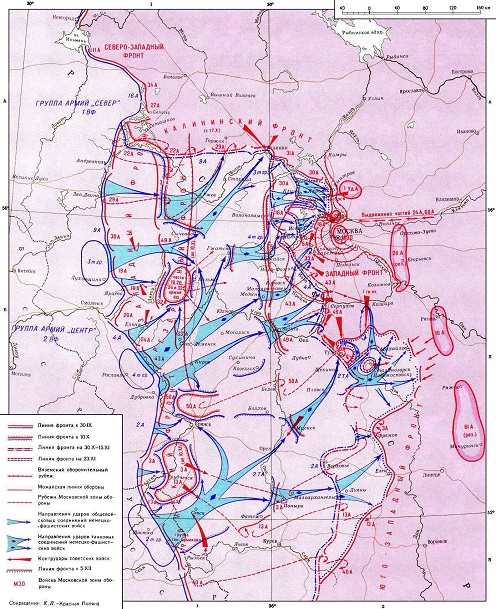
Parade on November 7, 1941 on Red Square in Moscow, the first parade in the Great Patriotic War 1941-1945. it was held at a time when the German forces were only thirty kilometers from the center of Moscow, which was partially evacuated at that time.
Stalin announced his intention to organize a parade in honor of the 7th anniversary of the October Revolution on November 1941, 24, the day before, on November 6, 1941, at the solemn session of the Moscow City Soviet, which was held in the Bolshoi Theater instead of the traditional Mayakovsky metro station. The parade was supposed to raise the morale of the Soviet people and had a great resonance in the USSR and in the world.
The soldiers participating in the parade were informed about their participation in the parade around 23:6 p.m. on November 7 - they were told that the Muscovites wanted to see a review of the units moving to the front. The invited representatives of the workers who will attend the parade on Red Square were informed about it around five o'clock in the morning on November 7. On the night of November XNUMX, the protection was removed from Lenin's mausoleum and the stars on the Kremlin towers were revealed illuminated.
The parade time was moved at the last minute from 10 a.m. to 8 a.m. In order to prevent the German aviation from bombing the Red Square during the parade, on November 5, the Soviet aviation bombed the German airfields in the surrounding area of Moscow. On the afternoon of November 6, military meteorologists estimated that there would be heavy snow and blizzard on November 7, which reduced the fear of enemy planes. For the defense of Red Square, 550 Soviet aircraft were deployed at that moment, some of which were brought from other fronts. The staff didn't know exactly what they were hired for. 34 German planes were shot down in the vicinity of Moscow that day. On the front around Moscow, anti-aircraft artillery was operating and shots were fired on the entire front to make the Germans think about the Soviet war initiative. Marshal Zhukov remained at the front.
At 7 hours and 50 minutes, Stalin and the members of the Soviet government who remained in Moscow appeared on the platform of the mausoleum.
At 8 o'clock in the morning, from all loudspeakers, which at that time were not turned off day or night, the solemn voice of the announcer announced the beginning of the broadcast of the Soviet Union Radio parade of the Soviet units in honor of the celebration of the 24th anniversary of the October Revolution.
At 8:XNUMX a.m., Marshal of the Soviet Union Semyon Budzhoni rode out of the gates of the Spasskaya Tower of the Kremlin. After a tour of the deployed units, the parade participants were addressed by Joseph Stalin, then in the capacity of President of the State Defense Committee, Supreme Commander-in-Chief and People's Commissar of Defense of the USSR. To show that the leadership had not left Moscow, members of the Soviet government stood next to Stalin at Lenin's mausoleum.
Stalin's speech at the parade was first recorded without sound, because due to the postponement of the start of the broadcast and the blizzard, perhaps because they forgot to inform them in their haste, the operators did not manage to make it to the beginning. The cameramen were then allegedly taken to Ljubjanka, where they were told that Stalin insisted that the footage of the parade be as authentic as possible.
After the parade in the Grand Kremlin Palace, they made a decoration that resembled the tribune at Lenin's mausoleum. The film clip of Stalin's speech, which was shown to the public, was made on that specially built decoration. Stalin repeated the entire speech (allegedly this was the only time he repeated a speech). To make it more authentic, so that steam would come out of his mouth because of the cold, all the windows were open.
Filmers who were late really missed the point. In the first sentence of that war speech, Stalin used the words "brothers and sisters" for the first time: "Comrades Red Army men, Red sailors, commanders and political workers, male and female workers, kolkhoz farmers, workers of intellectual work, brothers and sisters in the rear of our enemies who has temporarily fallen under the yoke of German bandits, our famous partisans who are destroying the rear of our enemies!»
Stalin's speech ended with a historic appeal: "May you be inspired in this war by the courage of our great ancestors - Alexander Nevsky, Dimitri Donski, Kuzma Minnin, Dimitri Pozharsky, Alexander Suvorov, Mikhail Kutuzov!" Let the invincible banner of the great Lenin overshadow you!
Those who later analyzed Soviet wartime propaganda later noted that this date was the first time that the names of famous Russian military leaders were mentioned:
One surviving Soviet soldier, a participant in the parade, later told how his fellow soldier immediately reacted: "Finally, they mentioned Suvorov..."
About 28.000 soldiers participated in the parade. Members of the NKVD made up more than half of the participants in the parade. In addition to trainees at the artillery academy, battalions of Moscow defense units in civilian clothes also participated.
The weapons displayed at the parade were loaded, including tanks and other heavy equipment, but there were no accidents. Soviet T-34 and KV-1 tanks were also shown at that parade. 160 tanks passed through the Flower Square (some of the heavier tanks were brought from the front), 140 artillery pieces, etc. and due to bad weather and limited visibility, aviation did not participate.
Some units were sent straight from the parade to the front.
Apart from Moscow, the parade was also held in Kuybyshev (Samara) and Voronezh.
On November 7, 2016, a parade was held on the Red Circle in Moscow, representing the reconstruction of the parade from 1941 as part of the celebration of the Day of Military Glory of Russia. This has been practiced since 2004, when November 7 was declared the Day of Russian Military Glory. Since then, partial reconstructions of that historic parade in 1941 have been organized on that day, and in 2006, on the occasion of the 65th anniversary of the legendary parade, a complete reconstruction was organized.
According to the data of the Russian Historical Society, parades on Red Square were held at the time of boyars' hats and long beards. During the time of Peter the Great, a parade was held on November 11, 1702, after the capture of Oreshko (Notteburg), but the army did not march through Red Square, but through Mjesnički Street, which was veiled with a red cloth for the occasion. They dragged the war flags of the defeated Swedes behind the parade. (In 1945, at the Red Square parade, German war flags were thrown to the ground, and behind the "parade" of German prisoners, the streets were washed with snot).
Red Square became a place for parades at the beginning of the 1818th century - in 1931, a guard parade was organized there dedicated to the unveiling of the monuments to Minin and Požarski (which were moved closer to the temple of Basil the Blessed in 1917, because the authorities judged that the monuments interfered with military parades). In XNUMX, Kerensky's Provisional Government managed to organize a parade of its army on Red Square (even airplanes participated in the parade!), and a year later the new Soviet government displayed its bayonets on Red Square.
On the anniversary of the October Revolution, on November 7, 1918, the report on the parade was received by Vladimir Ulyanov-Lenin on the reconstructed Red Square. In the Soviet era, civilian demonstrators walked "side by side" with armed soldiers and tanks and cannons - they moved not from the temple of Vladimir the Blessed to the Historical Museum, but in the opposite direction.
In 1925, the cavalry parade on that square was organized by Mihail Frunze, and on May 1, 1925, the parade represented manifestations and demonstrations of military equipment.
The parade on November 7, 1957 was remembered for the display of missiles (and ballistics) which was later a tradition, and the aviation did not appear in 1957 due to bad weather. Aviation did not participate in parades until 2005, and the story spread that before the May Day parade, as a rule, clouds are broken with "anti-hail means".
The fiftieth anniversary of Soviet rule was characterized by the fact that soldiers in overcoats from the Civil War first passed through Red Square, and then intercontinental ballistic missiles were shown, but in some years (1975 and 1976) they were not shown.
The last parade of the Soviet government was on November 7, 1990. Gorbachev spoke from the podium of the mausoleum, which was the second time after Stalin in 1941 that a head of state spoke at the November 7 parade.
Since 1991, parades have not been held on Red Square, and on November 7, 2000, a solemn march of veterans of the November March of 1941 was organized, which was repeated in the following years. In 2012, the program included the commemoration of the 200th anniversary of the Battle of Borodino in 1812. In 2013, military equipment from the Great Patriotic War of 1941-45 was displayed, and among the honored participants of the march were 28 participants of the legendary parade in 1941...
( Video 360: reconstruction of the legendary military parade of 1941 in Moscow, Short link 7 November 2016, 16:12)
( Military parade on Red Square in Moscow, November 7, 1941, RIAN, 07.11.2016)
(
Performance at the parade on the Red Square, souz.info, November 7, 1941)
( Calendar: November 7, 1941 - parade of troops in Moscow - day of military glory to Russia, Russian Historical Society)