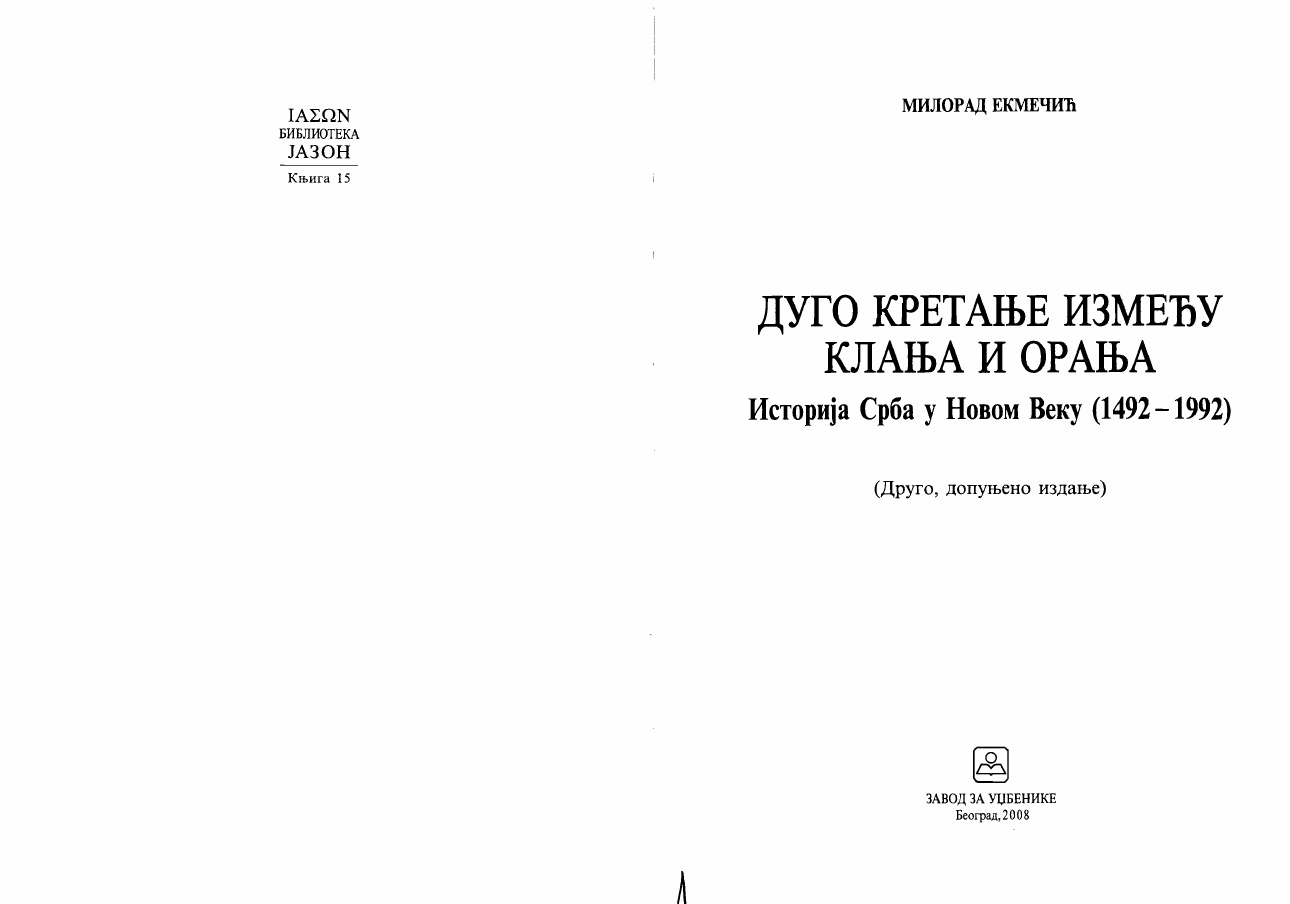
The strange title of this book is borrowed from the assessment of the long march of Serbian history written in 1919 by the writer Ivo Andrić. As with other peoples, the history of the Serbs was a constant and painstaking effort to preserve their identity. In this, the abandonment of the Middle Ages and the transition to the new one had the opposite significance from the one attributed to it in later times. According to what followed, the Middle Ages are not dark, so it was a transition from light to darkness, not the opposite, as is believed.
Until 1492, Serbs were an organic part of what was then Europe. With the Turkish military conquest, they became part of a different world in which the passage of time was slower and the achieved achievements seemed immutable and long-lived. A century of European history is not the same as a century of Turkish history.
With the advent of the Islamic type of society, the feeling that the historical course represents a purposeful ascent and has some distant goal was lost. Islam put the final goal at the beginning and from that there is a change only when the crisis of that type of society and culture came to a deep fall and destiny heard the fatal ticking of the clock of the necessary breakdown. It is no coincidence that the Turkish historian Ilber Ortayli called the 1983th century of abandonment of Islamic society (XNUMX) "the longest century of the empire".
The sixteenth century brought great and fateful changes throughout Europe, on which the creation of future national societies depended. The main change is in the general tendency to move the centers of state communities and peoples from the south to the north. The Mediterranean is the south and its entire area, except for sea routes, is dominated by caravan traffic. In the Serbian part of the Balkans, it lasted until 1914, although in those latter times it was an exotic exception even for domestic conditions.
The entire European south is vividly identified with a man who has more bones than flesh. In his work on the Mediterranean, Fernand Braudel quotes a German travel writer that a 1945th-century Turkish resident consumes twelve times less food than a Flanders resident. Merino sheep with better wool, with which England's first industry would flourish, was created by crossing a Spanish sheep with a North African sheep. The fruits of that gift will, however, be used first by the European northwest. The Balkans produce fabric from coarser wool, rasha. Its names in the writing of foreigners ("rassa", "jascia") do not mean Serbian fabric. It prevailed in the Serbian-Karst area, at least in men's clothing, until XNUMX.
The birth of more people than the land can feed them has always destroyed the established civilizational machine, and on the other hand opened great epochs of migration to the richer lands of the north. From the uninhabited mountains, in the south of Europe, the surplus population, which cannot withstand the scarcity, has to be resettled periodically.
Another change that occurred with the Turkish conquests is far more significant for the Serbian people. It is the end of the continuity of social, political and cultural institutions that were similar or identical to institutions in the west of Europe.
In addition to the change from the European type of feudalism, in which the lord was a private owner of the land, to the Islamic feudalism of state ownership of real estate, the most significant change was the type of city. He always depended on the hinterland, which enabled him to have uninterrupted economic progress in continuity. With the transfer of Serbian silver and gold mines to Turkish state ownership, an invisible crack opens through which Mediterranean cities slowly begin to stagnate. The Turkish city is divided by religion.
On his way to the Turkish capital, the new Venetian ambassador Paolo Contarini recorded in his diary in 1583 that on the land around Pljevlja the residence was divided into two parts; in the one by the water, there are Muslims, and higher, in the hills, there are Orthodox Christians. Muslim neighborhoods are full of mosques. In Novi Pazar, with about six thousand Muslims, they have 16 places of worship. They are always the best maintained part of the town. The first thing that catches the eye of an intentional traveler in a Turkish town is a religious building, not workshops and windmills.
Before the arrival of the Turks, Serbia developed according to Western European motives. There was a tendency for the feudal elite of society to be replaced by the merchant elite. The basis is in the production of silver and precious metals in general. From the Bosnian parts of the mine, 5,67 tons of silver (1422) are exported annually through Dubrovnik. Serbian mines provide 20-25% of silver production in Central and Western Europe. Along with that, as Momčilo Spremić points out (Despot Đurađ Branković i his era, 1994), economic operations are characteristic of the early stages of European capitalism.
With the use of securities, banking operations begin to penetrate. Double bookkeeping is introduced, interest is given up to 20 percent. The cities are Belgrade, Smederevo, Pristina. Blinking. Rudnik, Valjevo, Višegrad, Braničevo, Prijepolje, Pljevlja, Pirot, Niš. Desanka Kovačević-Kojić processed medieval works in Bosnia. Some, like the prosperous Drijeva, disappeared, and in 1372 there were two hundred Dubrovnik merchants and entrepreneurs. There were five hundred of them in Srebrenica in 1434. There are also Srebrenica, Visoko, Foca, Goražde, Jajce and others. A large city is over ten thousand people, and that is rare. The middle town is below that, up to two thousand. City-type settlements below that would probably. corresponded to the term "burg". which Ferpan Braudel in France considered a connection with rural-type settlements, at the same time.
In the development of the Serbian people, an important role was played by the fact that in addition to the church, as the basic source of culture, there was always a secular culture. It was a factor that largely determined its historical maintenance. Although to a small extent, Serbs also belong to those merchant nations in the world whose secular culture was determined by the number of merchants in society, in all historical periods.
There is a known theory in science. which is wrongly attributed to the German sociologist Max Weber (Weber) that the theological permission to lend money raised the Protestant social communities of Europe to bearers of the victories of the capitalist mode of production. This theory was created by the historian Leopold Von Ranke, and in English culture, before Max Weber, it was thoroughly elaborated by Thomas Macaulay (Macauley). On his example, Karl Marx dealt with the theory that the spirit of Protestantism created modern capitalism.
Historians have noticed that Orthodox merchants in the Turkish Empire, throughout modern times, used an interest rate of about 8 percent. It is very unclear how it came about. For the Serbian Middle Ages, Sima Ćirković established that it was a rule that merchants and money changers used an interest rate of 8 percent, and church people had a rule from a charter of Emperor Dušan that a monk who "gives dinars at interest should be roped". In the 8,33th century, the usual interest rate was XNUMX percent. It comes from the ancient Roman Empire and Byzantine theology afterwards. Regardless of its obscure roots, interest has been a sustaining factor through the murky centuries of history up to modern times.
The political structure of those cities is similar everywhere. and it was founded on the Byzantine tradition. The city is ruled by Byzantine cephalians, which in the Serbian case are translated as dukes and princes. In addition to them, there are more than 12 purgaras, which is why urban settlements on the Bosnian and Serbian sides do not differ.
In addition to German terms in mining, some trades (schneiders and shoemakers) also bear this stamp. In three centuries, the Serbs overtook the Turks in opening printing houses.
The situation in the development of agriculture is similar. It is difficult to establish exactly the real difference in agricultural production in the west of Europe and in the Serbian area of the Middle Ages. Fernand Braudel concluded that two quintals of grain had to be produced for the annual nutrition of one inhabitant. Miloš Blagojević ("Agriculture in Medieval Serbia", 1973) calculated that, despite lagging behind, the Serbs still reached that level. He concluded by examining examples around Dubrovnik, Skopje, on the island of Mljet, that the yield was, as a rule, four times more grain than what was sown.
The difference is in the lesser use of the plow and the dominance of the plough. The difference between a plow and a plow is that the plow spreads the soil only on one side and has two handles, the plow on two sides and has one handle. Two types of arable land, the "central type" and the "marginal type", divide Serbia and Bosnia from Croatia and Bulgaria. Blagojević says that the first plow was mentioned in 1401 in Konavle, and that in general there were fewer of them in Serbian agriculture. In the West, the plow had begun to take the lead at least a century earlier. In 1930, plows accounted for 90 percent of all plowing equipment in the Bosnian Krajina, and ploughshares accounted for the rest. Although Blagojević concluded that agricultural production among the Serbs was less developed than in the West at the same time, he does not make a significant difference. The real backwardness begins with the conversion of the country into state property, with the Turkish conquest. Then animal husbandry will also have value before cultivating the land. In Turkish times, herders have lower taxes, more freedom of movement. Entire hilly areas receive a milder degree of management.
One of the important differences between the history of the Serbian people in the Middle Ages and the new century is the change in the understanding of what the Serbian people are. Ordinary people, who make up the main part of the people. there was no headache about that question. Until the time of the appearance of "mass nationalism" in the 20th century, ordinary people do not know what a people and a nation are, because no one has ever asked them about it. Only with the emergence of the idea of national sovereignty and the citizen's right to elect deputies to the freely elected parliament. the struggle over national identity will not become a general phenomenon.
This does not mean that the struggle for identity and awareness of belonging to the nation did not exist. Attempts in recent times to declare the nation as a temporary phenomenon and that it is not eternal, cannot shake off the robes of political ideology, according to which the awareness of identity should be created anew. The nation is an eternal concept, so it is only a matter of scientific explanation how it changed and developed in the Serbian community. Since ancient times, there has been a continuity of understanding of what a special people is. Herodotus linked the identity of the Hellenes to a special language, Olympian gods and political freedom. The Roman poet Virgil sings that the particular "gentes" were distinguished by "languages, customs (costume) and arms (state)" ("variae linguis, habitutam vestis et armis"). In the fourth century, the historian Amiens Marcellinus distinguished the people "by language, customs and laws."
To date, all attempts to define national identity have been based on those three peculiarities: language, customs and political organization. Science has never been able to prove that a nation is a natural phenomenon based on some special racial characteristics. Today, the dominant theory that the nation is a natural and not an artificially created creation starts from the fact that naturalness consists in the long-term processes of creating a special identity.
Historian Fernand Braudel, in his life work on the identity of France, elaborated the intersection of two important factors that made the French national identity a natural phenomenon: one billion people who have lived on French territory since prehistoric times, and on the other hand, two millennia of building an agrarian society.
The naturalness of a nation is not in special blood, but in the longevity of the process of building awareness of common belonging. Historian Reinhard Wenskus (Reinhard Wenskus) in 1961, in his work on the creation of tribes in the early Middle Ages, developed the thesis that in the early Middle Ages the "notion of a special ethnic identity" was tied to the "small cores of tradition" of special groups.
In other words, a nation is not special because of racial specialness, but because of the constructed consciousness of specialness. He says that such an awareness of uniqueness could be built in a long process, at least three centuries, and a population of at least one hundred thousand single-tribe people. They must have a special tradition, or religion, and a unique feeling that binds them and separates them from others.
The political crushing of traditionally large nations into smaller regional state entities, a process that has progressed in modern times with the interests of developed Western states, has created an intrusive political ideology in culture that nations are children of modern development and are not natural phenomena.
The question must always be asked if the nation is not a natural phenomenon, what remains of man's natural right to freedom? Modern democracy was created on the principles of national sovereignty. Only in it did the individual man become free, with the conviction that no one from the outside gave him his freedom, because he could take it away from the outside, but it grew with the type of a new state in which every individual is an accomplice in its management.
Any understanding of the uniqueness of the people assumes that they had a common language and a special political organization of their society. Linguistic science in the 1,2005th century created the idea of Serbs as the third branch into which the once common Slavic nation was divided. In a study on the transformation of identity from antiquity to the Middle Ages, historian Walter Paul (Pohl, "Annales", XNUMX) says that in the fifth century in Europe, the identities of the Alemanni, Saxons, Anglo-Saxons and Slavs were built in particular. Other literature has shown how this was changing. The Slavic division into Russian, Polish and Serbian wings presupposed a very wide territory inhabited by each of those three wings. Since the XNUMXth century, European linguistics considered that all South Slavs, including the Bulgarians, were in these Serbian borders.
The Štokavian dialect of that language has always been considered the basic factor of Serbian identity. It stretched from western Bulgaria to Koper in Istria. In the tenth century, Constantine Porphyrogenitus separated Serbs and Croats, as one people. along the rivers Cetina in Dalmatia, then Imota and Pliva inland. Other medieval writers believed that in a great migration, the Serbian people settled the area of Dalmatia, then considered the land from the Adriatic coast to the Drava in the north.
Various factors contributed to the fact that a single Serbian ethnic identity did not develop in that area. In the first place, it is belonging to different countries. In the 15th century, before the Turkish conquest, that area was connected to Bosnia, Serbia, the whole of inner Dalmatia, Slavonia, later part of Vojvodina, Montenegro and Kosovo with Metohija. The concept of Old Serbia is related to northeastern Macedonia, first to Shkodër, and then to Šar Mountain. The Serbian zone of northern Albania was flooded by Albanian expansion. In the life of the despot Stefan Lazarevic, Constantine the philosopher says that he ruled "the land of the Serbs" from Dalmatia to Dacia. That would be more proof that the true ethnic border of the Serbs was not known, than that it existed. Dalmatia was then no longer the territory up to the Drava River, but a narrow strip of the Adriatic coast, and Romanian Dacia was definitely separated from the Serbian language from the middle of the 19th century.
Before that, in Wallachia, 50 percent of the words spoken by the population were of Slavic origin.
In addition to separate states and legal machinery, a unique type of social relations has never been built in that space. For Fernand Braudel, it is the second essential factor of the naturalness of the French national identity. For him, it lasts from prehistory and the first news about human communities on French soil, until 1975.
Only recently has France ceased to be a primarily agrarian country. In the entire Balkans, this has not yet been completed, and the beginning of the construction of a common agricultural model of society is at a later date. In the Middle Ages, the type of plow differed on Croatian and Bulgarian territory, according to the unique type of Serbia and Bosnia. In the entire karst area, which stretches from the borders of Albania to northern Italy, in history, the organizations of livestock communities dominate. It is customary to call that world that follows its cattle by the name of Vlach. In a polemic about "Serbstvo-Croatia", as early as 1879, Jakov Grubković claimed that Serbs are called by that name in ordinary speech, as opposed to Croats from the Adriatic islands, which they call Bodulima.
The only true conclusion about examining the ethnic identity of the Serbian people in the history of the new century would have to be that a unique consciousness exists, always suppressed by provincial names, or names for social classes. What started with the new century as a permanent characteristic of the Serbian people is their affiliation to Orthodox Christianity. In the documents on the history of the Serbs in Hungary, which were published in several books by Slavko Gavrilović, it can be seen that in the entire period up to the end of the 18th century in the territory of Hungary, the "Orthodox Racis" were distinguished from the "Catholic Racis". The awareness that they are one nation called Raš is always present, as is the religious difference in those two branches. Faith has always stuck to the soul more easily than knowledge of a common origin.
Separation of national identity from language and origin in the new century is neither Serbian nor Balkan exception. If it wasn't a European phenomenon, it wouldn't have won with the Serbs either. Some other European nations also failed to overcome the boundaries of their religious particularity. The early division of Germans into Catholic and Protestant people has not yet healed. The Catholic Flemings split from the Calvinist Dutch, although they were once one people and still speak one language. The Irish were separated by Protestantism from the 1517th century onwards, just as the Orthodox Uniates assimilated into other nations, or built a sense of uniqueness, only from the beginning of the Lutheran Reformation in 1521, or the establishment of the Lutheran church community after XNUMX.
Attempts to create ecclesiastical unity with the Orthodox in the Union of Florence in 1439, or the Protestants in the Council of Trent from 1545 to 1563, only widened the gap between the separated churches...
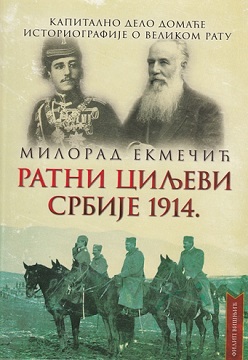
(Excerpt from the introduction Milorad Ekmečić: The long movement between slaughter and plowing, History of the Serbs in the New Century Institute for textbooks in 2008)