In Palermo on Saturday, December 5, 2009, the Italian police arrested the number two man of Cosa Nostra, twenty-eight-year-old Gianni Nicchi, described by the Italian minister Roberto Maroni as a "young, dangerous, ambitious, ruthless killer", otherwise the son of a mobster in life imprisonment.
Gianni Niki was arrested in a three-story building in Via Filippo Juvara 25, not far from the Palace of Justice in Palermo. The apartment on the first floor where the boss was arrested has a kitchen, bathroom, living room and bedroom, is small and looks like it belongs to rich people. It was usually empty because the owner, who was normally under police control, died a few months ago.
Nicky tried to escape through the skylight.
He had been on the run since January 2008, when he was sentenced to 18 years in prison for extortion and ties to the mafia. He quickly rose to the top of the mafia families in Palermo, after the mafia boss Salvatore Lo Piccolo was arrested two years ago. The police got to him by listening in on his phone calls. One of the sentences from that conversation reads: "Always shoot three times... When it falls to the ground, in the head, and that's it..."
The Italian Minister of the Interior said that the police discovered Niki during a search of an apartment where he was hiding.
While he was walking with his brother-in-law on Via Margherra in the center of Milan, seventy-four-year-old Gaetano Fidancati, who was released from prison in 2006 but was under suspicion for ties to the mafia since December 2008, was also arrested.
The Italian police announced that his arrest put 17 people behind bars from the list of 30 most wanted suspects, at the top of which is Matteo Messina Denaro, whom investigators describe as the main boss of Cosa Nostra, who rose from his fortress in Trapani, in western Sicily, to the top after the 2006 Corleone arrests.
The Italian newspaper Mesaggero writes that he was arrested at the moment when he was supposed to meet the person who was being followed. During the search for him, some of his traces in Milan from forty years ago were also used. The arrested did not resist and asked the officers for cigarettes before being transferred to San Vittore.
Reports say that these arrests create a power vacuum in Cosa Nostra, but that they clearly also have a political connotation, as soon as Italian Prime Minister Berlusconi found it necessary to speak out, saying that it was the best response to the slanders leveled at him by irresponsible people, and that his government has done more (in arresting mobsters) than any other in the last twenty years.
Berlusconi thus responded to what the repentant mobster Giuseppe Spatuzza testified in the Turin court last Friday - that Berlusconi and Senator Marcello Del Utri were connected to the mafia in the 90s - he said that "he got everything thanks to the confidentiality of those two people" and that the Sicilian mafia "holds the country in its hand" thanks to such help.
Berlusconi recently lost his immunity, allowing the trial to begin in which he is accused of bribing a lawyer to testify falsely in some corruption cases. In Milan, a trial against Berlusconi is scheduled for January.
Berlusconi and Del Utri have vigorously denied ties to the mafia. A series of events shows that the mood of public opinion in Italy is turning against corruption, the mafia, and that politicians are also associated with them. A crowd gathered outside the police station in Palermo to applaud as masked policemen, showing two fingers in victory, led away a bound Gianni Niki in a leather jacket and lilac shirt.
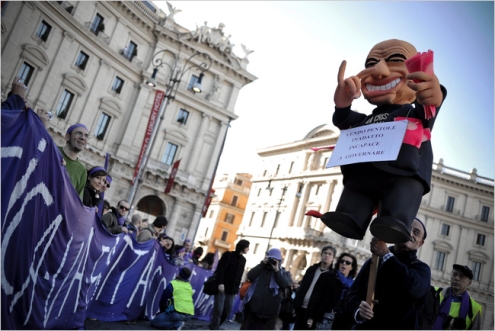
About 90.000 people protested on Saturday, December 6 in Rome's Piazza di Repubblica against Berlusconi, accusing him of not caring about real Italian problems, but only about his own. Demonstrators from all over Italy carried banners demanding Berlusconi's resignation. The protest was organized by a group of bloggers, who did not allow politicians to speak, and about 360.000 people joined that group on Facebook. Facebook group since that movement began in October. Self-organization in this way becomes an interesting political phenomenon.