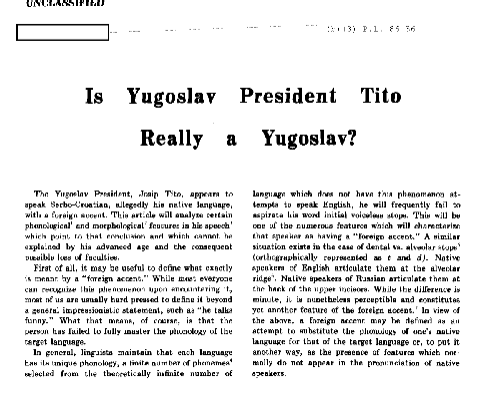
The National Security Agency (NSA) declassified the 1977 analysis. PL 86-36 Is Yugoslav President Tito Really a
Yugoslav? in which it is concluded that Josip Broz Tito spoke the Serbo-Croatian language with a foreign accent, most likely Polish or Russian.
The reader of that analysis is explained to the Serbo-Croatian language (combination of non-palatal consonants c, d, g, h, k, l, n, s, tiz with the j sound, whereby prepalatalized "soft" (palatalized) consonants are created in the words h, f, f, h, l, nj, and f...) The Serbo-Croatian language is said to have four soft palatal consonants ć, đ, nj and lj, and that will before a vowel i those whose mother tongue is Russian (or Polish) in the word «mani» (batali, leave) tend to pronounce it softened n' (nj), as in the word "smaller", which Tito did, and that the same tendency was observed when he pronounced the words personality, republic, current (issue), citizens...
The author of the analysis, who is not signed, refers in the footnotes to two linguistic works (Guide to the Slavonic LanguagesR.GA deBray, (London and New York: Dent and Dutton, 1969), and A Prehistory of Slavic George Y. Shevelov, (New York: Columbia University Press, 1965)) The reader is briefly introduced to Sheveljov's division of Slavic languages into groups with "active palatalization" (Russian, Polish, Belarusian, the language of Lusatian Serbs and Eastern Bulgarians), with lost palatalization (Ukrainian, Czech, Slovak and Bulgarian (except in the eastern parts) and to groups that do not have palatalization (Serbo-Croatian, Slovenian, Macedonian).
At the end of the analysis, the assumption is made that Tito's "change of identity" most likely took place at the end of the 30s, when he was relatively unknown.
In the analysis, it is also recalled that Dragoljub (Draža) Mihailović, after the meeting with Tito on September 19, 1941, was convinced that his interlocutor was Russian.
It is also said that his non-Yugoslav origin can explain "impartiality and, therefore, success in relations with different ethnic groups in Yugoslavia", and that the question is whether his successors will succeed.
In the end, it is concluded that even if Tito is not the real Josip Broz born in 1892, it does not have too much significance. All of Tito's great successes, from resistance to the Germans to world recognition as the leader of the nonaligned movement, happened after 1941. The authors of the analysis conclude that Tito leaves the impression of a man who wants to be written down in history as "Josip Broz, a Yugoslav" and that therefore the question is whether a deeper investigation into his real identity would have any purpose, other than an academic one.
It is said, however, that the fact that Tito is most likely not Josip Broz, born in 1892, has real significance because Tito is possibly a much younger man. The analysis was done three years before Tito's death, at a time when he was said to have suffered a stroke and there was speculation about possible successors.
More can be read in the original text Is Yugoslav President Tito Really a Yugoslav? , on the NSA website.