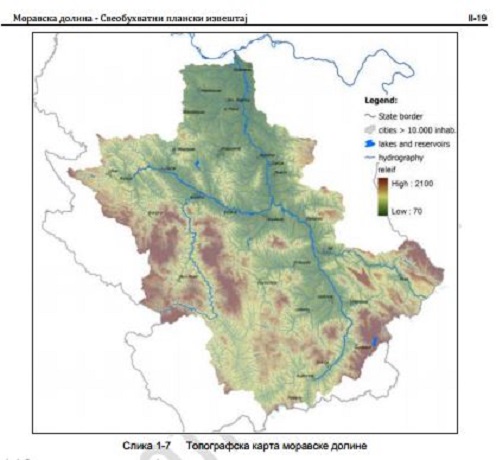
In January 2013, CHINA GEZHOUBA CORPORATION LIMITED, hereinafter referred to as CGGC, signed a Memorandum of Understanding with the Ministry of Natural Resources, Mining and Spatial Planning of the Government of the Republic of Serbia in order to implement the overall exploitation of the Serbian Morava River. In June 2013, CGGC organized a team of designers (PRPSDC) with supporting staff from the construction company No.5 Engineering to conduct a survey of the Morava River segment in Serbia. During the 15-day research, successful consultations were held with various sectors of the Government of Serbia, companies, associations, universities and research institutes, where the state of the Morava River was discussed, and a tour of the terrain, i.e. Great, Western and Southern Morava, was also carried out. In July 2007 (?!) year, CGGC gathered staff to participate in the
to the PRPSDC technical planning leave, where the framework, content and basis for the development of the project are specified. As requested at the meeting, the "Moravian Valley - Overall Planning Report" was made in September 2013 based on earlier research results.
This planning report includes three main rivers, the Velika Morava, the South Morava and the West Morava. Navigation research will include the Morava River and the Vardar River, where the priority will be the Morava River. For the purposes of this planning, the years 2002, 2020 and 2023 were taken as the current reference year, medium-term reference year and long-term reference year. In this planning, the basis is the main content topics, namely navigation, hydropower, conservation of water resources, water supply and irrigation, flood control and tourism.
The Chinese study contains an overview of hydrological, economic, water management facts, apparently from local official sources, on the basis of which the following conclusion is drawn:
CONCLUSION
Based on all of the above, it can be concluded that the project of building the Moravian Canal through Serbia is feasible and profitable, and that it has a positive impact in the following areas:
1. Navigation - Given that it connects Western and Central Europe with the Aegean Sea and reduces transport costs, and improves mobility, safety and quality of life;
2. Production of electricity - Increases the amount of renewable energy in the system, brings economic benefits and positively affects the optimization of the energy structure in Serbia;
3. Industry (agriculture, tourism, transport) - The land is arable and therefore suitable for growing various types of plants (wheat, corn, fruit and many others;
4. Irrigation - Enables the development of the irrigation system, which has a positive effect on agriculture;
5. More stable supply of drinking water;
6. Flood protection.
All this has a positive effect on the development of industry and economy and on the employment of people, which increases the standard of living in that part of Serbia.
Chief designer: Yang Huihui and his associates, Zhou Qiuhong, Sun Luo, Xie Kai, Li Wenhua, Yang Huihui, Fu Zhihao, Liu Yazhou, Xiong Hanwen, Zeng Wenze, Kan Dongdong, Yang Fengjuan, Hu Heping indicate possible positive effects in various economic fields, which the reader can see in the following inserts from the study
Traffic
According to the analysis results of the Internal View from Europe (INE), the average external marginal costs of road traffic are 24,12 euros / 1.000 tons * km, the average external marginal costs of rail traffic are 12,35 euros / km * 1.000 tons, while the external marginal costs for inland navigation is 5,0 euros / km * 1.000 tons.
It is noted that within the available transport system, the external marginal costs for inland navigation are the lowest. In addition, the ideas of connecting the waterway along the Morava River and building a new canal from the Vardar River to the Aegean Sea are in line with European strategies for the promotion and improvement of inland waterway transport. In order to improve mobility, safety and quality of life, it is necessary to establish inland water traffic within the multimodal traffic policy.
Energy
After the completion of the construction of the planned cascades, the installed capacity will be increased by 360,1 MW, and the production capacity will be increased by 1427,8 GWH. The Serbian energy system will be further optimized, and pollution will also be reduced. Therefore, it will be more economical and rational to use coal for the needs of the base load of the functioning of the system. Based on the calculation of shadow prices for electricity of 0,06 euros / (kW•h), the annual profit from the production of electricity would amount to 85,67 million euros.
Water resources
3) After the completion of water resources protection planning, the existing situation characterized by the direct discharge of waste water from the sewage system into the river will change, the rate of waste water processing will increase and the aquatic environment will be protected. At the same time, this will trigger the development of tourism.
5) After the implementation of the planned projects related to water sources, the rate of water provision for the needs of households and industrial production would amount to 95 percent, the rate of ecological water provision would amount to 90 percent, while for the needs of agriculture it would amount to 75-90 percent. By 2030, the water demand for the needs of 3.191.000 people and 14.500 hectares of agricultural land under irrigation will be met...
Short-term arrangement
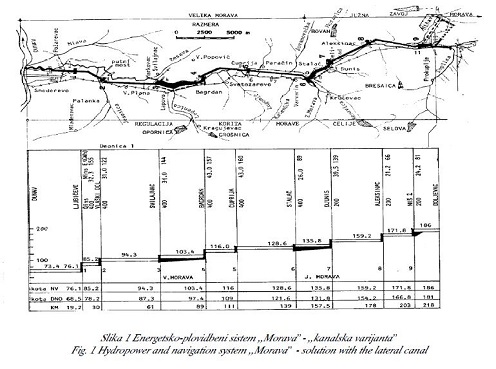
1) Priority will be given to the development of navigation along the Velika Morava. Cascades St1-St5 will be built in Velika Morava with the aim of connecting upstream channels. The two cascades (St6 and St26) foreseen as part of the navigation road project will be built upstream and downstream of the Zapadna Morava valley (Nis), in order to increase the benefit of electricity production and improve the flood protection function.
2) In accordance with the sequence of development of the cascades, optimal implementation of projects related to water supply will take place in the cities of Paraćin, Ćuprija, Velika Plana, Batočina, Jagodina, Lapovo and Doljevac. Water will be taken from watercourses, in order to provide more sources of water supply….
Planned cascades
• In November 2010, the SEEC company published the "General Project of HPP on the Velika Morava within the integral use of the available waters of the Velika Morava River", with a comprehensive techno-economic comparison of four cascade development schemes on the Velika Morava:
1) Preliminary development of the idea mentioned in the Energoprojekt report from 1987, i.e. development scheme 7
cascade.
2) Development scheme of optimized 7 cascades proposed by SEEC company
3) Development scheme for 6 cascades proposed by the SEEC company
4) Development scheme for 5 cascades, proposed by the SEEC company
These four schemes only show a techno-economic comparison from the point of view of hydraulic energy production without considering navigation and a solution of 5 cascades is proposed for the development of hydroelectric power plants on the Velika Morava. In describing the development of cascades on the Velika Morava, this report is based on SEEC's variant of 5 cascades.
CHINA GEZHOUBA CORPORATION LIMITED: Chief Designer: Yang Huihui
Prepared by: Zhou Qiuhong, Sun Luo, Xie Kai, Li Wenhua, Yang Huihui, Fu Zhihao, Liu Yazhou, Xiong Hanwen, Zeng Wenze, Kan Dongdong, Yang Fengjuan and Hu Heping
The entire study: Study on the feasibility of the Morava canal Ministry of Natural Resources, Mining and Spatial PlanningMinistry of Natural Resources, Mining and Spatial Planning
(After the abolition of the Ministry of Natural Resources, Mining and Spatial Planning, the document can be viewed on the website Morava Valley – Comprehensive Planning Report www.istinomer.rs )