The Appellate Chamber of the Tribunal acquitted General Gotovina Markač by a majority of three to two. In April 2011, Gotovina was sentenced to 24 years in prison, and Markač to 18 years, by the first-instance verdict of the Tribunal.
Judge Fausto Pokar, one of the members of the appeal panel of the Hague Tribunal who voted against the acquittal of Markač and Gotovina, assessed that the verdict that the panel, with his opposition, handed down to Croatian General Anto Gotovina was contrary to any sense of justice.
"I do not believe that justice is served when the guilt established by the verdict - which the first-instance panel did not take lightly, as evidenced by more than 1300 pages of analysis - is changed in one fell swoop in just a few paragraphs, without a careful consideration of the documents and adequate explanation," added Pokar in his opposition. opinion that is part of the final judgment ( read the full judgment or just Pokar's reasoning on page 102. ).
Pokar pointed out "a large number of errors and wrong constructions in the reasoning of the majority of judges". He added that the verdict was based on a misinterpretation of the conclusions of the first-instance panel and a violation of judicial practice and standards in the appeal procedure. According to him, the majority of judges "pretended" to consider all the evidence. In addition, the "cornerstone" of the first-instance conviction was misinterpreted - the finding that the shelling of four towns in Krajina was illegal because the shells fell outside the 200-meter radius of presumed legitimate military targets. The appeals panel, however, declared the "200-meter rule" to be unfounded in the evidence and determined that there was no other evidence that the artillery attacks on the towns in Krajina were illegal.
In addition, the majority of judges, except Pokar and Agius, found that since the attacks were not illegal, there could not have been a joint criminal enterprise based on them. Pokar notes that the majority of judges did not take into account evidence such as the transcripts from the meeting of the military and political leadership of Croatia in Brioni on July 31, 1995, at which President Tuđman and General Gotovina, planning Operation "Storm", "agreed on a joint plan to remove Serbian civilians from Krajina". Pokar adds that the majority did not take into account Gotovina's order from August 2, 1995 to "put the cities under artillery fire", as well as the numerous testimonies of eyewitnesses, UNPROFOR soldiers and experts.
Strong opposition to the verdict was expressed by another member of the appeals panel, Judge Carmel Agius from Malta. The decision to overturn the first-instance conviction and release the Croatian generals was made by judges Theodore Meron from the USA, Patrick Robinson from Jamaica and Mehmet Ginej from Turkey.
The five-member court panel passed the final verdict against Croatian generals Anta Gotovina and Mladen Markac by overvoting, since two members - the former president of the tribunal - judge Fausto Pokar and judge Karmel Agijus, had a different opinion.
The appeals panel, presided over by judge Teodor Meron, rejected the trial panel's key conclusions that Gotovina and Markač participated in a joint criminal enterprise, as well as accusations of illegal artillery attacks on Knin, Gračac, Obrovac and Benkovac.
"After the Trial Chamber's thesis that the shelling was illegal was refuted, the Appeals Chamber maintains that there is no evidence that there was a joint criminal enterprise with the aim of removing the Serbian civilian population from Krajina by force or threat of force," Judge Meron said.
The court released Gotovina and Markač from command responsibility.
"The appeals panel overturns the convictions of Gotovina and Markac for persecution, deportation, murder, failure to act, crimes against humanity, looting of public and private property, violation of the laws and customs of war, and pronounces an acquittal on all counts of the indictment except the third count," Meron said.
The appeals panel also rejected the conclusion that the artillery attacks on four towns in Krajina - Knin, Obrovac, Gračac and Benkovac - were illegal.
The panel also believes that the departure of civilians during the artillery attacks on those four cities cannot be characterized as deportation.
"The departure of civilians, which occurred at the same time as the legitimate artillery attacks, cannot be characterized as deportation," Meron said.
Gotovina and Markač were acquitted of all counts of the indictment except for the third, which concerns that they knew about the criminal acts that had been committed and that they should have investigated those acts, which the accused, according to the Trial Panel, failed to do.
And with regard to Markač's responsibility, the Chamber is of the opinion that there are not enough conclusions for a conviction "based on the responsibility of a superior".
In Croatia, the verdict was awaited with great attention.
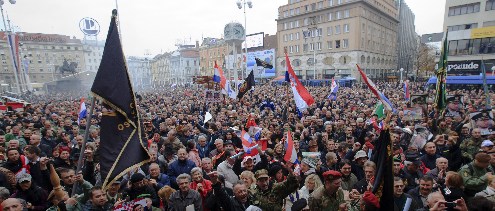
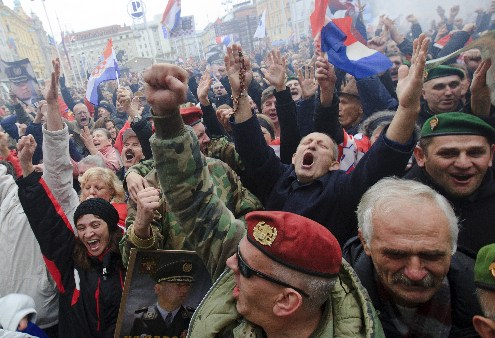
More than 1.000 Croatian veterans gathered in Zagreb on Thursday evening for a mass and vigil in support of the Croatian generals.

AP Photo/Nikola Solic
In Split, after the acquittal, a large number of citizens took to the streets and joined those who watched the broadcast from Scheveningen on a large video screen in the main square. Children were let out of school early, and ship sirens and church bells sounded.
There was similar euphoria in Knin, and the mayor, Josipa Rimac, said that her city was liberated for the second time today. "Today's verdict cleansed the stain of the Homeland War, the entire liberation action of Oluja, Croatia, the Croatian people," said Šibenik-Knin prefect Goran Pauk, who welcomed the verdict in Knin.
The ceremonial reception of the freed generals was organized in Zagreb at 16:XNUMX p.m., after they were transported from Scheveningen by the Croatian Government plane accompanied by Defense Ministers Ante Kotromanić and Croatian Defense Minister Predrag Matić.
As "Jutarnji list" reports, "the fire department greeted the plane with Gotovina and Markac with a water salute" - they created a "water arch in honor of the general" with snots. Several tens of citizens gathered on Ban Jelačić Square.
A video beam was placed on it, and the meeting organized by the Coordination of Veterans Associations is proceeding peacefully.
In today's reports, the world media conveyed the atmosphere of celebration from Croatia and criticism from Serbia. The American agency Associated Press (AP) estimates that today's verdict is one of the most significant court decisions in its 18-year history. AP adds that the verdict caused an outpouring of celebrations in Croatia, while in Serbia it will anger "the staunch opponents of the Hague Tribunal, who believe that the judges are anti-Serbian".
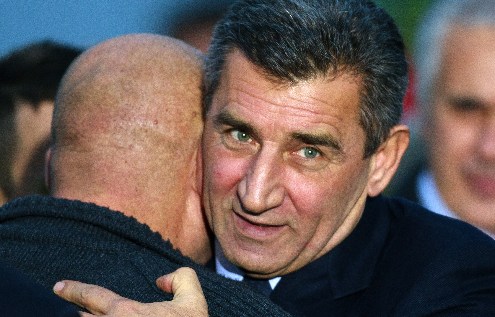
Ante Gotovina (AP Photo/Nikola Solic)
Agence France-Presse comments that Markač and Gotovina welcomed the verdict relatively calmly, while there was a momentary euphoria in the courtroom, in which many supporters of the Croatian generals approached Markač's wife Mirjana to congratulate her.
"Gotovina, dressed in a light blue suit, with a dark blue tie, occasionally tapping his fingers on the table, listened attentively to Judge Meron as he read the verdict. When it became obvious that he was going to be released, he smiled and offered his hand to Markac," the French agency said, citing "Blitz".
Mladen Markač (AP Photo/Bas Czerwinski, Pool)
The Reuters agency only states, without making any comments, that the Appeals Chamber of the Hague Tribunal changed the first-instance verdicts against Markač and Gotovina, while the BBC reports that there is a big celebration in the center of Zagreb due to the verdicts.
Radio Free Europe (RSE) assesses that the passing of the judgment of the Appeals Chamber "was more than tense, as evidenced by the fact that it was passed with the dissenting opinion of two, out of a total of five appeals judges." RSE also reminds that Judge Teodor Meron, who ordered the release of the Croatian generals, "overthrew the 45-year sentence (of the former chief of staff of the Croatian army in Mostar) Tihomir Blaškić, but also tripled the sentence (of the former officer and commander of the JNA in Vukovar) Veselin Šljivančanin for the crimes committed in Vukovar".
Croatia allocated more than 27 million euros from the budget for the defense of Croatian generals before the Hague Tribunal in the past six years. The Croatian portal "H-Alter" reports that this is only part of the funds used to pay the research teams of the three Croatian generals Ante Gotovina, Mladen Markač and Ivan Cermak, while the so far unknown remainder was paid from the "Foundation for the Truth about the Homeland War".
President of Serbia Tomislav Nikolić said on this occasion that the decision of the Hague Court will not contribute to the stabilization of the situation in the region: "The decision will open old wounds, and put the Serbs in Croatia, the small number of them who are left to live there, in the position of culprits whom anyone can still carry out with impunity his 'justice'". The president also wondered who was to blame for the fact that during Operation Storm, over 220.000 Serbs were expelled and thousands of unarmed men, women and children were killed. "With today's decision of the Hague Tribunal, Croatia can legitimately celebrate the biggest pogrom in the world after World War II." A country that does not even allow the families of missing Serbs to determine where the bodies of their loved ones are," Nikolić pointed out and added: "If until now there was reason to believe those who claimed that the Hague Tribunal is neutral, fair and something more than a court To Serbia and the Serbian people, this was denied by the latest decision on the release of war criminals," said Nikolić. In the end, the President of Serbia pointed out that the Serbian people in recent history were victims of genocide, the cruelest crimes, persecution and torture, and that Serbs were branded as criminals who should be ashamed and silent. "It is a paradox that must not be repeated," said President Nikolić.
Serbian Prime Minister Ivica Dačić he assessed that the Hague Tribunal's acquittal of the Croatian generals confirms the claims that the Hague Tribunal is not a court but that it "fulfills pre-set political tasks".
Prosecutor for war crimes Vladimir Vukčević said that the principle of punishability of war crimes is seriously threatened and added that such a decision of the Hague Tribunal is scandalous. "This is one of the biggest war crimes in the territory of the former Yugoslavia, about the murders, expulsions and endangerment of hundreds of thousands of people, without anyone being held accountable," Vukčević told Tanjug. According to him, it is legally incomprehensible that the first-instance court panel imposed high sentences on the defendants, and that the second-instance panel made a diametrically opposite decision, given the equally established factual situation.
Director of the Documentation Center "Veritas" Savo Štrbac he says that he was "speechless when he heard the verdict". "I think I was the only Serb who believed in the justice of the court in The Hague and announced that the generals would be convicted, if not as participants in the genocide, then at least as helpers, but that did not happen," Štrbac said. "This is the end of this court for the area of the former Yugoslavia." This is scandalous, shocking, you can imagine what it's like for the people who fled in columns from Croatia. I think that even the most optimistic Croats did not believe in this. "I never dreamed of this," Strbac told "Blic".
President of the Association of Refugees and other Associations of Serbs from Croatia Milojko Budimir stated today that Krajišniki were affected by the acquittal in The Hague of Croatian generals Anta Gotovina and Mladen Markač and added that the facts are completely different from what was decided by the Tribunal in The Hague. "The result is so devastating for us that all of this is hitting us as if another 'Storm' has arrived, because the injustice is even worse than the 'Storm' that happened to us," said Budimir at the "Veritas" press conference. He said that it was also seen what Croatia did to reach that verdict, "and on the other hand, we didn't have what we should have, which is certain logistics."
President of the National Council for Cooperation with the Hague Tribunal, Rasim Ljajić said that the Hague Tribunal, after such a decision, "lost all credibility". "This today is just proof of selective justice, which is worse than any injustice," Ljajić told reporters at the Belgrade Media Center. "The decision of the Appellate Chamber takes us three steps back and the perception of the Tribunal in our public will be even worse," added Ljajić.
President of the Serbian Restoration Movement Vuk Drašković in addition to condemning the acquittal of Gotovina and Markač, in his statement to Tanjug, he emphasized that the command responsibility of the Croatian generals for a great crime against civilians was indisputable, and it was the basis for punishing Serbian war commanders in all previous judgments of the Hague Tribunal. "According to today's verdict, helpless children, women and the elderly were a legal war target of the heroic homeland Croatian army," said Drašković.
Vuk Jeremić, President of the United Nations General Assembly, wrote on his Twitter profile: "Everything I've always thought about 'Hague justice', after today there is no longer any reason to formulate it in politically correct language" and "Let those who agreed to EULEX investigate the organ trade on Kosovo. Gentlemen will conclude that we took them out for ourselves."
Political analyst Đorđe Vukadinović he assessed that the acquittal is a surprise even for those who have no illusions about the character and nature of the Hague Tribunal and the double standards of that institution. "This verdict is brutal and cynical and represents a slap in the face of justice, but above all Serbia and the Serbian victims." Both in the Storm and beyond it," Vukadinović told the Beta agency. He assessed that the Hague Court has shown that it is biased and subjective, but also susceptible to the pressures that Croatia, through a strong lobbying campaign, has implemented all over the world, especially in countries that have a direct influence on that court and its financing.
Čedomir Antić from the Advanced Club assessed today that the decision of the Appellate Chamber of the Hague Tribunal is "shameful and dishonorable", that it was partially expected. "This is the death of the Hague Tribunal," said Antic. He said that this decision does not mean that war crimes should not be prosecuted and does not mean that Serbia made a mistake when it cooperated with the Hague Tribunal in good faith and under great pressure. "That masquerade is over." "Cooperation with the Hague Tribunal is not cooperation with justice, but with a merciless war winner," said Antić.
President of the Belgrade Fund for Humanitarian Law, Nataša Kandić she stated that the acquittal of Gotovina and Markac did not bring justice for the victims and that the verdict did not mention war crimes or the exodus of Serbs from Croatia. "The verdict did not bring justice for the victims, it was forgotten what happened to the people from the moment the shelling began, and the appeals panel's explanation that the defendants did not participate in the adoption of discriminatory regulations that prevented the return of Serbs and that they cannot be attributed to a joint criminal enterprise, as that they were charged with direct ordering and not with command responsibility," Kandic said.
The Serbian media also reported criticism of Nebojša Stefanović, President of the Serbian Assembly, Serbian Progressive Party, Dragan Marković Palma, President of United Serbia, Vladimir Ilic, Head of the Parliamentary Group of the United Regions of Serbia, Petar Petković, Spokesman of the Democratic Party of Serbia, Branko Ružić, Head of the Sociojalistka Parliamentary Group. party of Serbia, Liberal Democratic Party, Nikola Selaković, Minister of Justice and State Administration, historians Predrag Marković and Dubravka Stojanović and others.
President of Croatia Ivo Josipović said that he was happy that the people he was convinced were innocent were at liberty. "I'm glad that the verdict is the way it is, because we knew that Uluja was not a criminal enterprise." There were crimes, but the generals are not to blame for them."
Prime Minister Zoran Milanovic said at the extraordinary conference that "it is about two innocent people, but that does not mean that the war was not difficult, bloody and just". "It lasted 17 years and it is important that people go home to their families, but it is important for Croatia because there were a lot of precedents and a lot of politics in everything. To those whom Croatia has wronged, it will fulfill the debt of justice. That must not be forgotten. Thank you to Markač and Gotovina for doing so much for Croatia," Milanović said. "This is one of the rare days in the lives of nations and individuals when everyone is happy and practically no one is evil. This was an outpouring of joy, that ordinary healthy human joy, not happiness because anyone had ever suffered or was unwell, but simply a huge stone from our hearts, which fell from our hearts, with this we show that we also have a heart. Have a good trip home," said the Prime Minister of Croatia.
Former spokesperson of the Prosecutor's Office of the Hague Court, Florence Artman stated that with the decision on the acquittal of Croatian generals Ante Gotovina and Mladen Markač in connection with the indictment for crimes against the Krajina Serbs in 1995, the Hague Court does not claim that there were no crimes and victims, but that the two defendants are not responsible for those crimes. "Croatia could have overtaken the Hague Court, arrested the real perpetrators and tried them in its own courts." That is why he bears part of the responsibility for the crisis surrounding the general," said Florence Artman. She stated that the problem with the indictment of Gotovina existed from the very beginning and that the first-instance sentence of 24 years in prison was based on a "strange construction" - the Brion meeting of the political and military leadership of Croatia, where there was talk of "criminal intentions within the intervention in Krajina". . She characterized as "strange" the construction from the indictment on excessive shelling of Knin, which is why an acquittal could be expected, reports Hina. "If there is no joint criminal enterprise, if we don't have shelling but have a military operation, Gotovina cannot be connected to the ethnic cleansing that happened later," Florence Artman told Slovenian Television.
President of the Republic of Srpska Milorad Dodik called the acquittal of the Croatian generals incredible and shameful. "It is incredible that after the first-instance verdict, the Croatian generals are now acquitted." Perhaps a reduction in the sentence could have been expected, but not this," Dodik told reporters in Banja Luka. "This is a humiliating decision for all victims, for all Serbs, and after it we cannot trust the Hague Tribunal. Everyone who believed that international justice exists can now be sure that it is both selective and political, and that it is exercised only in that way," Dodik pointed out.
Croatian Minister of Defense Ante Kotromanović said that I feel the same as I did in 1995. "All the time I claimed that Gotovina was innocent, although some did not dare to say it. I persistently repeated this, because I knew what we were doing, and we were doing pure military work. Now we finally have a document from The Hague for that".
General Ivan Cermak, who was acquitted by the Hague Tribunal last year for war crimes during and after the "Storm" action in 1995, said today that the acquittal of Anta Gotovina and Mladen Markac is a great day for Croatia. "I believe that there will be no more politicking and that they will no longer shove the "Storm", expulsion of Serbs and deportations in our noses. We all know that there were no such things, and that is a big thing for Croatia and for relations in the region," Cermak said.
Croatian non-governmental organization Documenta - Center for facing the past reminded the victims in a statement: "Regardless of the verdict of Gotovina and Markač, the victims' families have the moral right to expect that the perpetrators are responsible for their tragedies and the tragedies of many others, regardless of which side they fought on and in whose name the crimes were committed." Once again, we remind those responsible and the Croatian public of some well-known,
and unprocessed crimes such as the murder of civilians in Golubić, Gošić,
In Varivoda and Mokro Polje in the Knin area, he attacked a refugee
column between Glina and Dvor and the death of a large number of civilians,
murders in Komić in the Korenica area," Documenta said in a statement, which concluded that the moment had come for the Croatian judiciary to take full responsibility for the prosecution of committed war crimes, and the Croatian government to ensure compensation for the civilian victims of the war.