
Nutrition
A craze among young people: Are protein shakes harmful?
Protein shakes, bars and puddings are increasingly popular, yet experts warn that excessive protein intake can be harmful
(continuation of the previous text, additions)
Sila
The JNA ground forces had about 140.000 active members, of which 90.000 were conscripts, and could mobilize more than a million reservists.
Tank brigades with a total of more than a thousand tanks consisted of two or three battalions. Soviet T-54s and T-55s, about 70 T-72s and about 300 domestic M-84s dominated numerically. In reserve there were some American M-47s ("pattons") and veterans of the Second World War, Soviet T-34/85s and American "shermans". Along with tanks, the JNA had a huge number of armored personnel carriers.
Artillery regiments were equipped with Soviet (about a thousand), American (about 700) and domestic weapons of large caliber. Artillery also includes YMRL-32 and M-63 missile systems, four launchers for Soviet FROG-7 unguided surface-to-surface missiles with a range of 100 kilometers; a little less than a thousand tools in total. The self-propelled artillery had about 700 guns at its disposal. To that should be added large quantities of anti-tank weapons and assets.
Large units of the JNA had extensive tactical anti-aircraft (PVO) equipment; it was estimated that there were more than 5000 artillery anti-aircraft guns in total. The land units included four surface-to-air missile regiments and 11 anti-aircraft artillery regiments. Rocket air defense regiments were equipped with a large number of Soviet rockets SA-6, SA-7, SA-9, SA-13, SA-14, SA-16.
Coastal artillery also had cannons and surface-to-surface rockets, Soviet SS-C-3 and truck-mounted Yugoslav "Brom" anti-ship missiles (domestic variant of the Soviet SS-N-2). Coastal artillery included more than 400 88 mm, 122 mm, 130 mm and 152 mm guns of Soviet, American, German (post-war) and Yugoslav production.
The Air Force (JRV) had about 32.000 members, including 4000 conscripts; it had more than 700 planes and 200 helicopters.
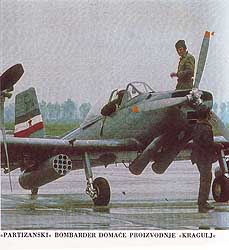
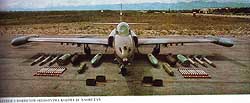
Domestically produced attack fighters for direct air support (12 Orao-165, Super Galeb and J-2 Jastreb aircraft, and the older P-21 Kraguj) are deployed in 2 squadrons. They were armed with American-made AGM-65 Maverick air-to-surface missiles or Soviet AS-7 and AS-9 missiles. There were 130 Soviet MiG-21 interceptors deployed in nine squadrons, heavily outdated and armed with Soviet AA-2 air-to-air missiles and similar outdated or slightly more modern AA-8 missiles. During 1987, Yugoslavia received 16 MiG-29 interceptors. It also had two squadrons with more than 30 Soviet Yak-40, Antonov An-12 and Antonov An-26 transport aircraft, seven squadrons of Mi-8 transport helicopters and domestic Partizans (French Aérospatiale Gazelle produced under license).
The Navy (JRM) consisted of 80 frigates, corvettes, submarines, minesweepers, missile, torpedo and patrol boats. After the Second World War, a lot of German and Italian submarines, destroyers, minesweepers and landing ships that were captured or obtained through reparations entered the navy. The navy was modernized in the 10s with the introduction of 4 Soviet Osa-I class missile boats and 1980 Shershen class torpedo boats. During 1982 and 1990, the Navy received two Soviet Koni-class frigates, two more were built under license. In 3, the main combat submarine units were 533 Hero-class submarines, armed with 1990 mm torpedoes, two smaller Sava-class submarines were introduced in the late seventies, and two Sutjeska-class submarines served in 4 for training. Small submarines were produced: 4 Una class and 10.000 Mala class, in use since the end of the eighties. The Navy had amphibious vehicles for transporting tanks and people on the Danube, Sava and Drava rivers. The JRM had 4400 sailors (of which 900 conscripts and XNUMX marines).
Comrades po to the enemy
In World War II, allied agents infiltrated both the Chetniks and the Partisans. Intelligence on active resistance groups was crucial to the success of Allied support and supply missions, which were evenly distributed throughout 1942. After that, the Allies abandoned support for the Chetniks in favor of the Partisans, apparently based on a 1943 report by British intelligence officer Deakin. , when he noted that the partisans suffered heavy losses in the battles with the German First Mountain Division and the 104th Light Division; a bizarre detail is that the First Mountain Division was transferred from Russia via railway lines through the territory controlled by the Chetniks of Draža Mihajlović - without any problems. According to American data, between January 1, 1944 and October 15, 1944, 1152 American airmen were rescued on the territory of Yugoslavia, 796 with the help of partisans and 356 with the help of Chetniks. During the war, partisans and civilians rescued 33 American and 303 British airmen from 30 flying fortresses shot down over Slovenia.
Ethnic čišćenje JNA
The splitting of the JNA along ethnic lines began in the period between 1968 and 1974, when the conception of the nation and, together with it, the system of territorial defense (TO) was introduced. With the constitution of the SFRY from 1974, the republics received practical powers over TO units, recruitment and armaments, which, as some of the highest officers of the JNA feared at the time and as was shown at the beginning of the secessionist wars in Slovenia and Croatia, would become the nucleus for the creation of national army.
On the eve of the dissolution of the state, the national composition of the officer cadre often served as an argument for the assertion of the JNA as a Serbian-Montenegrin army. The disproportions were visible, but it cannot be said that the significantly larger number of Serbs, Montenegrins and Yugoslavs at the expense of Croats, Muslims, Slovenes and Albanians was the product of a deliberate military-personnel kitchen. On the contrary: the JNA, as "an army of all our peoples and nationalities", has always tried to ensure their participation among the epaulettes as proportionately as possible, not even shying away from positive discrimination of those "in short supply".
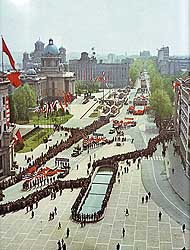
The denial of planned conscription contingents begins in 1988–1990: the republics refused or at least bargained over the sending of "their" people to military service, at the same time accusing the JNA of being Greater Serbian (and Montenegrin).
On the other hand, from the perspective of the JNA, Slovenes and Croats first became suspicious, then undesirable in the Slovenian (June–July 1991) and Croatian wars (1991/92). Officers who withdrew from Slovenia and Croatia with JNA units, often with their families, were exposed to suspicion, removal from responsible positions and, finally, direct dismissal from service. Secret at first, the order intensifying the ethnic cleansing of the JNA is justified by the introduction of a "patriotic criterion". In the case of the operational units - the Air Force, from which there were at least six "flyovers" during 1991 - this may be understandable, but the "cleaning" of the Military Medical Academy in Belgrade has neither patriotic nor, especially, professional justification.
The withdrawal of the JNA from Bosnia and Herzegovina was carried out with (or because of) the awareness that no single army could be maintained in that "Balkan fortress", especially when the ethnically configured political parties, SDS, SDA and HDZ, invited "their own" to enroll in their "own" armies.
Conception i contraception
The successor of the JNA, the Yugoslav Army was announced in 1992 as professional, with a recruitment period limited to a maximum of six months and with service in the home republic, active officers well and regularly paid, military pensioners as well, and military schools attractive.
The first public requests for military service in "their" republic came from Slovenia at the beginning of the eighties, simultaneously with the then unimaginable proposal for the introduction of civilian service and respect for conscientious objection to the handling of weapons. The answer then consisted not only in a general refusal - which some military conscripts paid for with repeated prison terms and additional service - but also in a short-term, doomed to failure attempt to have women serve in the army as well. At the end of the 1991s, before the dissolution of the SFRY, demands that recruits not leave the republic's territory became a mandatory political slogan in Slovenia and Croatia. With the beginning of the bloody disintegration - which was paid the heaviest by the "recruitment contingent" of March XNUMX - the public and private suspension of sending recruits to the army turned into a call for desertion, on the one hand, and refusal to participate in the civil war, on the other.
Before the collapse of the SFRY, the army decided to professionalize in the form of contract soldiers, and in the summer of 1991, it called for volunteers. The effects of the introduction of professional soldiers have never been publicly analyzed, and the role, participation and use of volunteers in the wars of 1991-1995. many patriotic memoirs have already been written, as well as some Hague indictments.
In the breakup of Yugoslavia, the JNA was used in the worst imaginable form, as an army of the civil war - without any noticeable resistance from the army leaders. Its successor on the territory of the "reduced" state, the Yugoslav Army, opted for professionalization, depoliticization and support for the regime of Slobodan Milošević, practically until October 5, 2000.
Kosovo i Slovenija
The drama begins with the fall of the Berlin Wall in 1989. Created and developed as an armed arm of the Communist Party, the JNA acquired the status of one of the three sacred cows of socialist Yugoslavia: Tito, the Party, the Army. For 45 years, the JNA lived in a comfortable tower of gray-olive ivory, looked after, pampered and paid, protected from parliamentary and public control, supported by ideological glorification. All the characteristics of a closed hierarchical organization were there: self-centeredness, ideological obstinacy, negative personnel selection (rat race), gaining privileges as a basic life goal and a complete lack of interest in civilian - that is, real - life.
That army claimed that nothing could surprise it; people who served military service (and some officers too) doubted it to some extent, but they were smart enough not to express their opinion publicly. The JNA failed to notice that Communism was dying, even when the Russians saw it. By the way, there has always been a special, transverse connection with Moscow, beyond the official structure of the party and government; from Josip Broz, the ministers of defense - Nikola Ljubičić, Branko Mamula and Veljko Kadijević - inherited that connection. Regardless of quarrels, fears and reservations, the first country of socialism always remained as the last support of the regime. The JNA got into its first troubles in the mid-eighties, regarding Kosovo and Slovenia: it lost its innocence in Kosovo, where it was used against the population for the first time. The Kosovo crisis was declared - according to (Slovenian) Stanet Dolanac, back in 1981 - a "counter-revolution". Something else is starting to happen in Slovenia, which in the long term is equally worrying for the JNA: open criticism of the military establishment is getting louder; the status of the sacred cow was lost, "Mladina" bit the first minister of the military, Branko Mamula, so that soon the Slovenian public opinion would begin to openly question the taboo topics about defense.
During 1990, federal prime minister Ante Marković tried to reform the Yugoslav federation, but encountered equally fierce resistance from the leaderships of Slovenia, Croatia and Serbia. The systematic identification of Yugoslavia with socialism was present until the end as the official dogma of the JNA: Yugoslavia cannot exist if it is not socialist. What the JNA refuses to understand is the nature of the choice before it: should it save its country, Yugoslavia, or communism. In the end, nothing will be saved in that hesitation, and the JNA will also perish.
Division military waste
At the beginning of the dissolution of the SFRY, there were about a hundred tanks and self-propelled guns left in Slovenia, 65 working tanks (mainly T-55A) were left in Varaždin alone. A little later, the JNA admits that 170 tanks and 142 armored vehicles were stolen from it.
The inventory lists of the JNA and its successor, the VJ, also lacked a multitude of "trifles" in the type and quantity of 15.000 rifles, 600 artillery pieces, 2000 anti-tank missiles, 13.000 mines, 550 rocket artillery pieces, 500 machine guns, 30.000 bombs, about 10 million bullets and unidentified ( or unpublished) quantities explosives. It is not known - or someone carefully chose the moment to publish the quoted data, before the "pre-deployment" from BiH - how much, who and what the former JNA left on the ground they had to leave. It is also impossible to assess the "gains" of the ex-JNA committed by mining, disabling or demolishing and/or looting their own property (Zeljava base and airport near Bihać, Tuzla airport, equipment and housing stock in Macedonia, communication installations, explosives in disabled rockets, bombs and mines...).
At that moment, from the beginning of the nineties, the military prosecutor's office filed 700 criminal charges against about a hundred officers, 50 non-commissioned officers, 500 soldiers and dozens of civil servants for theft and "surrender".
The lack of na list
At the beginning of the summer of 1992, the then president of the FR Yugoslavia, Dobrica Ćosić, announced in the Assembly that "there are no more soldiers and officers of the Yugoslav army in Bosnia and Herzegovina, and all the military equipment of the JNA has not been withdrawn due to the armed actions of the Croat-Muslim forces on the barracks and the blocking of roads".
By comparing the data for "abandoned" (to Serb citizens of BiH) and "seized" (by the "Muslim-Croat coalition") weapons, the absence of information on the quantities of mobile rocket, mortar and all kinds of infantry weapons that passed into the hands of the Army of the Republic was striking. Serbs. According to Ćosić's report to the Parliament of the FRY at the time, the JNA/VJ was left in Bosnia and Herzegovina without 24 planes, 20 helicopters, 531 tanks, four rocket divisions, 87 light and heavy rocket launchers, about 5000 mortars of larger calibers and about 220.000 pieces of infantry weapons. To these figures should be added the published numbers of "shortages" of JNA/VJ weapons after the war in Croatia (15.000 rifles, 6 planes, 170 tanks, 142 armored vehicles, 500 rocket artillery pieces, 600 cannons, 2000 pt. rockets, about 16.000 pieces of infantry weapons, 13.000 mines, 30.000 bombs and approx 10 million bullets) and Slovenia (hundreds of tanks and self-propelled and artillery guns, several downed helicopters, undisclosed amounts of other weapons).
Comments:
Protein shakes, bars and puddings are increasingly popular, yet experts warn that excessive protein intake can be harmful

Jabari Parker and Partizan terminated the contract by mutual agreement, which ended the saga that marked his stay in the black and white jersey

In the elections on May 5, 1935, the government and opposition lists were voted on. Before the elections, the government intimidated teachers and scholars with dismissals and arrests, called opposition candidates Ustasha allies and accused them of organizing the assassination of the king, prevented foreign journalists from reporting...

As if by pattern, the same thing that is happening now on Novoj.rs, happened on Television Novi Sad in October 1990.

Vesna Lalić, an excellent photographer, has passed away. She photographed all the most important social and political events in Serbia, as well as seemingly ordinary everyday moments.

It is necessary, first of all, to somehow get to the act of handing over power, if there is anyone from the Essenes who would hand over power. We want to say: Vučić and his team must not be trusted for even two seconds until the government is constituted

Majority Serbia carried by students must now find the strength to forgive ordinary people and appease those who voted for Vučić for years. And for higher echelons – court and Zabela

At the moment when this text is written, Pionirski Park is filled with police and masked men dressed in black and carrying mysterious large bags in which, we assume, they are not carrying wafers and southern fruit. But why all that?

The archive of the weekly Vreme includes all our digital editions, since the very beginning of our work. All issues can be downloaded in PDF format, by purchasing the digital edition, or you can read all available texts from the selected issue.
See all