When in July 1927, Moša Pijade, a communist, painter and journalist, a prisoner in Sremska Mitrovica, sued the warden of the prison Mita Mitić personally to the Minister of Justice Milan Srškić, doctor of law, for the unpaid full amount of the fee for the painting, a portrait of the warden done in oil on canvas, two interesting outcomes arose.
By November 1st, the prisoner won the state in court, which was represented by Mr. Mitić through the institution of the prison warden, and the Minister of Justice, as a state institution, practically sided with the prisoner, not interfering in the court process and then replacing Mitić. The court ordered Mitić to pay Moša Pijada the entire amount of fees and compensation for all court costs. Another interesting outcome is the correspondence preserved in the Archives of Yugoslavia, created from July to November 1927, between the plaintiff, the minister, the defendant manager, the judge, the lawyer and all the participants in the process. The most interesting are the letters in which the prison warden defends himself before the minister and later in court, which additionally and vividly reveal to us the nature of the regime and the entire state, the legal system, the independence of the judiciary and the treatment of political prisoners in the state.
In his letters, the warden of the Mitrovica prison justified the fact that the painter was delaying the creation of the canvas because during that time he enjoyed special privileges compared to other prisoners. He received half of the required fee at the beginning of the work, but the picture was not finished in a month, but only after three months, thus he did not comply with the provision of the contract regarding the deadline for the creation of the "object in question". He moved the manager from chair to chair, looked for "suitable light", moved closer and further away from the window, removed the curtains, looked for another, better room than the manager's office, and the like. The manager warned him that he would not give him the rest of the money, but the painter did not care about his threats because the arrangement was private, for a private house, and not their official obligation, nor was the work intended for the official cabinet. During that time, Pijade ate in the administration's restaurant, at a table served, he only slept in the prison room, but he stayed outside the room from morning to night for three whole months. Canvas, oil, easel, brushes, everything was paid for by the manager out of his own pocket and did not damage the state coffers, but police officers went to the city to procure painting materials, and did so several times, which kept the painter in control of the client.
Otherwise, it can be concluded from the correspondence that political prisoners represented a completely different category from other prisoners, criminally sanctioned (robbers, murderers, burglars, money embezzlers, corrupt officials, etc.): they did not go to manual labor, physical force was not applied to them, they had a certain freedom of movement in the circle, access to the library, the reading room, the right to cultural activities and intellectual work. Moša Pijade himself translated Marxist literature and held a Marxist school within the prison, which was not punishable or considered a criminal offense but rather his intellectual right. They slept in separate apartments from other prisoners and had a separate, better kitchen than others.
The prison administration regularly and accurately forwarded their possible income or earned fees to them, and it is concluded that through various banks from European centers they had solid and regular income from Moscow intended for their party work, in the amount determined by their place in the party hierarchy. Information about this was submitted to the court for review. Pijade, for example, received separate fees for translating literature and for political teaching, in addition to the regular salary of a party functionary. These incomes were often sent by political prisoners to their families, when they were at liberty. The warden of the prison noted in a letter that his accuser in September and the first half of October in 1927 had an even higher income than he, a civil servant, and as an attachment he submitted a certified report on the prisoner's salary to the court and the Minister of Justice. However, after the first signature on the lawsuit, which approved the process, the Minister of Justice completely distanced himself from the case, as the law requires.

Photo: Museum of YugoslaviaFRIENDS: Tito, Vladimir Bakarić and others
Moša Pijade looks at his works
Photo: Museum of Yugoslavia
All three actors were Belgraders of similar ages who personally knew each other as "university students" and participants in the First World War in the Serbian army. But the court process was completely independent of their acquaintance and private lives. Be that as it may, the court sided with the painter, and the manager was additionally removed from his position, with the settlement of the debt, at the discretion of the minister. Based on that process, it could not really be said that until 1928 the Yugoslav state was very repressive towards members of the KPJ, as citizens and even prisoners, but it was towards their organization.
After the (unsuccessful) assassination of regent Aleksandar Karađorđević in Belgrade (assassin Spasoje Stejić) in 1921, the murder of the Minister of the Interior Milorad Drašković in Delnice (assassin Alija Alijagić) and several other attacks on the highest officials of the state, the work of the Communist Party of Yugoslavia (KPJ) as a political organization and all its media outlets was banned, but not the existence of communists and their sympathizers. The rule of law did not punish people for their opinion or intention, but only for the committed criminal or anti-state crime, which was proven exclusively in court. In 1925, Moša Pijade was arrested and sentenced to prison for publishing the banned newspaper "Communist" and organizing an illegal party printing press for that newspaper.
After 1928 and the open declaration of war by the illegal KPJ on the Yugoslav state from the congress in Dresden, the regime in Belgrade became more repressive towards all participants in armed actions directed against the order of the Kingdom of SHS/Yugoslavia (the Bombing process, the Velebit Uprising and the like), although even then they were not tried for freedom of opinion but for the specific act of the specific perpetrator.
If we do not count the occupation regimes during the First and Second World Wars, which were brought about by foreign invaders, the most terrible repression in the territory of central Serbia lasted from October 20, 1944 to November 7, 1946, at the time of the arrival and consolidation of the KPJ's power in Yugoslavia. The repression in Serbia was also the biggest repression of the communist regime against the local population in the whole of Yugoslavia. At least 60.000 citizens of Serbia were killed, according to preserved shooting books, and it is believed that the number of victims was even higher. Tens of thousands of people were sent to prison, mostly in Metohija, for forced labor (building roads on the border with Albania, in Prokletije), many of whom did not survive.
The official two-year repression of the KPJ in Serbia was aimed at destroying civil society and free civil thought. At the end of that process, a one-party communist dictatorship ("dictatorship of the proletariat") was enthroned, and the state was called "democratic" and "people's" (DFJ, FNRJ). Just as the state became democratic and popular, the republic was also a republic ("res publica" as the government of the people): the exclusive power was held by one political party and its party leader, as the new Prime Minister. After the greatest repression in the history of modern Serbia, the dictatorship of one party and one man continued, in somewhat milder forms, until his death (1980), through various ups and downs. But the culture of government that was established in Serbia at that time, with the most brutal repression, unfortunately did not change after his death.
Political repression by definition means "the persecution of an individual or a group of people for political reasons, especially with the aim of limiting or preventing their ability to participate in the political life of society." It implies political discrimination in political life, and is often accompanied by human rights violations, abuse, police brutality, imprisonment, deprivation of civil rights, violent actions or terror: murders, executions, torture, forced removal and other types of extrajudicial punishment of political activists, or often punishment of entire "different" populations.
In cases where political repression is organized by the state, it represents state terrorism, politicide, a crime against humanity, even genocide against one's own people. It is characteristic of totalitarian (ideological) states which by definition are dictatorships - fascist, Nazi and communist regimes. The activities of systemic political repression are carried out by various means: secret police forces, the use of the army and "law and order" forces, paramilitary groups or death squads.
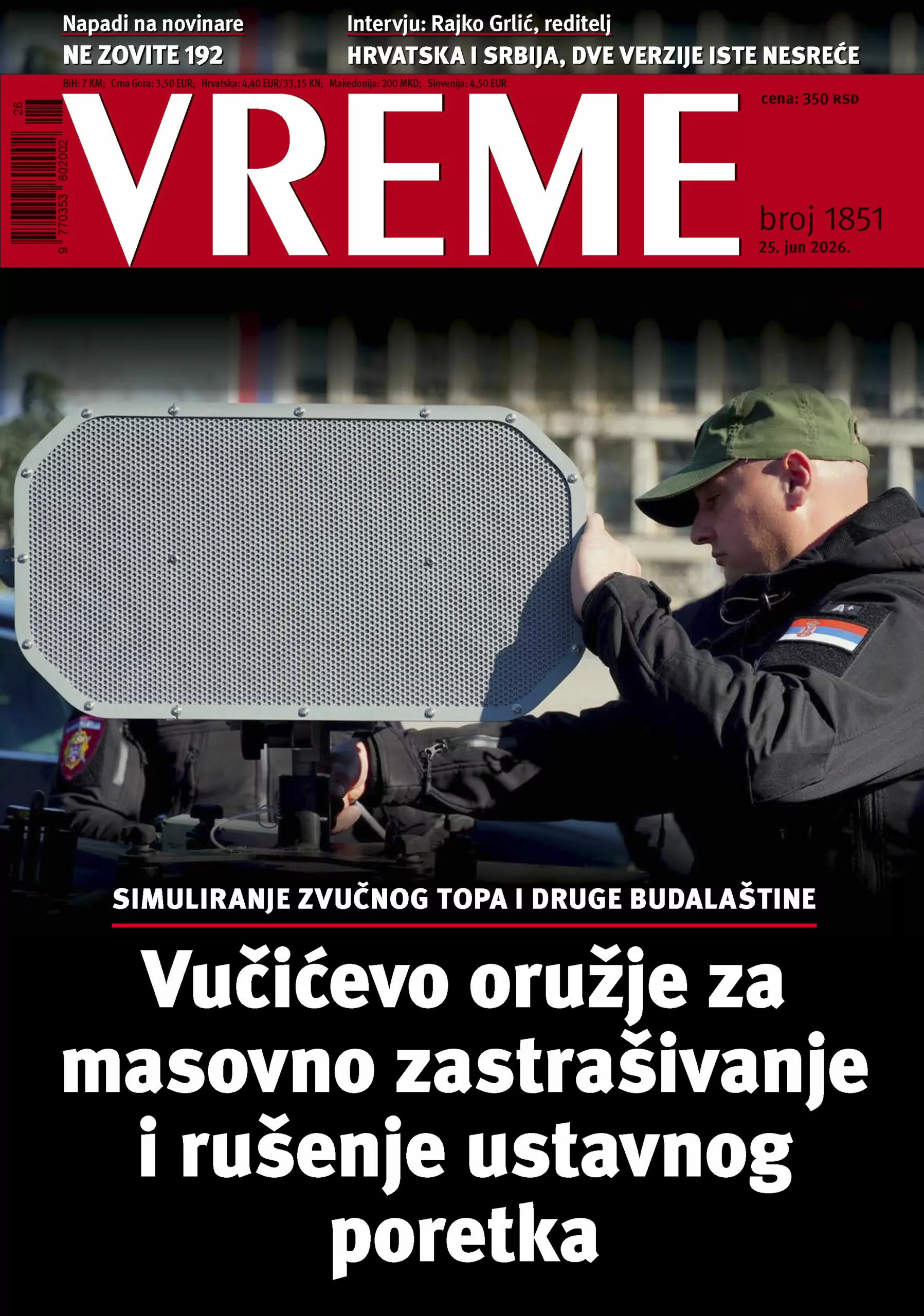
Dictatorship or "autonomy" otherwise, according to all dictionaries, means an autocratic form of government characterized by the personal power of a "leader", a man who has the powers of the government (executive body) with little or no restrictions (see "Time" No. 1789 "Man called the State"). A dictator leads and controls the entire country's politics. His work is facilitated by a narrow circle of people who call themselves the "elite" and they represent his ministers, advisers, generals and other top officials. Dictatorships often try to present a democratic facade by holding elections to establish their legitimacy or to incentivize members of the ruling party, but those elections are, by definition, not competitive for the opposition. Stability in a dictatorship is maintained by repression, which includes limiting access to information - media rule, monitoring political opposition and acts of violence. After all, the books say, repressive regimes that fail to sufficiently suppress opposition from political and social life become vulnerable to collapse through coups or revolutions.
In modern Europe, repressive regimes are particularly characteristic of certain countries of the former USSR and SFRY, in which the ruling communist party remained in power thanks to countless changes of official name or group of names of pseudo-parties. The common internal enemy of all today's repressive regimes is civil society and free civil thought.
For the Czech writer Milan Kundera, the common feature is the low paying power of all residents and kitsch, i.e. the anti-aesthetics introduced by the regime into every pore of public life, public speech, public symbols and even official religious life.