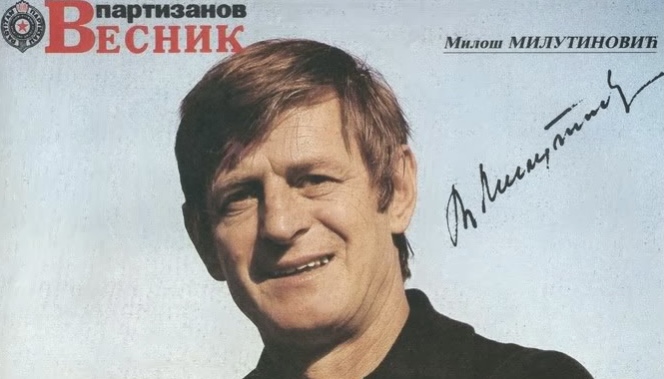
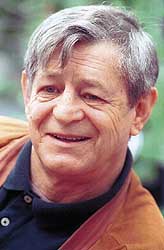
Expected and equally sad news: Miloš died. For the football world, no last name is enough. Miloš was a unique figure, one of the greatest masters that Yugoslavia ever had. The nickname "The Blue Tern", which only Alfredo di Stefano used in the football world, says it all.
He was the epitome of elegance, subtlety, lavish talent, unlimited imagination. He dribbled with ease, scored goals as if it were a joke, the defenders usually didn't even manage to trip him...
In his biography, it is written that he was born on February 5, 1933 in Bajana Bašta, but his football development began in Bor, where he came to live with his aunt at the age of four and play football. His younger brothers Milorad and Velibor Bora will follow him to Bor by the same route, also at the age of four. The talent of the wispy blonde did not go unnoticed by the selectors of the first junior national team of Yugoslavia, which won the championship title at the first European junior championship in Cannes in 1951, and Miloš was unanimously chosen as the best player....
The talented boy from Bor was the cause of a big fight between Crvena zvezda and Partizan. It was the first big affair in our football, Partizan was more dexterous because with the help of people from the top of the State Security Service, they managed to literally kidnap Miloš and persuade him to sign for "black and white"... Already in 1954, he played at the World Championship in Switzerland, alongside legends such as Rajko Mitić, Stjepan Bobek, Branko Zebec, Bernard Vukas... Miloš joined the famous Olympic team from Helsinki in 1952, enriching it with his magnificent talent. He excelled on the courts in Yugoslavia, but also in the Champions Cup. Miljan Miljanic told that Santiago Bernabeu, the president of Real Madrid, once - many years later, when Miljan was Real's coach - admitted that in 1955 he was terribly uncomfortable in the middle of Madrid because that "blue mischievous man could not score so many goals as much as the judge could cancel them". In the end it was 4:0 for Real, but Partizan in Belgrade, due to the heavy snow, was at home, tied, they won 3:0 with a post in the very finish...
Miloš played his first game in the national team on May 21, 1953 in Belgrade against Wales (5:2), his last against Germany in the quarter-finals of the 1958 World Cup in Sweden (0:1). He played 33 national team games where he scored 20 goals. He probably played his best game in a blue jersey on May 12, 1957 in Zagreb in the match between Yugoslavia and Italy (6:1). It was the first game that JRT broadcast live for the few who had a TV at the time. On Maksimir, 45.000 people were in ecstasy. Miloš scored two goals and played an unforgettable game. In the end, the crowd spontaneously burst onto the field and carried him in their arms... Unforgettable matches include the friendly duel with England in Belgrade on May 11, 1958. It was 5:0 and the trio of grandmasters Toza (Veselinović)–Miloš (Milutinović)–Šeki (Dragoslav Šekularac) humiliated the defense of the English team in football.
During 1959, he fell ill. Doctors diagnosed tuberculosis, at that time a disease from which people still died. Bayern Munich paid for the operation, with the condition that they take his shirt with him when he recovers. Miloš returned and played for the Bavarians and Racing from Paris for the next few years. In his late playing years, he returned to Yugoslavia and at the age of 36 signed together with his great friend Šekularac for OFK Belgrade. I remember their "debut" against Proleter in Karaburma, in the first round of the 1968/69 spring championship. Nearly 30.000 people came for them. It was 3:2 and Miloš, as in the most beautiful fairy tale, scored the first goal right at the beginning of the game....
The last time Miloš appeared in public was last summer on the occasion of the match between Partizan and Bayern in the Champions League qualifiers. The German club included him among their best players of all time. In the history of Partizan and Yugoslav football, he will be remembered as a rare football gem who, when he was at the peak of his strength, was prevented by illness from reaching world fame, but not from remaining forever in the hearts of all those who watched him at least once.