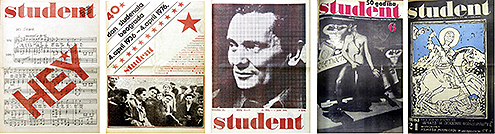
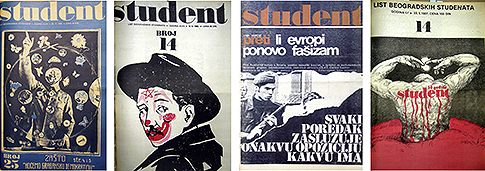
It was a time when the student movement at Belgrade University was one of the most massive, influential and well-organized movements among such movements on the Euro-American political map. This is the moment when a new, Second War was being prepared in the world. It goes without saying that the former Kingdom of Yugoslavia could not escape from such and such a world. Its ruling regime, however, believed that it was possible not only to mitigate, but perhaps to completely avoid the damage of the expected world war if, in time, it opted for the future victorious powers. Viceroy Prince Pavle Karađorđević, President of the Yugoslav Government Milan Stojadinović (economist, long-term radical politician, director of the representative offices of two large British concerns, also known as "the British man", founder of the pro-fascist Yugoslav Radical Community JRZ, Jerez, whose uniformed members addressed him as "Leader !" and greeted with a fascist salute) and his coalition partners in the government with whom, in order to block the policy of the Croatian Peasant Party, Vlatka Maček in Croatia, divided the power in the Kingdom into equal parts territorially, including Yugoslavia itself, then the Catholic priest Anton Korošec, a clero-nationalist, the president of the clerical Slovenian People's Party who was given control of Slovenia, and the lawyer Mehmed Spaho, the leader of the Yugoslav Muslim Organization (JMO ), to whom Bosnia and Herzegovina was left to manage, Croatia belonged to Macek anyway - they believed that Hitler's Germany and Mussolini's Italy were the countries that The Kingdom of Yugoslavia can and must be relied upon as their loyal ally. The rapprochement with Hitler's Germany, the military-political alliance with Mussolini's Italy and the secret agreement on giving Italy a quarter of the territory of Yugoslavia itself, the agreement on "sincere and eternal friendship" with Bulgaria under the authoritarian regime of Tsar Boris III, were the main results of Stojadinović's government. This foreign policy was supplemented by repressive measures of the regime on the internal level - the cooperation of the authorities in the application of the German-Japanese so-called Anti-comintern pacts, political trials and concentration camps for the opposition, mainly communists, measures to deport politically suspicious persons, the use of firearms with fatal results against demonstrators, the "university police" law, armed paramilitary groups (Jereza, Zbor Dimitrija Ljotić) against workers and students organized by the government and its political police, the violation of the autonomy of the University by the state apparatus, especially the police and the gendarmerie, with the intention of completely abolishing the autonomy...
In such an environment, therefore, a little more than two years before the beginning of the Second World War and four years before that war would engulf Yugoslavia, the newspaper "Student" was launched. It was the result of the implementation of the anti-fascist policy of the People's Front in the student movement (a broad alliance of communists, democrats, left and right-wing farmers...) and a visible consequence of several meetings of a group of student activists (anti-fascists, leftists, members of SKOJ)
which at the end of 1936 and the beginning of 1937, on the initiative of Ivo Lola Ribar, met in the Belgrade tavern Akademija (it was located on the ground floor of the Serbian Royal Academy, today SANU, at 15 Brankova street in Belgrade, where this institution was located until 1952).
Ivo Lola Ribar studied political science and political economy in Paris and Geneva until 1935, then he returned to Belgrade, enrolled at the Faculty of Law, graduated in 1939, and then enrolled at the Belgrade Faculty of Philosophy. He was one of the organizers and most prominent figures of the youth and student revolutionary movement in Belgrade and Yugoslavia at that time, a member of the Central Committee of the KPJ and secretary of the Central Committee of the SKOJ...
He was killed in an attack by an enemy plane on an improvised partisan airfield on Glamočki polje on November 27, 1943, from where he was, as a member of the Central Committee of the KPJ, a member of the Supreme Staff of NOV and POJ, editor-in-chief of "Youth Struggle", member of the "Borba" editorial staff, president of the United Alliance Anti-Fascist Youth of Yugoslavia (USAOJ), personal envoy of Josip Broz Tito and head of the first military mission of NOV and POJ, was supposed to fly to Cairo.
From March 15, 1937 until the outbreak of war in 1941, "Student" was edited by Bogdan Pešić (chief and responsible editor), Ivo Lola Ribar (unsigned writer of the main political editorials), Ratko Popović, Savo Dragojević, Boža Pejović, Puniša Perović, Milutin Popović Sandžaklija, Anton Kolendić and others. The editorial office worked at Simina 8. The main goals of the student movement for which the paper stood were: anti-war policy and resistance to the ruling regime, defense of academic freedom and university autonomy, development of student solidarity and networks for economic self-help, support for the work of student cultural, sports and other associations, support for the trade union movement and workers' struggle for their rights, consistent anti-fascism...
This is particularly convincingly evidenced by "Student" from December 23, 1939, on the front page of which the obituaries of students and workers who were killed by the police and gendarmerie during the large student-worker demonstrations in Belgrade on December 14, 1939, were published. 50.000 people. The police used force and started clashes with the demonstrators. The fiercest clashes between protesters and the police took place in what was then Pristina Street (after World War II, this street was called 14. December Street for decades; recently, the authorities changed its name to Tsar Nikolaja Street), near the Faculty of Law, near the Technical Faculty, and in Aleksandrova street (for decades Boulevard of the Revolution, today Boulevard of King Aleksandar). During the demonstration, over 50 students and workers were wounded, while 10 participants, of which 8 were students, were killed. Among the dead were: Mirko Luković, a medical student, Rajko Lalić, a carpenter, Bosiljka Bosa Milićević, a student of a higher commercial school, Živadin Sedlan, a technical student and others.
Restored as early as 1946, immediately after the end of the Second World War, without abandoning the original concept from 1937, "Student" as a newspaper of Belgrade students and the student movement was published continuously until the end of the eighties of the 20th century. On Students' Day 1968 - April 4 - "Student" was awarded the Order of Fraternity and Unity, which was awarded to him by JB Tito. The publication of such and such a paper in printed form was suspended during the ten-year war for the Yugoslav heritage, in the mid-nineties of the 20th century.
As active subjects of Yugoslav and Serbian social, cultural, political, artistic, scientific, journalistic and every other history, generations of "Student's" editors and collaborators left more than a deep, stimulating and indelible mark. Evidence of this can be found today in the preserved sets of that paper, in the personal biographies of the creators who marked the 20th century, in the archives of political and police institutions that dealt with the "Student" and his collaborators over the decades, or in the corpus of ideas that make up our special history. Unfortunately, that immensely large vault of creativity and imagination has not been explored to this day - impartially, systematically and critically.
The task of eliminating this major deficiency remains for better times. The initiative to mark 80 years since the first issue of "Student", launched in September 2016 by an informal group of "Student" veterans from different generations - from 1953 to the end of the eighties - aims to encourage, initiate and encourage such a course of events in the future. And when that happens, the question of why that paper did not exist in 2017, on the eightieth anniversary of its first issue, will definitely have to be answered. There is no space here to offer an adequate answer to such an important question. But none other than George Orwell with his 1984. it helps to understand the scale of the problem we encounter when we go in search of an answer to the question, "Why does 'Student' no longer exist?" Here is just one of his pointers:
Who controls the past, was the Party's slogan, controls the future, who controls the present, controls the past.
(The author is Associate, editor, editor-in-chief, publisher of "Student", 1973-1977)