
Culture
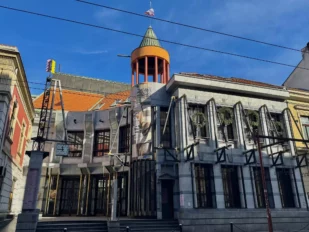
"Atelje 212" is 70 years old, and has one birthday wish
"Atelje 212" invites friends to tomorrow's 70th birthday celebration, and tells the city authorities not to agree to the collapse of culture
Ugo Cornia, Fables from the Reformatory, translated from Italian by Mirjana Ognjanović; Makart, Plato, Belgrade, 2025.
The simplest, encyclopedic definition of a fable says that it is about literary a kind in which primarily animals, but also plants, mythological creatures, and sometimes objects - have human characteristics. In them, in an allegorical way, certain types of people and characteristic situations in interpersonal relationships are considered, and as such fables always contain a lesson that can, as a rule, be expressed in a proverbial form. This is the basic difference between a fable and a story about animals: the latter literary type, namely, mostly retains the typical characteristics of animals (that is: people), but its heroes are much more individualized, more independent in actions, and to that extent the lesson at the end of the story is not implied, or may not be expected.

The creator of this literary genre is Aesop, and, according to the preserved testimonies, his fables spoke about certain types of citizens and classes in the ancient polis, and to that extent they were suitable for expressing a critical attitude towards various negative social phenomena. Restorer of the fable
in the literature of the modern era is Lafontaine, who is generally considered to have painted the characters and relationships better than all other writers not only at the court of Louis XIV but also in the entire French society of that time. Each of his animal-heroes had their prototypes in reality, which were easily recognized by contemporaries, so that in later times they remained universal patterns of human types and relationships.
In the literature of the last century, there are many writers who used the form of fables or stories about animals, from Vladislav Raymont, Kafka and Borges, through Orwell, to Calvin and Saramago, so it can be said that this literary genre, despite the specific formal limitations that are inherent to it and with which modern literary taste does not always come to an end, still leaves enough space for the artistic imagination to flourish. Contemporary Italian writer Ugo Corniola (1965), professor of philosophy by education and author of a diverse oeuvre of nearly twenty books, the author of whose book Fables from the Reformatory (published in Italian in 2019) his first work that appears in our country, as a somewhat typical artist of the postmodern era, renews this literary genre both in terms of form and content. Already from the introductory story "The Fable of a Dog, a Prostitute and a Machete", which actually takes place before our eyes in the conversation of two unnamed interlocutors, a meta-genre, that is, a metapoetic awareness is present in Kornia's book. In other words, the reader is clearly presented from the beginning that what he is reading is an artistic construction that will not pay too much attention to realistic motivation, and that, being such, it is subject to the most unexpected whims of the author. This capriciousness is one of the striking stylistic features of Kornia's book, and so, for example, the very next "Fable of Repomir", in which the vegetable people Lukomir, Belolukivoje, Paradajzivoje and Krastavko appear alongside the title character, after the characters, having perished in the "agricultural-food jihad", accidentally met and introduced themselves to each other in a wooden crate - ends abruptly, absurdly and violently (they played cards, despite the flies, until they rotted). Cornia's other stories, such as "The Fable of the Peasant from Pian di Venola" or "The Fable of the Rodi", in which the main characters suffer because they are powerless to adapt to the rules of the world, end in a similar, harsh and stupid way.
All twenty stories in the book are characterized by a specific, fantastical-surrealist humor which, however, implies that there is always a double bottom, that is, another plane of the text, and sometimes more, which further break down reality and point to disastrous social trends. Thus "The Fable of the Wolf, the Deer, the Boar and the Buckler" tells about the animals who lost their jobs because "the economic crisis came to the forest". In desperation, the wolf goes to the unemployment office, where they offer him to be a frog: "You go to a bar, where I tell you. Then you spend a lot of time in the water, you jump here and there, you have to eat at least one hundred and fifty grams of insects a day, and then you will croak." After he agrees to be a frog for "one hundred and twenty euros a month", the wolf is disgusted with himself and hides as soon as any animal approaches the pond, and then he meets a deer and a boar, who play snails for "only eighty euros" and from whom he hears the story of a moose, who committed suicide ("He didn't find any work for a year, fell into depression and jumped off a cliff"), and the story of a bee, who plays a bee for "a hundred euros, a flat and food". From all that knowledge, it was easier for each of them individually, so every day for half an hour they gathered by the pond and chatted, "waiting for the revival of the economy". "The Story of Talking Fabrics" also has a predominant social theme, in which the origin of the "hero" talks about relationships in the modern world. The story ends with general orgies, which, by the way, appear as a motif in various fables, and which always suggest a specific feeling of (not only physical) liberation as a way out of social chaos and psychological pressures.
General, as it were, metaphysical confusion, socio-political hypocrisy and the unbridledness of sexual urges, which are features of the world of Korinij's fables, as well as the simplicity of the plots themselves, reduced to a few familiar, common motifs - all of this together brings these stories into connection with Boccaccio's legacy of entertainment and instruction. At the same time, however, with cynical-absurd passages, together with violent-surrealistic endings, Cornija renews the old literary genre with literary means suitable for today's world he describes, which has long since lost any moral and value compass.
"Atelje 212" invites friends to tomorrow's 70th birthday celebration, and tells the city authorities not to agree to the collapse of culture
In Belgrade, someone wrote graffiti on the window of the Salon of the City Museum, where the exhibition of the October Salon is held. The perpetrator should have been captured by security cameras

80 films are coming to the 32nd Original Film Festival, many of them with awards from the Cannes festival. It is organized by a citizens' association, without a dinar of state money

Tomorrow "Zvezdara Theater" will celebrate the 400th performance of "The Book of Milutin" by Nenad Jezdić's monodrama. Plays that have been in the repertoire for more than a decade are currently being played in Belgrade. The musical "Some like it hot", even - three

More than 400 artists and cultural workers signed the request of the Initiative for Free Culture, which calls for the dismissal of all the leaders of cultural institutions in Pancevo.

At the moment when the institutions of the Republic are destroyed, when Vučić's octopus is still alive, when people are disgusted by the injustice and the stench left behind by the Essenes regime, we have, as Machiavelli said, only civic virtue as the fuel with which we can return to the beginning

The four independent members of REM are an example of perseverance and civic responsibility. Rodoljub Šabić even, upon leaving the premises of REM, after the sentencing of the Informer, experienced that the Essenes insulted him, hit him with their hands and feet. But that too will soon be over

Vučić pardoned the batterers and Dijana Hrkalović. The election winners should abolish the sultan's power that allows one man to run afoul of the entire judicial system
The archive of the weekly Vreme includes all our digital editions, since the very beginning of our work. All issues can be downloaded in PDF format, by purchasing the digital edition, or you can read all available texts from the selected issue.
See all



