If we imagine the utopia, and for many a nightmarish dystopia, of the historic reconciliation of Serbia and Croatia, we will very easily imagine the propaganda machinery of both countries as, as part of a series of bilateral agreements, practically and creatively harmonize. In addition to the fact that in the short term it would no longer be a sin to say "bread" or "bread" where it should not be, in just a few months the co-production recording and broadcasting of a telenovela about a Serb and a Croatian woman who would be dragged from one obstacle to another by Aphrodite would begin. And already around the 50th episode, public opinion gauges on both sides would show quite satisfactory results, and by then some 74th episode even impressive results.
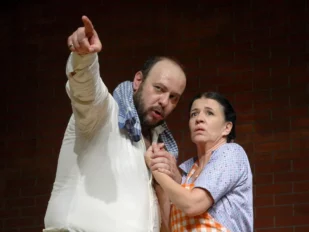
The impossible effort of the Zagreb-Belgrade playwright duo, Neva Lukić and Viktor Radonjić, to drama P(j)eschanik placed on stage it meant numerous polite rejections from both sides of the border, until the perseverance and vision of the director Jasmina Večanski Kujundžić brought it to the stage of the Pančevo Cultural Center, where it has been performed twice so far, and the play was recently, although according to the idea, a larger space suits it better, staged and on the small stage of Atelier 212. This five-year odyssey of a promising drama duo to materialize their dramatic text, with a plot precisely about "forbidden love", testifies, of course, about the power of the ban, the reasons for which are known to everyone, but also about the fact that love should not be underestimated either.
Love plot in P(j)to the eshchanik it is both a framework and a litmus test, which is an ambitious undertaking in itself, because the woman from Zagreb (Jelena Đulvezan Milković) and the man from Belgrade (Miloš Lazarov) will not only have to melt the frozen interstate conflict, carefully nurtured on both sides, with the persuasiveness of their internal and interpersonal conflicts, which would certainly be a melodramatic cliché, but also to resist the tendency of pseudo-Brechtian engaged moralizing imposed by the theme itself, which is so often presented to us pranks like art. Because it is a show of avant-garde theater, on the very edge of performance, with elements of shadow theater, even modern ballet, with interwoven film sequences on video-beam, therefore, a very hybrid structure, a show that could serve as a thematic counterpart, for example , Eugène Ionesco and his classic Rhino.
Similar to how Ionesco, like Cannetti in his time, dealt with the problem of the amorphization of personality in the crowd - "Who are we?" the desperate question of a Belgrade citizen echoes through the stage, perhaps best illustrating the dramatic situation, because "I is not we" - so both Lukić and Radonjić start from nationalist taboos and stereotypes that on the external level serve national homogenization, while on the individual level they only inflame eros. The director's solution for the personification of erotic sparking is both economical and effective: while the woman from Zagreb and the man from Belgrade are physically separated for most of the play, left and right, to the West and to the East, the contemporary Aphrodite (Jovana Urošević) occasionally walks onto the stage in the form of a provocatively dressed and provocative told television presenters.
In the love plot, the old-time stereotype of a Belgrade donjuan who goes on a business trip to Zagreb to hit the streets is elegantly broken. U P(j)to the eshchanik is the starting point exactly reversed, because the woman from Zagreb is coming to Belgrade for a business stay, no less than as a museum curator who will spend several weeks on professional training. At one point, when she is brought to a boil in the vortex of this toxic relationship, she will haughtily compare her arrival in Belgrade to going to Africa, in order to have an adventure with a Belgrader - a typical loser, divorced, without a permanent job, with artistic ambitions, desperate enough to falls in love - she almost racistly compared it to erotic gymnastics with an African-American on a trip through America.
It is precisely these exaggerations that point to the turning of the hourglass, because this view from above does not exclusively reflect a feminist rise, which would be insufficiently beneficial, not even so much the class difference between a woman from Zagreb and a man from Belgrade, no matter how much the variations on the musical theme echoed in the background. red flag, but above all reflects an openly colonizing narcissism of Zagreb, as a self-proclaimed center, towards the proverbial oriental and uncivilized Belgrade. What, however, Zagreb does not count on in its newly conquered arrogance, is that Belgrade will reciprocate with precisely the Croatian meaning of the word "sandbox", namely "enclosed space for children to play in the sand", so it will reciprocate no less than linguistically. , because the colonizer from the West, just by entering into a conversation, let alone an erotic relationship, will have to kneel in the pi(j)esak, to infantilize himself, thus behaving exactly the opposite of his intention, because of which he betrays and angers himself, which magnetizes the spiral of internal conflict.
Language, therefore, is not only a propaganda instrument. Language is the psyche itself. It is not by chance that I am midpoint, the culmination of the drama, is occupied by a musical-visual-dance section in which from off-and hears the voice of church singing. This chant in an ironic way sanctifies and forever cements the differences between the Croatian and Serbian languages, whereby the dictionaries of both languages become prayer books, with essentialist strongholds in two completely separate national entities, the existence of which is admittedly impossible to prove, but in them, of course, or rather , must v(j)er. Fortunately, the play, which up to this point was in danger of slipping into ideological pamphleteering according to a conciliatory recipe from the European, colonial center, in the second half turns to flesh and blood, stage concretion, a dramatic conflict between two actors on stage, subversively seeking resolution with on the other side of the linguistic-ideological framework, on the other side of correctness, thereby building a bridge that cannot be expressed discursively, but only with what makes art art.
The secondary character of the soldier (Zoran Ratković), whose sporadic appearance at the beginning can be experienced in a psychedelic-symbolic key, gets an interesting function in the plot towards the end of the play, becoming more concrete from a flashback in a very layered jealous scene, with which theater art once again shows us that its effect cannot be reduced to a mere presentation of theses and antitheses. P(j)eschanik is a play about forbidden loves and forbidden languages, but also about the eros that arises precisely from these prohibitions. If all the dramatic potential of this play had to be reduced to a single word, one stands out, albeit unspoken on stage, only shown, but completely the same in Croatian and Serbian, charged with eros and thanatos in equal measure, and that is the word : a hug.