Elena Ferrante is the pseudonym of a contemporary Italian writer. Her novels have been translated into many languages and are read all over the world. Translations of nine of her novels can be found and read here. Netflix is screened My genius friend i The Lying Life of Adults. As far as the theater is concerned, a stage adaptation of the novel was made in our region (specifically in Croatia). My genius friend, and in the Belgrade Drama Theater we can watch the dramatization of her latest book from 2019 The Lying Life of Adults.
The Lying Life of Adults is about a teenage girl growing up in Naples. Ferrante writes, what one would say "without a hair on the tongue", about various aspects of the growing up of a modern teenage girl (21st century), starting with the relationship to her changing body, the discovery of sexuality, the examination of one's own identity, the relationship to God, the opposite sex, parents , school, life priorities... Through the lens of a girl whose parents belong to the intellectual circles of the middle/upper middle class, Ferrante also criticizes this society. The essence of her complaint is what Marxists have long called "the double standards of the bourgeoisie". The main character's path of growing up leads through the exposure of the father's false morality and the process of normalizing his selfish behavior by first of all the girl's mother, and then by the father's second wife (otherwise, the mother's best friend). Ferrante shows that in the world of adults, no matter how much they (adults) deal with ideas, principles, freedom, justice - everything revolves around money and influence (which, of course, is valuable to the extent that it can be converted into money). With this, Ferrante shows that the modern citizenry has come full circle in a century and a half and is now re-living the problems of liberal capitalism from the second half of the 19th century, playing at the same time the salon left concerned with the problems of the third world and ecology. Convincing themselves to discuss the world's problems, adults rob, cheat and betray their fellow man. We assume that this social criticism was one of the main reasons that the celebrated Slovenian director of the middle generation, Sebastijan Horvath, otherwise very inclined to social themes and class issues (plays Forwards fear eats the soul, Cement), devoted to the theatrical adaptation of this novel.
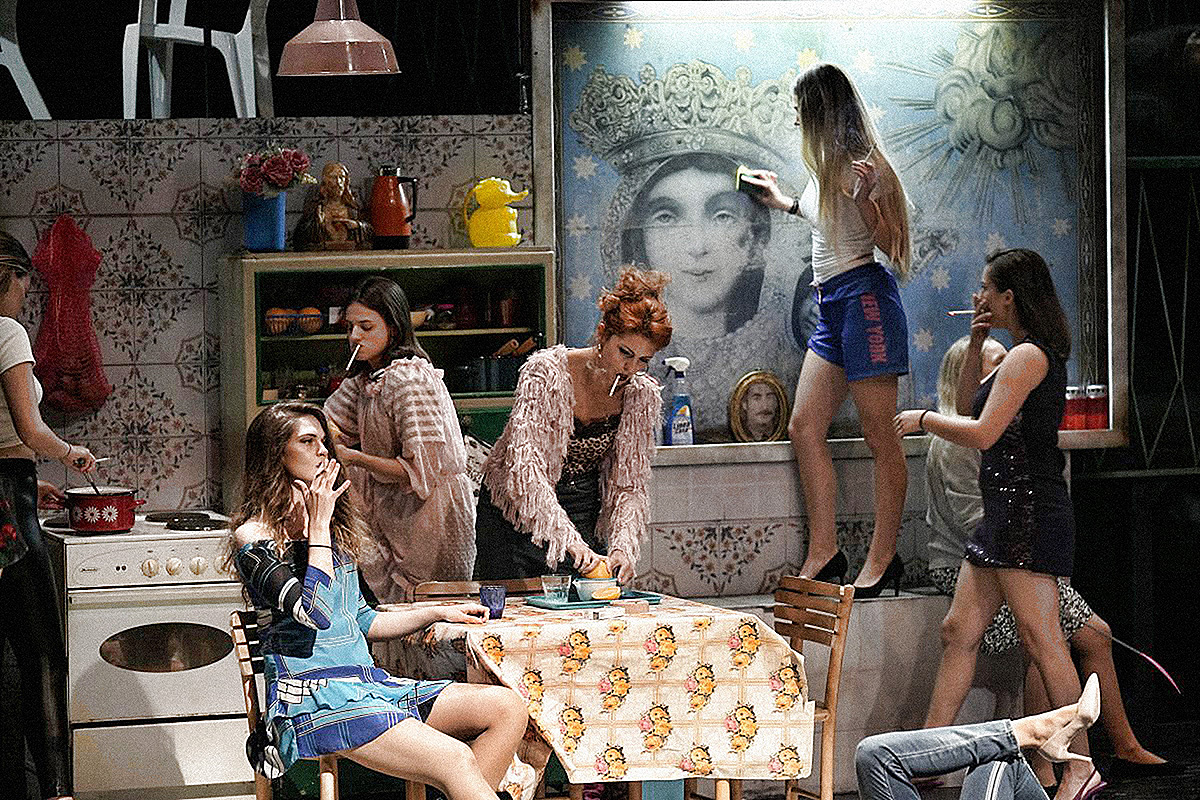
The author of the dramatization, Nina Kuclar Stiković, and the director, Sebastijan Horvat, decided not to experiment or intervene much, but to dramatize the main flow of the novel's story. Nina Kuclar Stiković tried to transfer the dialogues from the novel to a dramatization as much as possible, but not to completely translate it into the classic dramatic form, but to translate the narration, so characteristic of the novel, into the theater. This was achieved by the director deciding to have the entire play performed by a "choir of girls", i.e. a group of 17 actresses (Maša Obradović, Isidora Simijonović, Bojana Stojković, Jovana Šokčević, Vanja Panić, Sofija Kovačević, Marija Pikić, Nevena Mihailović, Jana Bjelica, Anđela Kribl, Anja Ćurčić, Mina Nenadović, Staša Milovanović, Antonela Vasić, Mia Radovanović, Alisa Radaković and Stanislava Nikolić) who act out scenes from the novel and, if necessary, add narrative parts to each other like a ball novel. This conception was a good director's choice because it made it possible to see the entirety of the work and preserve the style and ideas of the novel. The decision to have actresses play both male and female roles in the play is good for at least two reasons.
The first is that the novel is a woman's story told from a woman's point of view. The second reason concerns the fact that this approach enables additional stylization in the acting process, which is justified because stylization allows us to complete the stage process in our minds, just as, when we read a novel, we complete the characters' actions by imagining. The idea that the chorus plays all the characters and, if necessary, narrates allows the actresses to divide their tasks into smaller units and to master them more easily. For example, instead of one actress playing the main character Giovana in all three stages of her life, which would be quite a challenging task because Giovana changes a lot during her growing up, the director chose three actresses (Maša Obradović, Isidora Simijonović and Bojana Stojković) and thus made the change much more obvious and allowed the actresses to each have a simpler task. Fortunately for our attention, this procedure is not consistently applied to all characters - the other actresses in the ensemble play one role each and participate in the narration.
This directorial procedure is not new, but it was well chosen and allowed the narration to flow slowly and monotonously across the scene, like a kind of spilled river, allowing the audience to think about women's rights in the modern world, about new family relationships, about the growing up of modern teenagers, about what is today, honesty, and what about love... Nevertheless, the greatest benefit of this stage procedure is that it enabled the director and the actresses to find a good and witty way to set the scenes of sexual contact from the novel. Elena Ferrante talks about sex very clearly and in an extremely unromantic way, and any kind of acting and pretending would be inappropriate. But in the theater, naturalism in such scenes is by no means a good solution. It's not a matter of some false morality, but a matter of the fact that scenes of rough, direct physical contact very rarely (if not never) look good on stage - or are dangerous and uncomfortable for the actors (in which case the audience stops watching the play and starts to take care of people on stage) or act fake. In any case, instead of faking or gross naturalism, the actresses from the choir played for us in a very stylized and witty way how a young man treats his own erection, how he treats the girl's body and how the girl sees the whole situation. Those who like to read the mysterious author (or author or group of authors) who hides behind the pseudonym Elena Ferrante will surely enjoy watching this play, or you can come to the play at the Belgrade Drama Theater to see if you would like to read the novels of this hit writer.