
Culture
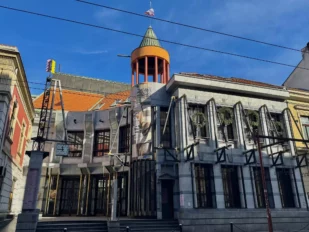
"Atelje 212" is 70 years old, and has one birthday wish
"Atelje 212" invites friends to tomorrow's 70th birthday celebration, and tells the city authorities not to agree to the collapse of culture

Although the film '79 stones' testifies to the gap between the Serbian and Albanian people in Kosovo, it does not talk about 'life', nor 'we don't give away holy things', nor 'see you in Prizren next year', but about basic human rights - says director Rastko Šejić
On Sunday, May 25, the 25th Archaeological Film Festival at the National Museum ended. 19 films from 6 countries were shown, among them "79 stones" directed by Rastko Šejić.

The synopsis says that this documentary film follows professor Dr. Mitra Reljić and poet Živojin Rakočević as they risk everything to conduct modern archaeological research in Gornji Nerodimlje - a Serbian village devastated by ethnic cleansing. In the eerily destroyed Orthodox cemetery, which is the setting of the film, there were Dušan's pine, a protected natural monument, and the church of St. Archangel Gabriel with a bell tower, cultural monuments of exceptional importance.
Recording reality
Director Rastko Šejić tells that "that traditional Serbian village, important for the history of the Nemanjić dynasty, was completely ethnically cleansed immediately after the Kumanovo Peace Agreement, and all the property of the citizens was destroyed, burned, mined, including cultural monuments and the cemetery. A team of scientists did not go to the modern archaeological survey of the area, as one would expect, but only Živojin Rakočević and professor Mitra Reljić."

His idea was to record "the reality of that research process."
"So, it's not about 'lives', nor 'we don't give shrines', nor 'see you in Prizren next year', but about the reality of two top intellectuals risking their lives to sort through the broken monuments. They put together puzzles from the surviving pieces of marble that lie scattered on the moldy ground and take photos, record names, families. They return the pieces to their place facing the ground in order to preserve them. Emperor Dušan's pine was a huge tree of height 25 meters, it was cut down, then burned. The Church of St. Gabriel, built in the 17th century, was first looted, then demolished with explosives. The whole area is covered with various garbage, and the smell is dominated by the abundance of disposable diapers that were thrown there unwillingly."
No politics
In the film, the destruction of villages and cemeteries is mentioned only as a fact - there is no politics in it.

But that's why, says Šejić, "the right to freedom of speech, movement, religion, the right to life, these are all basic rights, which must not be questioned if any society strives for development. And in this way, this poetic short documentary has a relationship with the consequences of policies, through scientific research. Without the intention to name the guilty, to cause bad blood, but to record the truth. There is no more important obligation of an artist."
Šejić says that the filming was "short and guerilla".
"It is an extremely hostile rural environment, where children throw stones at your car because of Serbian license plates. Elderly people spit. In the store, they will try not to sell you cold sour water. Here, throughout the Balkans, hatred is cultivated, watered and littered, fear of otherness serves as a means of control. Personal experiences in the southern province with Albanians are colorful, from unpleasant searches of cars, luggage, document checks under long pipes, to peaceful cafes in the center of Prishtina. It seems that the Albanians, including the intellectual class, feel like absolute winners, that the Serbian issue has been resolved."
The film is about literate and smart people
Rastko Šejić says that he is not afraid that his film will be misused, that it will be used to further deepen the gap between nations.
"Ibar will not go backwards. It is certain that because of the signatures that have been put on the documents that are now being implemented with the support of Belgrade, and especially after the riots in Banjska, nothing that happens in the south arouses any emotions or reactions from the public. And then there is the criminalization of the Serbian political elite and corruption. This film is about the literate and intelligent, who are not welcome in the media space. It is an artistic and scientific film, which requires ethics and morality."

About the Archaeological Film Festival, which, although it has existed for 25 years, is not as prominent as it deserves - so this year it was held at the same time as Beldocs, the documentary film festival, Rastko Šejić says that regardless of everything, "there is no more natural place and institution that could organize it than the National Museum" and says that he "watched several excellent documentaries from all over the world, the production of which, the fact that some of them were filmed for dozens of years, on several continents, speaks of the attitude of those societies towards archaeological cultural heritage."
"I'm afraid that in our country archaeological research is not recognized as important, nor is it funded at that level. Even the unfortunate sentence that archaeologists are the enemies of development has been said. And it's hard to imagine that you can get anywhere, if you don't even know where you started from," believes Rastko Šejić, director of the documentary film "79 Stones".
"Atelje 212" invites friends to tomorrow's 70th birthday celebration, and tells the city authorities not to agree to the collapse of culture

In Belgrade, someone wrote graffiti on the window of the Salon of the City Museum, where the exhibition of the October Salon is held. The perpetrator should have been captured by security cameras

80 films are coming to the 32nd Original Film Festival, many of them with awards from the Cannes festival. It is organized by a citizens' association, without a dinar of state money

Tomorrow "Zvezdara Theater" will celebrate the 400th performance of "The Book of Milutin" by Nenad Jezdić's monodrama. Plays that have been in the repertoire for more than a decade are currently being played in Belgrade. The musical "Some like it hot", even - three

More than 400 artists and cultural workers signed the request of the Initiative for Free Culture, which calls for the dismissal of all the leaders of cultural institutions in Pancevo.

At the moment when the institutions of the Republic are destroyed, when Vučić's octopus is still alive, when people are disgusted by the injustice and the stench left behind by the Essenes regime, we have, as Machiavelli said, only civic virtue as the fuel with which we can return to the beginning

The four independent members of REM are an example of perseverance and civic responsibility. Rodoljub Šabić even, upon leaving the premises of REM, after the sentencing of the Informer, experienced that the Essenes insulted him, hit him with their hands and feet. But that too will soon be over

Vučić pardoned the batterers and Dijana Hrkalović. The election winners should abolish the sultan's power that allows one man to run afoul of the entire judicial system

Time explores: The construction of the St. Sava Temple
Did the money paid by the Government to SPC end up in Moscow through Alta Bank? subscribeThe archive of the weekly Vreme includes all our digital editions, since the very beginning of our work. All issues can be downloaded in PDF format, by purchasing the digital edition, or you can read all available texts from the selected issue.
See all



