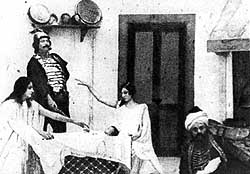
SHOT FROM THE FIRST FEATURE FILM: "Karađorđe", 1911.
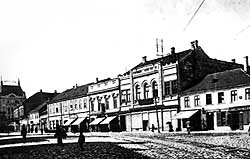
Less than six months after the first public screening of the Lumière brothers' cinematograph in the Indian salon of the Grand Cafe in Paris, on December 28, 1895, in Belgrade, on June 6, 1896, the screening of "photographs brought to life by means of cinematography" began in a hall of the Zlatan krst inn on Terazije. . It was the first film screening in Belgrade, on that day the film entered Serbia and the Balkans, and a new window to the world was opened for our people, a world recorded with moving photographs. Representatives of the "Limiere Brothers" factory from Lyon, André Carre and Jules Girin, stayed in Belgrade for 25 days, showing the oldest films of the Lyon company: Entry the train u the station, Demolition wall, Children's a playgirl, Bathing u moru, Parisian boulevard, Fish market u Marseille and others. The films lasted a few minutes each, and the performances were held "every day from 4 pm. in the afternoon until 9 pm. in the evening, and on Sundays and holidays there are also screenings in the morning". The ticket for adults cost one dinar, and for children 50 dinars. The viewers were delighted with the showing of this "miracle of science", and an unknown journalist from Belgrade's "Mali novina" described the film projection where "... you can see shots of creatures and objects in the most diverse movements; you will see the movements of the child playing; the movements made by a railway train when it goes, and all of that so vividly presented, that you feel as if you are looking at reality, not photographs. The citizens of Belgrade should not miss this opportunity to see this truly greatest success...". His Excellency did not miss the opportunity either. King Aleksandar Obrenović and H.H. Queen Mati Natalija, who on June 16, 1896 "...honored their visit to the cinematographic productions at the 'Golden Cross'..." and royally paid 300 French francs for that pleasure! At the end of June, representatives of "Limier Brothers" traveled to Bucharest with their projector.
Since that first film screening at the Golden Cross, the film has gradually become an integral part of everyday life in Serbia. At first, our people were just spectators, fans cinematographic production which were shown more and more often by traveling and then by permanent cinemas, so that relatively quickly local people also accepted film cameras in the desire to film themselves mobile pictures about their environment and that, finally, they produce and record "cinematic pieces from our national life and national history".
TRAVELING CINEMAS THROUGH SERBIA: Traveling cinemas - the oldest form of showing films in the world and in our country - can be divided into two categories: small companies whose owners themselves also perform the work of cinematographers and show films in rented premises (bars, hotels, warehouse sheds) and large well-equipped companies with their own tents, cars, mechanical organs and electric generators that only toured the larger cities. The owners were mostly foreigners (Germans, Austrians, Czechs, Hungarians), but over time, our people also got involved in these businesses.
From March 6, 1897, Andre Carr again showed films in Belgrade, this time in the tavern near "Hajduk Veljko" at the beginning of Knez Mihailova Street. He showed the standard program "Limijer Brothers", he stayed in Belgrade for 38 days, with the fact that he stayed in Šabac for a few days. Kar's stay in Belgrade is particularly significant because he recorded and showed several films on that occasion of Belgrade slika (which will be discussed later). After him, more and more often, traveling performers stayed in our region. Already in the last years of the 1900th and during the first decade of the 1904th century, in addition to Belgrade, almost all our cities had the opportunity to see the magic of moving pictures - Šabac, Jagodina, Niš, Zaječar, Kragujevac, Valjevo, Požarevac, etc. Along with the oldest documentary films, "cinematic theater pieces" - short comedies, chase films, "historical pictures" and dramas - are becoming increasingly popular. The first local man with a projector was Stojan Nanić from Zaječar (son of Nanet the baker), who was a traveling entertainer from his early youth, "the first Serbian magician-magician", and from 1911 he showed films in his First Serbian Cinema. The first large traveling cinema that set up its tent on Mali Kelemegdan in July 1905 was the Elektro-bioscope theater of the brothers Karel and Aleksandar Lifko (Aleksandar settled in Subotica in 1908, where he opened a permanent cinema). From 1908 to XNUMX, the German Georg Narten's "Narten Cinema" was a regular guest in Belgrade, showing films in his own tent, as well as in the "Slavija" and "Paris" hotels. Our man Todor Najdanović from Negotin was the owner of a traveling menagerie, with which he showed films in Serbian cities (Negotin, Zaječar, Požarevac) from XNUMX, and with his own tent he also toured in Belgrade. The film very quickly became the most popular form of entertainment for a wide range of viewers - and this led to the opening of permanent cinemas both in the world and in our country.
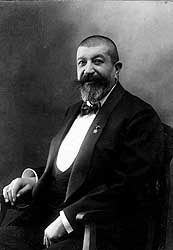
Đoka Bogdanović, owner of the "Kasina" cinema and film producer
FIRST PERMANENT CINEMAS: The owners of hotels and taverns who rented their premises to traveling exhibitors realized that this activity was profitable, and they began to open permanent cinemas. The first was Svetozar Botorić, the owner of the Belgrade Hotel "Paris" on Terazije, who opened the "Cinematic Theater in the Hotel Pariz" at the end of 1908. Botorić's example was followed by many others - the owner of the Casino Đoka Bogdanović, the owners of the Belgrade inn "Kolarac", the Cvetković brothers, Evgenije Rajhl, the owner of the Russian Tsar in Niš, etc. At the same time, at the end of the first and the beginning of the second decade of the 1910th century, cinemas were opened outside the pub premises: the Belgrade journalists and publishers Savić brothers opened their Modern Cinema in 1911 in a purpose-built wooden building at the beginning of Kolarceva Street; In 90, Mihailo Šonda, a Belgrade industrialist, built a brick building for his Colosseum cinema (today's Zvezda - it has not changed its purpose for over 30 years). On the eve of the First World War, there were about XNUMX permanent cinemas in the Kingdom of Serbia.
FIRST MOVIES RECORDED U SERBIA: During his second stay in Belgrade at the beginning of 1897, the representative of the Limier brothers, Andre Carr, shot five films, according to information from the press: Kalemegdanska a walk, Tram station na Terazima, Going out workers iz Factories tobacco, Povratak King's iz Sofije i Ceremonies 22. February. We are still looking for those first shots taken in Serbia, although they are most likely finally lost. Later, various foreign videographers or owners of traveling cinemas recorded more documentary reportages, which we now know about based on the writings of the then press or foreign film catalogs (The wedding King Aleksandra Obrenović i Expensive Machine City of Kyiv, Ukraine, Serbia, 1903 and several others). For us, the most significant - because it has been preserved and represents a valuable historical document - is the film Coronation King Petra I Karađorđević, a documentary of more than 50 minutes that was recorded in September 1904 by Arnold Muir Wilson (Arnold Muir Wilson), honorary consul of the Kingdom of Serbia in Sheffield (England), and his cameraman Frank Mottershaw (Frank Mottershaw). This important document, known and appreciated in the world history of film, was restored by the Yugoslav Cinematheque and a new copy will be shown on the occasion of the centenary of that event. Traveling cinemas often filmed the so-called local films which they would show in the cities where they stayed, primarily to attract viewers. In this regard, Narten's cinema stood out in Belgrade, which filmed and showed many domestic interesting things, e.g. Terasius, Such iz Belgrade, Funeral general Brand Katanić, Such of Belgrade factory, then the "Ben Akiba" cinema, which he recorded and showed in 1908 Korzo u Belgrade, Shift courtly guards, A big one market, Exercises army etc. After 1908, foreign newsreels showing events in Serbia appeared in Serbian cinemas: Review Serbian army na Banjic field, Serbian the capital, Danube i iron the door, Kraljeva visit Russia, Visit King Petra Turkey, King Petar u Rome. A small part of these foreign film newsreels has been preserved, while other films are constantly and persistently searched for in the world's film archives. Certainly, films about us, our regions and events attracted especially domestic viewers and they are pictures were the most interesting part of the program. Therefore, it is quite understandable that the owners of our cinemas also came up with the idea to approach the recording of local film newsreels themselves, so some of them, interested in the great possibilities of film, became our first film producers.
Teraije with the "Golden Cross" inn at the time of the first film screening in Belgrade (a building with three arched windows)
PIONEERS SERBIAN CINEMATOGRAPHIES: Svetozar Botorić, the owner of the "Paris" cinema, was the first to do it. He hired the French cinematographer Louis de Beéry, who from 1911 to 1913 shot about 20 documentary reports for Botorić, among other things Formal teaching old i reception new zastava, Departure King, Crown Prince i Princesses Present u Petrograd, Trke na Spas, Flight aviator Giovanni Vidmer na Spas, then a large number of films from the Balkan Wars. The first Serbian cinematographer, Slavko Jovanović, who shot some of Botorić's films, but also worked for other film producers, also learned the trade with Louis de Berri. Until two months ago, Botorić's films were considered lost. However, a large part of his film legacy has been found in the Austrian Film Archive (which shows that one should never lose hope).
The owners of the Modern Cinema, the Savić brothers, Botorić's competitors, hired the young Austrian Karl Freund in 1911 (Karl Freund, later a famous German-American cinematographer and winner of the Oscar for the camera in 1937). He organized a film laboratory for them and shot several documentaries: Sa of Belgrade promenade, Iz Jewish male i sa Dorcol, Welcome Croatian students u Belgrade, Easter racing na Spas and others. No films produced by the Savić brothers have been found yet.
In 1913, the owner of the Kasina cinema, Đoka Bogdanović, hired the Russian cinematographer Samson Chernov, who shot a large number of reports from the Second Balkan War and several other films for him: Detection monument Karadjordje na Kalemegdan, Funeral Russian the deputy Hartwig and others. The largest part of Đoka Bogdanović's material has been preserved and until recently represented the only complete collection of Serbian films made before the First World War.
The Cvetković brothers, owners of the "Kolarac" cinema, appear in 1913 as the fourth Belgrade film producers. Slavko Jovanović probably filmed for them and they showed their own films in their cinema: Festive welcome Serbian victorious army sa Serbian-Bulgarian battlefields (1913) Vrbica u Belgrade, Festive arrival i oath recruit iz Nine Of Serbia u Lower graduated (1914). These films have not been found yet.
FIRST SERBIAN MOVIES: So far we know for sure that three feature films were shot in Serbia at that time. He was the first Karadjordje or Life i share immortal leader Karađorđe, filmed in 1911, which until two months ago was thought to be lost, has, however, been found in the Austrian Film Archive. This film was produced by Svetozar Botorić, directed by Ilija Stanojević - Uncle Ilija, and filmed by Louis de Berry. The most famous Serbian actors play in the film, and the character of Karađorđ is played by the champion of the National Theater Milorad Petrović. The film is in a very bad condition, and the copy is about to be restored, and only after that will this one First Serbian played film to be able to analyze it in more detail and to evaluate its values. But, based on the short parts, in fact a few shots that were recently shown publicly (in the Yugoslav Cinematheque and on television), we can conclude that it is an artistic achievement that, in terms of style and photographic values, does not lag behind the best foreign historical films of the time. Parts of Botorić's second feature film from 1911 were also found - Ulrich Celje i Vladislav Hunyadi - about which we didn't know anything until now except that it is "...a historical drama from the 15th century, performed by the members of Kralj. Srp. of the National Theater...", so there is still a new discovery to come.
Botorić's competitor Boža Savić, co-owner and manager of the Modern Cinema, produced the third Serbian feature film of that time in 1912, a melodrama Poor maypole in which the main role was played by the actress of the National Theater Emilija Popović. The film was shot by Karl Freund, while the other authors are unknown (one of them is probably Boža Savić himself). This movie has not been found yet.
How, then, were the foundations of cinematography in Serbia laid, on which everything that happened later, including the successes of contemporary Serbian cinema, is built upon? The development path until 1914 is clear: it started in Zlatni krst - the penetration of film continued through traveling and permanent cinemas - foreigners were the first to take and show us moving photographs of us - this interested local people and the first pioneers of domestic film in Serbia appeared : producers, videographers, directors, actors - and all of that was abruptly cut short by the First World War...