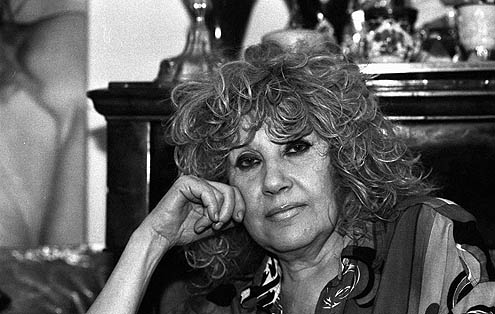
Olja Ivanjicki was a participant in the most stormy years of our painting, and she left a significant mark in that time. It was a time of ideology in art, but also a time in which the hoops began to loosen under the pressure of the boiling of a different feeling of the world. This painter also contributed to that fragility in two important moments. The first is the gathering of artists in the Mediala group, a group with a clear determination for an integral, whole person and for the unity of opposites in ideas and in art. We have been convinced that these ideas have not been properly understood and interpreted even these days, listening to the phrases, foolishness and stupidity of various interpreters of Olja's work.
A reflection of a medial idea, or better to say an aspiration, because working on a medial image as a basic goal implies the work of generations, an endless journey, a form of continuous ritual purification (about which Sheik wrote in detail and clearly in his Treatise on painting, Miro Glavurtić and Siniša Vuković in their Mediale manifestos), so Olja showed a reflection of that aspiration in her paintings from that era, and I would especially single out the painting Teuta. Like her fellow pilots, as the suprematist Malevich would say, she was not looking for artistic expression as such, but through painting she was looking for a way to express the existential problems of the modern world, abandoning all hope that that way would be clearly revealed.

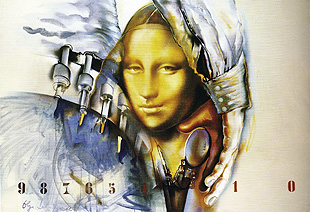
Mona Lisa and the Man with a Gun, 1975.
Olja's other important contribution to our contemporary art was in the sixties, after her stay in New York. At that time, a movement was emerging in our country new figuration, which, in contrast to Mediala, but under its recognizable influence and reflex, had no special program, but a clearly differentiated, ironic attitude towards the modern world, consumer society and the idea of progress. Both Mediala and new figuration were essentially looking for the same solutions when it comes to one-dimensional man, alienated society and the entropy of technology. Mediala wanted to reunite and collect the extremes in man, to restore the lost balance, and the new figuration to scream about the consequences of the abandoned harmony and the creation of the world in the Heideggerian sense, and therefore the enslavement of man with the inventions of his materialized work, which turns into a garbage dump , on whose throne sit the creators of the garbage dump of contemporary art.
Thanks to the Italian Enrico Crispolti, an exhibition of new figuration, at which our painters also exhibited, attracted the attention of the world public at the beginning of the seventies as a return of confidence in the "brave new world", a world that had an ear for the modern, but in whose creation she was and apprehension of what the modern can bring to humanity. Those painters (Šejka, Olja, Miljuš, Reljić, Otašević, Kalajić, to mention a few names) warned of the "rise of insignificance". Unfortunately, that warning was drowned out by the noise and panic of the times. Because, as Olja Ivanjicki wrote in her Diary 1956-1957, "the possibility of finding a new Path does not exist; instead of the Road, we are looking for a garbage dump, discarded and abandoned". These words were in fact a grim legacy of the sixties artist. And it was fulfilled.
Olya's happenings from the sixties, collecting discarded objects, declaring discarded and worthless things as works of art, playing with dolls as the artist's doubles, rituals of burning doubles as an expression of self-forgetfulness, all this contributed to mocking life as an alienated form of the new Great Game of modern art. This is what we should think about when we talk about Olja Ivanjicki, and not about some kind of false glamour, fashion, or the supposed renaissance of the modern world. The inability to interpret today is a reflection of the decline of knowledge, invention and imagination.
With her accomplices and interlocutors, Olja Ivanjicki dealt with the problems of the future, but that very future took many of them under its wing and crushed them with its leviathan jaws, without leaving a single trace of rapture. The future nonchalantly licked those traces without blinking, and art once again opened the door to a new ideology.
That is why we fear that the time to come will exclude any thought of humanity in art, of sincerity, that forgotten fact of every significant work of art. Oblivion is the bleak perspective of human aspirations that take place on the edge, with the certainty that only the edge will endure. The rest will be lost in the abyss of Malstrom, in transience, without that hope that has already turned into sarcasm. I hope Olja Ivanjicki understood that.
"In those ancient times, Miro Glavurtić, Leonid Šejka, Siniša Vuković and Olja Ivanjicki founded Mediala. I did not participate in that. I'm a bit younger than them, but of course I knew what they did, and I saw them as exceptional people. I remember that, for example, Sheika's picture of me Museum exhibition fascinated. And then there was an exhibition at the Academy where one of my paintings was exhibited. From somewhere, Olja appeared at the exhibition, and to my surprise asked: 'Who is Ljuba Popović here?' I didn't know why she was looking for me, and then she said that Sheika wanted to meet me. Sheika then stood in front of my picture and told me: 'You are one of ours.' With that, I also got a kind of ticket to Mediala.
Olja, along with Ingrid Lotarijus, was the most beautiful woman in Belgrade at the time. She was so beautiful that a man simply couldn't even look her in the eyes. As a person she possessed some magic, some feline secret, and she had beauty and a strange, soothing voice.
Everyone then had painters they adored. Miro Glavurtić adored Dali, Sheik Vermeer, Siniša Vuković was obsessed with Đorđe de Kirik, and Olj - Leonardo da Vinci.
While Šejka was alive, within the framework of Mediala and in the euphoria of that time, a very original painting was created, a painting that was born here, in our area, and which, unlike Enformal, which represented another parallel current of our art scene at the time, was not imported from the side. Mediala had a strange light, and many intellectuals of the time supported this painting.
After Sheika's death we all split up and went our separate ways. Only Olja remained, as the only time holder of Mediala. What she later did was a different kind of painting that had little to do with Medial and only partially contained an undertone of medial currents. But although her painting went in a different direction, Olja Ivanjicki remained in the spirit of Mediala for the rest of her life."
RV