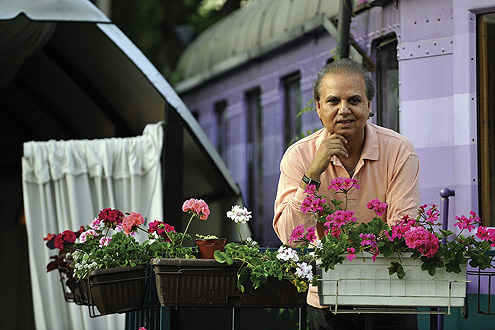
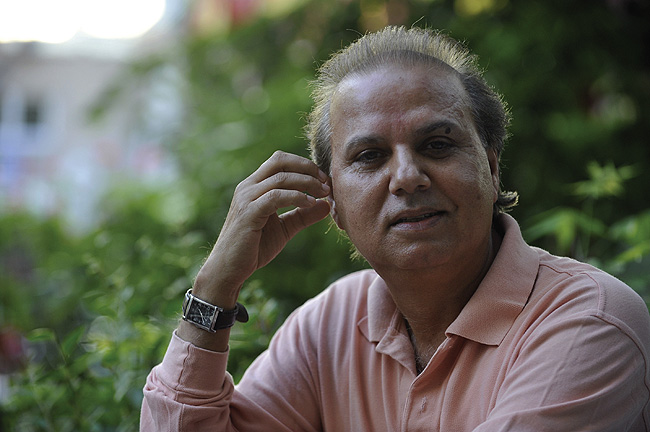
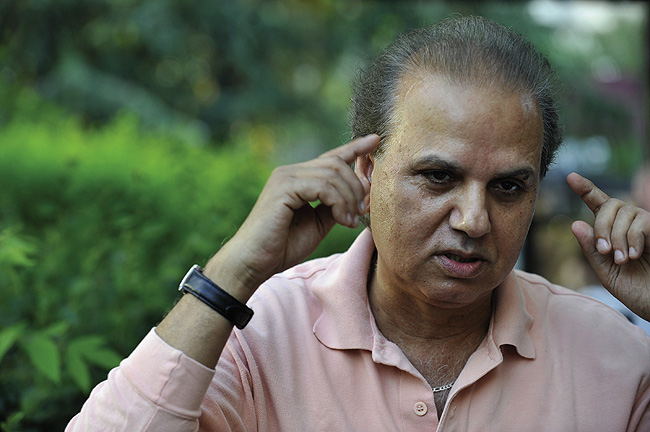
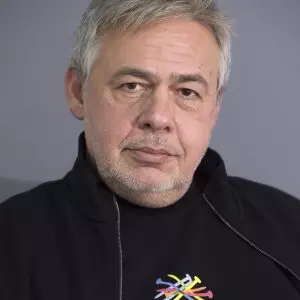
After 35 years of absence, Muharem Serbezovski, singer, composer, writer, translator, politician and master of law, is returning to Belgrade, where he will hold a concert on May 27, in the "Sava" center. It would be expected that the audience here has forgotten him a little in the meantime, however, it turns out that it is not at all easy to start an interview with him, because a group of teenagers at a table in a cafe on Banovo brdo persistently tries to get his attention by singing My son. With a big smile, he approaches and takes a picture with them, and even sings a part of the song. "I was at Pink yesterday, so now they know it's me," he tries to be modest: "I came to Belgrade at the beginning of May and I'm not leaving until the concert." My plan is to remind people of me. Today five people recognize me on the street, tomorrow fifteen..."
Muharem Serbezovski is a fascinating phenomenon in many ways. He was born in 1950 in the largest gypsy settlement in the Balkans, Šuto Orizari in Skopje, in a family of eleven. He started singing at the age of 14, when he had to start earning money due to poverty. Since then, he has released about fifty albums and written about 400 songs, some of which are among the greatest hits of folk music, such as Branch, Branch, my friend, Why did your hair turn white mate, My son, At the wedding table... A lot of people believe that many of his songs are Romani folk songs. They are mostly surprised when they hear that these songs have an author, and especially when they find out that he is still alive and well. Apart from music, he also deals with literature and translation. He is the author of five novels – Colorful diamonds, Category A gypsies, War of the Gypsy Gods i Gypsies in the National Liberation War u, collections of poems No one knows the ways of the winds and the gypsies and studies Gypsies and human rights, which was translated into seven languages and included in the collection of 128 university libraries. He translated the Koran and the Bible, as well as novels, into the Romani language Crime and Punishment Fyodor Mikhailovich Dostoyevsky, War and peace Leo Tolstoy and One hundred years of solitude Gabriel Garcia Marquez.
We start the conversation with a story about the return concert in Belgrade: "I'm going back to where I started. I lived in Belgrade from 1969 to 1975. I'm glad that my songs that are the most popular in Serbia are the ones I wrote in Belgrade. That's probably why they stayed in Belgrade. It doesn't matter how many years have passed. Every man goes his own way, he is carried by storms, especially us Gypsies. No one knows the ways of the winds and the gypsies, that's the name of one of my poetry collections. I traveled all over the world and here I am again in Belgrade. What pulled me back? I was sitting in Sarajevo when a married couple from Belgrade contacted me and got to know each other thanks to my songs. Over the years, they came to the verge of divorce. They told me how they were sitting, each in their own room, browsing the Internet and both found my song that says: 'I don't believe, no, that everything is over, and you believe, that's why our love dies, don't you think, love, to forget everything, are you going to trample on our love so easily'? And so, they went to each other's house, met in the hallway and decided not to divorce. He will come to the concert with the children."
"WEATHER": Although you were not in Serbia for a long time, your songs live on thanks to some other artists. How do you view other people's interpretations of your hits??
MUHAREM SERBEZOVSKI: Many singers have sung my songs. I have heard different comments, from my friends and others. They asked me why I don't draw their attention to how they should sing. I always tell them that they need to look at things a little more broadly. Those who sing my songs, help me, my cult remains there. Let them sing my song 300 times, at some point the audience will know that I sing it. I sang in a bar in Frankfurt and a company from Serbia asked me to sing for them Was I like this? by Ace Lucas. I tell them: "Well, I happen to know that song!" I sing to them, they say: you sing better! Well, my song, how can I not sing.
From those who perform your songs, Who do you admire the most??
I appreciate all my colleagues, but of all our singers who have ever sung, my favorite is the late Toma Zdravković. He and I performed together for seven or eight years. We created songs together. When I wrote something new, he heard it first. Even today, when I hear his song, I feel the warmth of everything that came out of his soul.
As for those who sing my songs, I have to say: I am grateful to all of them because they saved what I wrote at a time when I was passive and did not want to do music. But I am most grateful to Sinan Sakić. He and my son Durmish are responsible for me singing again, because they told me that I am not ready to retire yet. That's why I recorded a duet with him last year Last applause. It's a terribly emotional duet. Sinan is an emotion, a soul. What happens with the emotions between him and the audience, none of us have. Why? He is in his movie, closes his eyes and nothing happens around him except the song. Phenomenon.
What does that feel like?, for you as the author, when your songs become so popular that people don't even know they're yours anymore?
These days I walk around Belgrade, I meet some young people who are surprised when they hear that I wrote some songs that they think are folk songs. I'm glad when I hear that, that someone is surprised that a song is mine. I always think: that's it. I was a guest at Lee Kish's on Pink yesterday. I was a little late, but when I entered the studio and sang, the crowd was asking for an encore. They tell me that never happened on that show. But when I see that they know by heart Branch, Branch, my friend or Anyone, anyone's, and you know, it shakes me sometimes.
There's always a story behind your greatest hits. At the wedding table, Branch, Branch, Ramajana, they all have characters who are actors in some drama. Are there any events behind the creation of those songs??
My lyrics are always true and talk about real events. People tend to add touches to it, and when I sing, I listen to how they receive it. Three or four big hits showed me the right path, and my path is similar to Nušić's: I had to wait two years for my song to make a circuit through Yugoslavia, while everyone heard it, so that it became a hit, and later an evergreen. I am at an advantage, when I see a young boy or girl singing my songs, I am surprised, and they tell me that their parents recommended them to listen to it. There must always be harmony, as Plato says. Harmony in the state creates harmony. Interpretation is a display of character. People read my character through interpretation, and when they see that I wrote both the lyrics and the melody, and see my imagination, then success is certain.
Every song of mine is an event. I hear a story somewhere, something happens to me or a friend, or I make up an event. Let's say, when we talk about the song At the wedding table, I made a story about two people who loved each other, then broke up, she gets married again, and he says to her: you were my first love, here, I will be your witness at the wedding... That's how people in they feel when something like that happens. If it weren't so, if there wasn't a lot of truth in that song, it would have been forgotten.
They say that in your music, more than any other Roma performer from this area, India is listening.
I am trying to find some connection between us Gypsies and India. I was in India, I was a guest of Indira Gandhi with about thirty other people from Yugoslavia at the Second International Roma Festival in 1978. Her son Rajiv gave me the same suit as his and we stopped to take pictures. Indira stood between Rajiv and me and people wondered who was Gandhi and who was Muharrem. At the time I was writing a novel that should have been called Gypsies in the National Liberation War u, and it should have dealt with whether we come from India. After about fifteen days, everyone returned home, and I stayed at the invitation of Indira Gandhi, because I became popular after singing Ramayana, my song, in Indian language. I asked Indira if we were from India. She just smiled, but I read in that smile that I should look for connections between our two peoples. On the streets of Delhi, I saw a huge advertisement, 12 meters, on which was written in huge letters in English "Massage Factory", and behind that huge banner an old man, Hindu, on a small board, an improvised massage table, was massaging people. It was clear to me immediately, I found a connection with us, Gypsies. We are grandmasters, and with us it can be written "Massage Factory" and there is only one sign behind it.
However, there are also big differences between us and them. I am watching these Indian serials. Completely opposite to us, Indians, when they meet for something, first look at each other for a bit, talk, slowly, intently. And with us, let's work our temper, let's get down to business, what do you need. The fact is that our physiognomy is similar, but our temperament changed as we moved, because we stayed everywhere for a hundred years. We Gypsies are only a millimeter away from happiness and crying. I have a song that says: "The gypsy soul will sing and dance and weep bitterly." For us, joy is a reason to cry.
It's interesting when my intellectual friends catch me telling me how they heard a beautiful gypsy song and ask me to translate the words for them. Then I tell them: I'd better not translate for you. In those texts, the words are not important, they are just arranged to go with the melody, they often do not make any sense, cases, masculine, feminine and neuter are not respected. The words don't convey the emotion here, the emotion lies in the melody, and that's why it's better to just listen to the music.
What are you listening to??
When I'm alone in the car, I listen to what I like, and when I'm driving someone else, I'm both a chauffeur and a DJ. I'm not an ordinary listener, it's not enough for me to like a song. I hear better than others and I am very demanding. In order for me to like something, it has to be flawless, clean and not only technically sound, but it has to have a soul. When Placido Domingo sings Granada, he sings flawlessly, but his interpretation is not perfect just because of that, but because of what he personally brings to the interpretation. That's why I also sang recently, when I was a guest in Bijeljina on a television Granada, because I wanted people to hear how it sounds when a gypsy sings it. There must be some connection between Spain and the Gypsies.
When did you start writing??
I found a hole in world literature. For example, Pearl Buck, as well as others, write about Gypsies in a very limited way, just for the sake of color. That's how I came up with the idea: when Pearl Buck became famous by writing about other people's people, she's an American and writes about the Chinese, why wouldn't I write about my own people? This is where authenticity is concerned. It doesn't necessarily mean that I will be a great writer, but I will be authentic and that is my priority. Now my seventh novel is out, War of the Gypsy Saints, it is satire. My first novel was recently translated into Swedish, which I'm very happy about, because I secretly hope I could win the Nobel Prize for literature.
You also do translation work.. You translated the Quran., The Old Testament, War and peace, Crime and punishment, One hundred years of solitude, and you are nearing the end of the translation of the New Testament.
In a way, I am the gypsy Dositej Obradović. I sing in this language of ours so that my Gypsies can learn it, and I translate it into Gypsy. My translation work is the reason why I abstained from music for ten years. Once I started, I never stopped. Why? Well, I'll tell you something, and you connect. One evening, in '72. year, I played simulcast with Karpov. Sarajevo actors picked me up from the street, ran into me and said: come with us. He went through all the boards and saw that only on mine were the pieces not lined up. I say: I have never played chess, we Gypsies do not play chess, who will make us sit in one place for two hours? He only drew with me because he was playing for himself and for me, and he gave me his book. That's why I sat for ten years, to prove that a gypsy can sit for more than two hours. What I am doing is not typical for us, but I want to take us at least a few steps above where we are now. I want to be an example. I left school at the age of 14 and started singing, and here I am, graduating with a master's degree in law. I have now also enrolled in doctoral studies. If only five gypsies look up to me, I will be overjoyed.
When I was recording my first album in Skopje in 1968, my father asked me what language I sang in. I say: in gypsy. He says: that's too local for you, only gypsies will understand you. I ask him if I should sing in Macedonian, and he says, that's a bit wider for you, but it's also local to you, sing so that the whole world understands you, and your gypsies will love you by inertia. Sing in the language in which the whole of Yugoslavia will understand you.
And what is the name of that language??
(laughs) I speak many languages, and Serbo-Croatian is foreign to me, Gypsy is my mother tongue, and then Macedonian. Well, if I used to speak seven languages, now I speak twelve. I left school early, even though I was an excellent student, because there were eleven of us in the house, and only my father worked. He just told me one day: you, Muharram, have to leave school, but please, keep reading. At that time I only knew Gypsy and Macedonian. I didn't know Serbian at all. When I came to Belgrade for the first time, I slept in the "Slavija" hotel, in the morning I went to the "Kultura" bookstore and, grandiosely, chose the thickest book I saw, How steel was tempered from Ostrovsky. And that is, in fact: how Muharrem was celebrated. I read one page for three months, I didn't understand anything. I'm talking now about effort. I eventually learned. At that time, I performed with Tozovac, Dragoslav Genčić, Ismet Krcić, the late Tom Zdravković, Silvana, Radojko and Tinet Živković... And so, they talk among themselves, and my father said to me: when you are in a big company, keep quiet, don't talk until learn the language, so they don't laugh at you. Once I said something and saw that they were laughing at me. I was explaining to them how I was at school. "I had A's, so the teacher said: 'I wish all my children were like him.'" When I said "him", they laughed, and then they constantly teased me about it. For the next six months, they tell me: come on, kid, talk, and I just laugh. However, Tozovac and Tom start arguing about "second puberty", but they can't remember what it's called. I call out to them: "Climacterium", and they shout: "The little one has spoken!"
How do you choose what to translate??
We Gypsies have both Muslims and Christians, and we have neither the Koran nor the Bible in our language. My goal is for all Gypsies to have a translation of God's word, to see that there are no big differences. Gypsies are believers, although first of all they are Gypsies, and only then Muslim Gypsies, Orthodox Gypsies, Catholic Gypsies. But those are things that don't matter between us. When a gypsy meets a gypsy, they don't ask what their religion is. For example, I started translating Marques because what he writes reminds me of gypsies. Melquiades from One hundred years of solitude is a gypsy. Well, those circuses, the way they walk around the towns and how thanks to them people experience both splendor and misery more strongly, that's what attracts me to Marques. My library is huge. I had 7800 books in Skopje, in the settlement of Shoto Riza, where 60.000 Gypsies live.
Arsen Dedić and Rade Šerbedžija visited me there once, and when they saw so many books, Arsen says: "I always said, judging by his poems, Muharem is something else - now I understand why."
If you decided on Marquez and One Hundred Years of Solitude because of Melquiades, why War and Peace? What would the official history of warfare look like if it was written by Gypsies who participated in those wars?
I have a desire to say something to Europe and the world. When you look at encyclopedias and history books about Gypsies, it's a pure disaster how they've been treated over the centuries. When you take a map of Europe and look at it, there is always one path on which the story goes that says that Gypsies are weeds, that they cannot be re-educated, that they should be freed, their way of life should be destroyed. And now I will say something that may sound unusual: I used to be a fierce opponent of all those who renounced their gypsy origin for some reason. People do this for various reasons, to finish university, to get a job... Today I welcome it. They took huge steps to progress personally, and when they renounced their origins, they actually renounced prejudices, that image of them that was imposed on them. We Gypsies are not fighting for a country, only for a place under the sun. The state is an obligation, bureaucracy, counters.
At one point, in 2007, You also entered politics.. You were a member of the parliament of the Federation of BiH as a deputy of the Party for BiH. They said that you entered politics to help your people, and not to be a professional politician. However, it was seen that you lack political experience, so it seems to me that you are not understood in the right way.
Unfortunately, it is. But both music and literature are something through which I give to others. An MP's salary is something I earn with one performance, I wasn't in it for the money. It can be said that I made some order in those four years. I had one of 300 families that received help, and I always told the ministers that they never hand out money. We will pay for firewood, electricity, water, but never cash. Once we went to a Roma family near Tuzla, their house had been demolished. We secured money, two engineers, everything needed. The media also came to record the start of construction. The journalists leave, the host calls me aside, says: "I'm not satisfied, my children." As it is not, he will get the house... He says: "I thought, you will give me one hundred miles (one thousand)."
When I was in the parliament, I kept saying that it is better to help the Gypsies now than to wait for someone from the outside to force us to do it. And what happened? The Sejdić-Finci case happened before the European Court of Human Rights in Strasbourg, where a Jew and a Gypsy sued their country, Bosnia and Herzegovina, and won. For me, that case served as an inspiration for the novel. It is very unusual for a gypsy to sue the state. We don't even sue each other, what kind of court, that's the procedure. So, a gypsy doesn't even sue his neighbor, but imagine the whole country! The night when I saw the news about the verdict on television, there were representatives of all three constituent nations on the screen, Bosniak, Serb, Croat. And everyone stood up and extended their hand to him, congratulated him. I interpreted that as if they told him: well done for suing the state. It inspired me to write a novel about a gypsy who sues the state and gets rewarded for it. In the past, there were no gypsies to sue another person, let alone the whole country.