From the legatee of Josip Slavenski
The organizers of the commemoration of the 50th anniversary of the death of composer Josip Slavenski were at a loss as to what to write on the memorial plaque placed on the occasion at the building at Svetosavska 33, where Slavenski lived. Is Josip Slavenski a "Croatian" or "Serbian" composer? Both definitions are and are not correct: Slavenski was born on May 11, 1896 in Čakovec, but in 1924 he moved to Belgrade, never to return to Croatia; he composed his best works in Belgrade, but they would probably not be what they are if Croatia was not in them; he was born with the surname Stolcer, but in accordance with his views he changed it to Slavenski in 1930.
After the discussion, the third, the only correct and appropriate designation was chosen: "great composer, Josip Slavenski".
His biographers add many more to this basic definition. Ana Karlović states that he was "endowed with an exceptional sense of hearing with which he reached the deepest, already extinct layers of folklore, a passionate mountaineer and a curious astronomer", a composer who "didn't need a piano because he heard everything inside him, a creator whose works aroused attention Bartok, Richard Strauss and Schoenberg, as well as world conductors, musical interpreter of Kant-Laplace's theory on the origin of the universe, creator of experimental works, dedicated pedagogue". Pavle Stefanović assessed Slavenski's music as "premature and late", explaining that Slavenski was among the first in Europe to "introduce the principle of bitonality and polytonality" and pointed out that the consequence of that principle is "a significant distortion of beauty in the classical and traditionalist meaning of that very artificial and abstract term". . Sanja Grujić describes Slavenski's music as "folkloric expressionism". Ana Kotevska, director of the Legate of Josip Slavenski, says that Nikola Herzigonja described him as a man "with his feet deep in the ground because of folklore, and his head in the sky because of the stars."
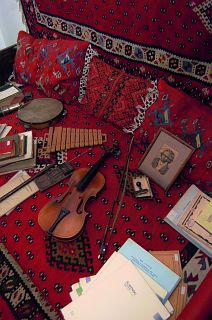
Today, the Legate of Josip Slavenski houses his study, library and correspondence - 1099 letters in eleven languages. "The sheet music is at the Faculty of Music, we will try to make it available on CD." We should soon publish the biography that Milana Slavenski wrote about her husband. The publication of his collected works, which were published by the Association of Composers of Serbia and the Croatian Composers' Association for more than ten years, was discontinued at the beginning of the nineties," says Ana Kotevska, director of Legat. The "Josip Stolcer Slavenski" music festival has been held in Čakovec since 1974. Ana Kotevska believes that, in the light of our carelessness towards values, it can be said that Slavenski has not been neglected even in Serbia: "Musicians and orchestras have it in their repertoire, foreign artists are also interested, this year two of his works were performed at Bemus, and the International the gathering organized on the occasion of the fiftieth anniversary of his death began and will end with a concert. I highlight the final concert of the students of the Josip Slavenski Music School. It is clear why he is important."
DUH MUSIC: The birth of the famous composer, however, was destined to make him a baker. It was understood that the eldest child and only son of Josip Štolcer, a baker from Čakovec and a zither maker in his spare time, would follow in his father's footsteps. Josip fulfilled the expectation, but along with his craft, he also inherited his father's gift for music. His father taught him sheet music in his early years, and his mother Julija passed on his love for Međimurje and old Croatian songs and tried to get him as many textbooks as possible. "I have always tried to improve myself according to my good mother's wish, and to be a musician according to my father," Slavenski wrote a few days before his death. The end of elementary school was greeted by a bakery oven and sheet music. "While the dough is soaking, you go outside and look at the stars, and then an indescribable curiosity for everything that was happening arose in me, with the eternal question: why?" It awakened in me the spirit of knowing the truth, the understanding of natural signs, in short, a great love for art and science."
At that time, he could not realize it, because the management of the Varaždin high school did not like Stolcer's public demonstration against the payment of compulsory school fees. Instead of a high school student, he became a journeyman baker in his cousin's bakery in Varaždin. However, it turned out to be a good choice. He was noticed by the local composer and pedagogue Antun Štur and gave him his first professional education. He helped him enroll in the Music School of the Croatian Music Institute, but Stolcer's works were negatively evaluated and his request for a scholarship was rejected because he was not born in Varaždin. However, it can be said that this was also a fortunate circumstance, because with the financial help of several wealthy residents of Varaždin, Štolcer enrolled at the Conservatory in Budapest in 1913. He supported himself by working in the bakery and by the generosity of his Varaždin patrons.
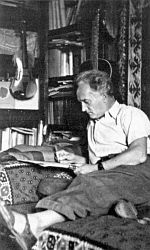
Josip Slavenski (1896-1955)
BALKANOPHONY: In Budapest, he met the composers Bela Bartók and Zoltan Kodalj. For transcribing their notes of folk music from the field, he receives a modest financial compensation and great experience. "It is very likely that this direct and practical contact with folk music texts deepened Štolcer's natural inclination towards this idiom and significantly influenced the beginnings of his compositional maturation", wrote Eva Sedak, the biographer of Josip Slavenski. The beginning of the First World War interrupted his studies in Budapest, and the end brought him back to Čakovec, that is, among his friends in Varaždin. In December 1918, with a delegation from Međimurje, he tried to unite that region with the Kingdom of Serbs, Croats and Slovenes in Belgrade. Then he added a new name to the surname Stolcer - Slavic, explaining that it corresponds to the Slavic character of his music. (Officially, he became only Slavenski in 1930, and five years later he converted from the Roman Catholic faith to the Orthodox faith.) At that time, he had already written a piano suite Sa Balkans, Balkan a song za glass i piano, Water beast iz stone, a demanding choral work, one of his masterpieces.
first success nocturnal for the orchestra performed by the Zagreb Philharmonic, brought him financial aid and the fulfillment of his great wish: studying at the Conservatory in Prague. With that diploma, after three years of schooling, he became a teacher of theoretical subjects at the junior and senior high school of the Royal Academy of Music in Zagreb. It begins in "1924. year, the year of the discovery of Josip Slavenski", as the famous musicologist A. Einstein wrote on the occasion of the success The first stringed instrument quartet at the Days of Chamber Music in Donauschingen, Slavenski's most fruitful year. Then, it's true, he also got fired, suddenly moved to Belgrade and got a job at the Music School (today "Mokranjac"). In the words of the composer's wife Milana, "the music world in Zagreb, those who follow music, who came from higher social classes and were brought up on classical music (and not only in music), looked down on Međimurje plebeianism scowling at incoherent which strikes with dissonance both musically and verbally, while in Belgrade everything was built from the beginning, unencumbered by conservative, unfettered roots, difficult to remove".
The new élan results in many compositions and a sudden departure to Paris. There, one of the most respected publishing houses in the world, "Shot", whose leaders are delighted with him First with strings quartet, buys the copyright for 10.000 francs. The period of success continues with the performance of the choirs "Prayer with good eyes" and "Ftyček veli" at the festival in Donauschingen in 1926 - the audience asked for them for an encore. He marries Milana Ilić, according to Eva Sedak "a free-spirited, excellently educated and independent girl for whom marrying a baker from Međimurje at that time was an act of civil courage as much as of human affection". He dedicates piano suites to Milan Songs i games sa Balkans which grow into Balkanophony.
Orchestra suite Balkanofonia and cantata Religiophony, later named A symphony Orient, are considered Josip Slavenski's greatest compositions. Right after the Belgrade premiere Balkanophonie In 1928, his publisher Schott made sure that the score reached the great conductor Erich Kleiber. He performed it in Berlin, at the matinee and at the evening concert - both times with extraordinary success. In the next ten years Balkanofonia was performed 83 times, all over the world. Religiophony was heard for the first time in 1934 in Belgrade. It was a shock to the middle. Last paragraph Song radu disturbs the authorities and the police, and the basic idea that "every religion has its own cry to heaven" was not understood even by the left-oriented, otherwise inclined to Slavonic, while the unconventionality of the musical script and the emphasis on non-Aryan contents aroused the suspicion of the others. In keeping with the taste of the coming Nazism, "Shot" refuses to print Religiophony because of the music of the Jews and Buddhists in it. This also ends the cooperation between "Shot" and Slavenski. In a letter to Rikard Schwartz in 1936, he wrote: "I was shocked to learn that the Czech Philharmonic was boycotting me because I czech-fob and in Germany yes A Jew!!! Some conservatives suggest that my works are chaotic, and some progressives cite my improvised choruses for school children as saying that I am a retard. However, as a musician, I confess the truth! For me, the pure octave is as important as my most chaotic hypersound, when I illustrate pagans or Buddhists or Macedonians, I, as a kind of medium, give that mood, that is, sound truth, and it is understood that this is why so many confusions and contradictions arise for those who think that everything should be classified according to comfortable templates."
INFLUENCE BELLS: The time of a completely new sound is coming, both for Slavenski and for our music. In Frankfurt in 1937, he studied electronic instruments in order to master the new tonal order, according to which the octave, instead of twelve, would be divided into 53 parts. "For many years I have been amused by the study of the natural tonal system (untempered), under the influence of our folk music from the Balkans and large bells," he writes explaining Music za natural tonal system. He composed it for Bosanquet's harmonium, one of the first electronic instruments, and for four trautoniums, slightly younger than Bosanquet, and three timpani. "The natural tone system and electric instruments have a great future," he concluded.
A sign of advancement in status is a change of job: he becomes a professor of harmony and counterpoint at the newly founded Academy of Music in 1937, in fact at the high school level. It is today's "Josip Slavenski" school. In the middle of the Second World War, in 1943, the chamber music he composed for Plautus' comedy was performed in the National Theater in Belgrade. Menechmi. It is believed that due to the excursion into comedy when it was not her time, Slavenski had to conform to the specific demands of socialist realism after liberation. In the 1950s, there was a pause in his creativity. According to Eva Sedak, it is possible to "interpret it as a consequence of a lack of willingness to participate in restoration tendencies, while on the other hand it stems from the incompatibility of his experimental curiosity with the general state of the available material".
The illness came suddenly. He was hiking with his company in Avala, he didn't want to take the road, but took a shortcut, a run, hit a tree, fell and passed out. In the hospital, it was discovered that he was already terminally ill. He died on November 30, 1955 in his apartment at Svetosavska 33. He received the Order of Merit for the People a few days before his death. "It's too late," he commented. He left it unfinished Mysterium, a great work on the creation of the world, and - a telescope on the terrace.