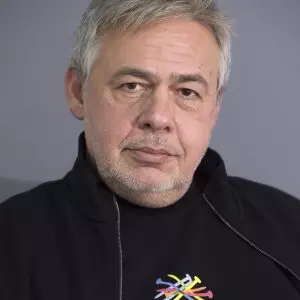
Study room in the apartment of Predrag Ejdus: a table with the text on which he is currently working, a few books, a graphite pencil. Everything is reduced to the basics, like in the classroom. At that table, Peca sits on a hard chair, bent over the text - and studies. That's right - he learns, because "character study" is a mystified, seductive term that leads to observation of patterns from life, and even imitation.
In my memory, this picture connects all the others - from performances, pub gatherings, guest appearances, my entire long-term experience with Pec. Because at the base of all his accomplishments is constant learning, developing and cultivating faith in acting as a vocation that surpasses all others, in terms of complexity, responsibility and the always required readiness to perform at the highest level. From evening to evening, from season to season. "What should an actor own?" A lot of things!" he told his students, "and first, the fanatical belief that this is the only calling he can and knows how to do. If he doesn't have that, he shouldn't be in this business."
Many call Pec's attitude towards acting professionalism, and that is true, but it is primarily about understanding that acting is a combination of aesthetics and ethics, that it is not just a skill but a responsibility towards oneself, one's vocation - and the audience. The endless respect of the audience for Predrag Ejdus means "the aspiration to reach a special state of contemplation, sanctification together with the audience". The Cartesian "I think, therefore I exist" was transformed by Pec into "I play, therefore I exist". The intellectual effort to understand the work and the world was accompanied by his almost ritualistic devotion to the rehearsal, which he loved more than the performance and which he attended with the excitement and curiosity of a beginner.
The proverbial "necessary egotism of an actor" in Peca means the opposite - a certain modesty. He is a true member of the old school of our acting greats who knew that individual talent in the theater is realized only in an ensemble, with others. And not only in his play and his theater, but in his complete belonging to the profession, the acting guild. More than once I was surprised when I would see Peca at almost all premieres in Belgrade. How and when did he arrive!? The actor, who at certain moments had as many as twenty roles in his repertoire (in one period he played in Podgorica, Novi Sad, Skopje and Belgrade!) came to almost all premieres, even of small, alternative groups.
That's why we all remember him as our representative and representative. He wanted to belong to the acting class in everything, even in his behavior off the stage. He was no stranger to the "vices" that are attributed to us, most often with prejudice. Anecdotes were and are still being told about Peca, the number of which may be surpassed only by those about Zoran Radmilović. One, characteristic of his constant engagement, talks about his famous notebook with a schedule of duties. Peca looks at the weekly schedule: Monday Venetian merchant, Tuesday Kir Janja, Wednesday shooting… What is this? Saturday: Wedding! "What a wedding, in which theater am I playing it!?" - "Vanjina, a wedding, Peco!" It was not a play, but the wedding of his daughter Vanja Eidus.
The whole actor belongs to the theater, on stage, off stage, in public and in private life. Like some high priest of calling, Predrag Eidus brought something ritualistic, unrealistic, balancing on the edge of the artificial to his game. That's why he was superior in works written in verse, and his prose lines acquired metric, melody and rhythm. He didn't try to be realistically believable, his kind of transformation was of a different kind. He did not put on the skin of a character, but lent his appearance to the character, and took the essence from it.
Today's theater has been conquered by the so-called "naturalness", what we used to pejoratively call "behavior" on stage. Largely influenced by domestic films, new acting stars want to surpass reality in their spontaneity and stuttering lines. That is why it would be nice if at least part of the memories of Predrag Ejdus were not only his roles, awards and anecdotes, his greatness, but above all the studiousness with which he achieved his believability - greater than the believability of an imitated life.
These days, the great creations of Predrag Ejdus are enumerated. His Mandeljstam, Mishkin, and the genius Kir Janja are also great... but I would say that Faust best characterizes Pec's philosophy of acting and theater. His Faust was one of the best that the famous German theater critic Henrik Rischbiter had seen in his life, as he wrote in "Theater Heute".
Faust II Mire Erceg begins with a long monologue. "The sun rises and moves away, the day is running out (...) Oh, why don't my wings lift me off the ground / To fly after him, always after him!" (...) But it won't be so easy for the wings of the spirit / To join the wings of the body..." For fifteen minutes, the actor Predrag Eidus speaks the lines almost without movement, with hardly noticeable movements on his face, and yet the excitement among the spectators is great. It's as if the balance that top acting strives for has been achieved - "emotions that think, thoughts that feel" (Boro Drašković).
I imagine Peca somewhere up there, at some heavenly desk, studying the text for renewal Faust and in his notebook he is looking for a free appointment. And as always, he finds it. Because his motto was "show must go on" even when it seems impossible.