
Culture
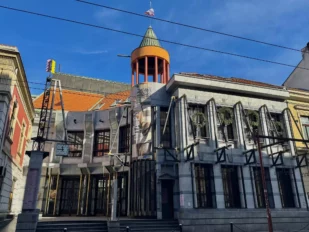
"Atelje 212" is 70 years old, and has one birthday wish
"Atelje 212" invites friends to tomorrow's 70th birthday celebration, and tells the city authorities not to agree to the collapse of culture
 photo: promo
Realization 3211 is a combination, actually a braid made up of drama parts and documentary, i.e., monologue confessional segments in which Stefan Đurić Rasta talks about his life and biography, as well as his incorrigible nature
Dabom, it's easier with the tried and tested, it's always and everywhere like that, even in the context of the cinema offer, and then the reactions of the audience and critics; it is much easier when both the target and the distance are known and certain. But as (at least occasionally) everything changes except for the metaphorical and proverbial state, occasionally there are twists and turns in that dense weaving of the expected and the confirmed... And so at the top of the viewership list is a film with a rather terminologically elusive structure, a hybrid feature-documentary , and also musically, and then biographically, where there is, as an additional and potentially disruptive factor, the dimension of a kind of litmus test for those in the audience who do not share musical and life worldview of the main protagonist, that is, the actor.

This is where the unraveling of the metaphorical ball can begin again in the case of the currently most viewed new film in Serbia; achievement 3211 is a combination, actually a braid made up of plays (which in turn serve as a playful staging of what the lyrics of the key hero's new songs are about) and documentary, i.e., monologue-set confessional segments in which Stefan Đurić Rasta talks about his life and biography, as well as his incorrigible nature, but above all about the recent prison episode, while the just mentioned forms the essence of his new album, which is additionally presented with this film, what then is this long-term achievement (of, admittedly, only and almost minimum 70 minutes of duration), makes it a kind of advertising and propaganda work. If additional clarifications are needed, let's also mention that Rasta Kanda, a leading author and producer in the sphere of local and regional trap, with evident craft progress in these ten and a half years of playing music of more or less that type, realized the dream of many with his prison transgression from the world of rap and later rap - provided that catchy G (as shorthand for gangsta) in front of the name of the music genre, which is a hugely dreamed dream in that in rows all over the planet - rapping/singing about the life of crime, and at least in part actually being the owner of the real experience of that crime. In the nineties, on the other side of the Atlantic, many rhymed and threw rhymes about it, to the extent that this minor footnote in the history of hip-hop was called the G-Funk Era. All this, of course, does not mean that Stefan Đurić Rasta purposefully navigated the waters of life behind bars, but it is at the same time proof of credibility in the eyes and ears of the consumers of his music and poetics, that is, the mythopoetics that he persistently built more than a decade ago.
In addition, as could be expected, and what is especially important for this film itself and its strengths, the prison episode was both a turning point and a transformative experience on life's journey. About that 3211 in its best parts, and in terms of meaning and other aspects, it speaks clearly and convincingly. Moreover, "transformative experience" can be reached when talking about the most valid one, when the focus is on film language and craftsmanship in the case of this, for the local notions and production habits (even habits) of an atypical work; namely, let's say, the half that concerns the music-play short films that illustrate Rasta's poems on the topics explained above, and Danilo Bećković, a director of cinema films with a clear genre structure, was in charge of that part as a director - Little Budo i Autumn of the Samurai, bring unreservedly praiseworthy directorial ambition, which is by no means exhausted in mere mimicry of similar examples from distant cinematic contexts. Bećković finds the right and precise balance between homage, pastiche and reinterpretation of postulates, "cuts" and interventions from that micro-genre milieu (which is at least equally due to the screenwriter - Dimitrija Vojnov, who since the beginning of this century has been working hard in the field of local (re) affirmations of the concept movie, therefore, as precisely as possible in the genre of the given, drinkable, communicative and in the commercial sense potent viewing of the film) versus here the ossified experience of the film which somehow by rote pretends to be true art, even in cases where there are no tangible grounds and confirmations for such, just mere aspirations. Their segments expertly follow the musical basis, which, of course, does not have to be to everyone's liking, not even those who are able to resist the temptations of cultural-racism and wrongly conceived elitism, and to recognize in this film what is valid and beyond Rasta's music. and the world that his music describes and sometimes even glorifies, and within the mise-en-scène and conceptual solutions there are also effective attempts to symbolically upgrade and strengthen what is essentially typical and everyday. So in all those short musical films, we also have a skillful attempt to break down the devil's wall between the documentary and factual basis and a certain poeticization - for example, when during the scene of the trial before the main actor's eyes his little daughter appears - of course, as the embodiment of his own hidden purity and innocence - with which he begins to play in front of the eyes of those present who are not even aware of it.
It seems that the approach applied and demonstrated by Vojnov and Bećković coincidentally "rhymes" with what we find somewhere in the middle of an unusually interesting study by the author Lidija B. Radulović - (Ne) they think of God: Anthropological study of religious life in prisons in Serbia, which was published this year by the University of Belgrade - Faculty of Philosophy, the Department of Ethnology and Anthropology and the Belgrade Dosier Studio, and which also highlights the following: "Prison institutions are places where organization and order are based on laws, procedures and regulations, and everyday life is conceived as their formal series of repetitions with clearly established and expected forms of behavior. Everything that jumps out of certain procedures, regulations and established forms of behavior that are, among other things, defined by regulations, disrupts the work and functioning of the institution. Rituals, by their characteristics, fit into such defined procedures and forms of behavior, whether they correspond to secular or religious contexts". With a little conceptual and semantic acrobatics, the quote just presented can be applied in the case of evaluating the author's attitude towards the chosen or imposed genre; and just like that, in 3211 in those paraplay and musical segments, we also witness an evolutionary and evolving skill that places new supporting pillars for our own belief in the impermanent power of the purity of the genre thinking of the film, and which again brings us to the point of a transformative experience, thanks to which it is possible for even the most stubborn to happen to visibly melt in front of Rasta's public persona and music. That fine and palpable rhyme established here between the music, which, therefore, is also marketed through film and presented in more detail to the target audience, and perhaps to a completely new audience, also calls to mind the association with the also extremely successful examples of local music "posters" from that field scarce heritage - on Denis and Denis show program (1985, directed by the late Dinko Tucaković) and the presentation of Darkwood Dub's early works in the early nineties in the School or Educational program of Radio-television Belgrade.
Overall, a very good film if we look at it as a single unit, 3211 however, it clearly lags behind in the second, documentary part (the director of that part is Andrijana Stojković); namely, the confessions to the camera, all to admit and praise that Rasta is a sufficiently interesting and relaxed (interlocutor), nevertheless point primarily to what in his resume belongs to the corpus of commonplaces. That part of the film seems routine, and even with the sudden mechanical change of those acting and confessional parts, that part 3211 perhaps it can also be considered a kind of tribute that had to be paid in order to reach the necessary point of acceptability when it comes to feature-length productions, which are the only ones that are part of regular cinema distribution all over the planet anyway. It's not down to the actors, it's not even down to that reduced set of "conducted" monologues that are communicated directly to the camera, simply, in the form of a spoken confession of that type, the story itself loses to that in the second half of the suggestively put into action and the embodiment of that G-beat of Rasta's recent of the past. Nevertheless, even this obvious imbalance does not have the power to threaten the favorable impression that leaves, without much thought, one might say, the essential and more significant half of this whole. And about the nature of cinema hits and the variations that happen here and there, we will certainly have the opportunity to discuss on some other occasion, perhaps in the near future. It is possible.
"Atelje 212" invites friends to tomorrow's 70th birthday celebration, and tells the city authorities not to agree to the collapse of culture

In Belgrade, someone wrote graffiti on the window of the Salon of the City Museum, where the exhibition of the October Salon is held. The perpetrator should have been captured by security cameras

80 films are coming to the 32nd Original Film Festival, many of them with awards from the Cannes festival. It is organized by a citizens' association, without a dinar of state money

Tomorrow "Zvezdara Theater" will celebrate the 400th performance of "The Book of Milutin" by Nenad Jezdić's monodrama. Plays that have been in the repertoire for more than a decade are currently being played in Belgrade. The musical "Some like it hot", even - three

More than 400 artists and cultural workers signed the request of the Initiative for Free Culture, which calls for the dismissal of all the leaders of cultural institutions in Pancevo.

At the moment when the institutions of the Republic are destroyed, when Vučić's octopus is still alive, when people are disgusted by the injustice and the stench left behind by the Essenes regime, we have, as Machiavelli said, only civic virtue as the fuel with which we can return to the beginning

The four independent members of REM are an example of perseverance and civic responsibility. Rodoljub Šabić even, upon leaving the premises of REM, after the sentencing of the Informer, experienced that the Essenes insulted him, hit him with their hands and feet. But that too will soon be over

Vučić pardoned the batterers and Dijana Hrkalović. The election winners should abolish the sultan's power that allows one man to run afoul of the entire judicial system

Time explores: The construction of the St. Sava Temple
Did the money paid by the Government to SPC end up in Moscow through Alta Bank? subscribeThe archive of the weekly Vreme includes all our digital editions, since the very beginning of our work. All issues can be downloaded in PDF format, by purchasing the digital edition, or you can read all available texts from the selected issue.
See all



