As one of the progenitors of the new artistic practice in Serbian art, Era Milivojević was and remains one of the most important artists from this area. Modest, reserved, always in the shadow of his more extroverted colleagues, Milivojević formed his art in a specific personal code that, regardless of his firm affiliation with the so-called to the "second line" of Serbian art, his work clearly differentiates it from artists who are generationally close. It is this "particularity" and "uniqueness" that still confuses theorists and art critics.
He was born in Užice in 1944, from where he went to Novi Sad, where he graduated from the School of Applied Arts in 1965. In the same year, he entered the Faculty of Fine Arts in Belgrade in the class of Professor Stojan Ćelić, with whom he graduated in 1971. From 1975 to 1976, he taught art education at the Mechanical and Technical School in Gornji Milanovac. Since 1989, he has been a member of the Association of Fine Artists of Serbia. For his work, he was awarded prizes at the 39th October Salon, the "From April to April" prize for the best exhibition in the past year, Studio B (1995), and the City of Belgrade Grand Prize in 2005. He had the status of a meritorious artist whose artistic practice was recognized as unique and valuable both locally and internationally.
From the very beginning, Milivojević developed following a specific line that combined conceptual art and strong individualism. As a member of the famous informal group of six artists who created in Belgrade in the early 70s in the gallery of the Student Cultural Center (Raša Todosijević, Marina Abramović, Zoran Popović, Neša Paripović and Gergelj Urkom), Milivojević very actively participated in what were called by critics at the time a "radical turn" on the art scene that led to the emergence of a "new artistic practice". In this period, Milivojević's work, as well as the work of other artists from this group, finds its starting point in conceptual art, in that approach that moves towards the complete dematerialization of the work of art, that is, the negation of the art object. Informally, in his student days, Millivojević was the first artist who started to perform actions, to give up classical painting for the sake of experiments inside and outside the work of art. What characterized his work then and later was the enormous energy and stubborn consistency with which he approached the performance of his works.

for an enlarged image, right click and »view image«
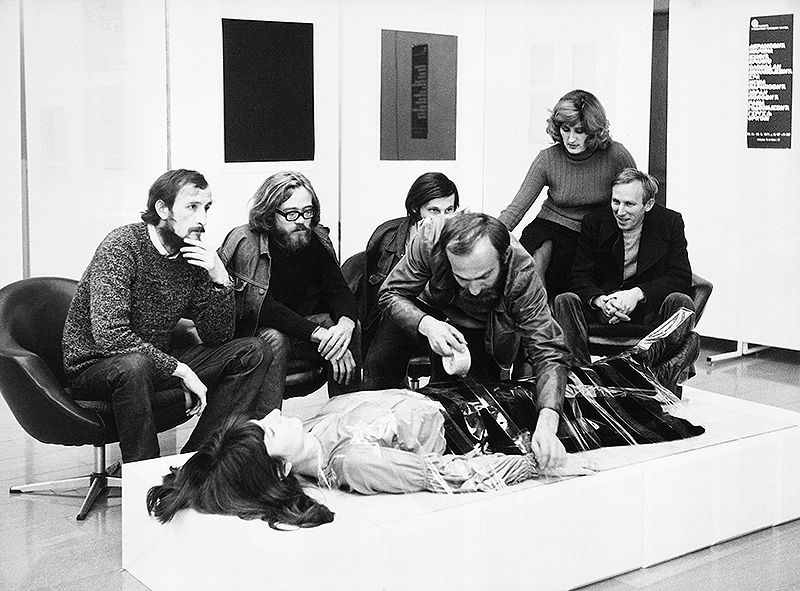
One of the most significant and complex works from the early period (1971) is the famous performance Mirror (mirror gluing). The work consisted of three segments: gluing the mirror with scotch tape, whereby this object gradually loses its primary function and becomes ready-made; tape intervention on a copy of Michelangelo's Roba in which during the artistic work the sculpture becomes a copy of a copy; and finally, taping Marina Abramović, "mummifying" her with tape and making a "living sculpture". Erin's approach to new artistic practices was unique and distinctive. Unlike his colleagues, Era used humor and imagination as a key element of his artistic credo, giving his works a certain esoteric note. Another significant and unusual work from this period is i Man design performed also in several variants. As Era himself said, the pattern is a matrix of relationships
Man-God-Cosmos, a mosaic of living and non-living matter in constant flux. Milivojević also uses repetition in this work, another typical procedure of the neo-avant-garde that he will use intensively until the end of his career. The pattern will become one of the key elements in his work and will run through his entire oeuvre. His persistent consideration of the possibility of creating series of works of art, i.e. work in continuity, based on small changes, will result in the famous meandering photographs.
As Slavko Timotijević wrote, his artistic production was autochthonous and distinctly individual without concrete and solid foundations in the contemporary tendencies of contemporary artistic practice. However, this did not prevent him from creating a compact synthetic entity from different materials. Therefore, it should not be surprising that domestic and foreign art history rightfully included him very early in the corpus of significant artists, and almost all regional museums included his works in their collections. Private collectors have also shown considerable interest in his installations, paintings and photographs.
for an enlarged image, right click and »view image«
Like hardly any artist before him, Milivojević devoted his entire being to art, to the extreme physical and mental limits, which eventually affected his health. He didn't just create art, he lived art, to the extent that we can dare to say that in his case there is no boundary that separates the artist from his work. Era Milivojević is a work of art in itself, whether it is about his performances, pasting, that is, drawing chess moves or some similar procedure.
In addition to art, to which he devoted himself completely, Era had several other great passions - football and chess, and it was in chess that he discovered a field that he explored almost to the end. Chess games, i.e. moves that he presented graphically and linearly, become the basis of a whole range of works that, in relation to where they are presented, whether it is the glass surfaces of shop windows, the walls of public buildings or painting canvas, essentially change little. From the first performance in SKC under the name Image changes, through the performance and installation on the roof of the Odeon cinema in the mid-90s to the iconic pasting of tapes on the windows of the entrance hall of the Faculty of Philosophy in 1999 during the NATO bombing. It was the artist's interpretation of the symbolic coincidence of chess and a historical moment, in both cases a battle of war - the famous six-game battle between the IBM computer Deep Blue and Kasparov, in which a man lost to a machine for the first time.
Era was constantly thinking about art, always with a photo-apparatus or camera in search of the perfect shot to immortalize and preserve scenes and memories. Thousands and thousands of photographs, initially analog, later digital, were not only a testimony of a time and an artistic process, but a continuous performance that never stopped.
"I bought my first Olympus camera in London. So I started shooting cities, urban spaces. Connecting one photo to another, which can be arranged like a labyrinth without beginning and end, I created a photo installation. A conceptual history, Still Images is a sublimation of previous ideas: Images of Changes, Art-sessions, etc."
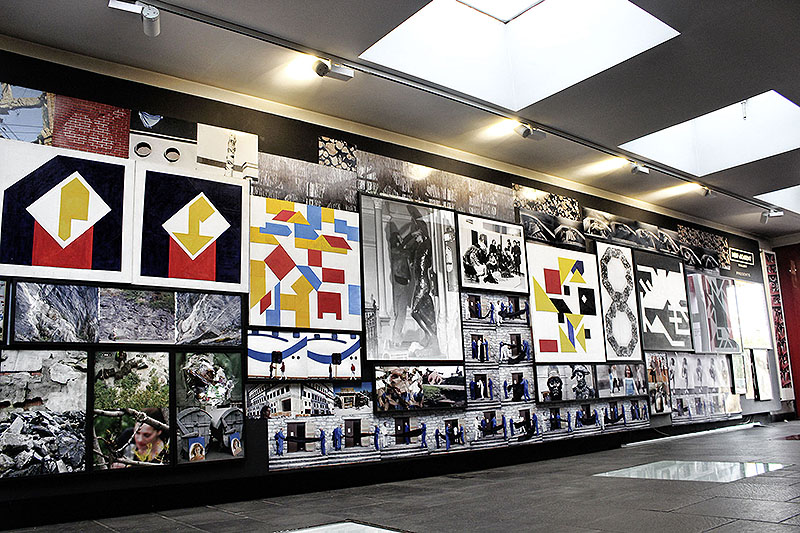
In this period works such as Black and white eye, a large installation of almost 400 photographs arranged in a geometric form that meanders into a real structure in which the photographs build on each other. With a logic known only to him, guided by geometric templates and the visual aesthetics of the photographs themselves, Era has created dozens of intriguing walls in the last two decades in which the product is as important as the process of working on it.
"The setting of the photo installation requires the greatest possible distance in space to make the maze as abstract as the 'white maze' of the background between the photos. Moving towards it gradually reveals the content. Then the world of figurative and real and visual information as knowledge opens up."
Era Milivojević lived art and created it while living, regardless of all obstacles, misunderstandings and difficulties. In an almost paranoid fear that someone might steal his idea for a new artistic work, Milivojević was often mistrustful and somewhat boyishly confused when communicating with people. Benevolent, passionate, maximally dedicated, an artist who uncompromisingly defends his art, attitudes and principles from which he did not give up, Era will be remembered as a great innovator, an artist who more or less consciously chose the position of social self-isolation of a misunderstood genius. An artist who will deal with domestic art history and how to deal with it.