Children of communism Milomir Marić for my generation were similar to Andrić's Alija Djerzelez. Let us remind you that in Andrić's story, Đerzelez is someone "whom everyone has heard of, but few have seen, because he rode his youth between Travnik and Istanbul". Children of communism, I say again, for my generation, was a book that everyone had heard of, but few had read. When the book was first published in 1987, we were still children, and then, while (to sentimentalize it a bit) everywhere, between Travnik and Stambol, we were riding through our youth with lead horseshoes, at one moment it seemed that the book belonged to someone long gone. time, without any deeper relation with modernity. When I would later see it in antique shops or at friends' home libraries, I would always think: I should finally read this. But, well, I never did, until the new edition from 2014 (Laguna, Belgrade), two huge volumes (over five hundred pages each) in paperback, advertised with the slogans "Cult Yugoslav bestseller" and "The book that changed everything!" ".

NAMES, LIVES: This pre-election Saturday, March 15, in the Belgrade "Danas", two authors (Dragoljub Petrović and Bratislav Grubačić) write extensively about this issue on two pages. The next day, on election Sunday, March 16, in Zagreb's "Jutarnji list", Drago Hedl writes about Milomir Marić on four pages. In "Danas", Grubačić recalls the time when, as the director of the publishing house Mladost, he received Marić's manuscript. That text of his corresponds perfectly with the preface that Marić wrote for the new edition Children of communism. In it, among other things, he recalls the positive echoes of the first edition, and the praise that, he says, his book received from figures such as Danilo Kiš or Adam Mihnjik. Nevertheless, from today's perspective, it is even more interesting to re-read the preface to the first edition and, for example, the episode sketched in that preface, about Ljuba Veselinović, the former commander of the Second Proletarian Brigade, who killed himself with a revolver shot in front of the Monument to the Liberators of Belgrade on April 1986, 1941, and a sign of protest "due to the complete disintegration of Yugoslavia" (as stated in the farewell letter in which Veselinović notes that "nationalism and separatism worse than those before XNUMX" and that they "sowed various divisions among the peoples of Yugoslavia and brought its working class to the brink of disintegration.") After the preface, there are fifteen chapters of the first volume (Fog from the east) and another twenty-three chapters of the second (People of the new age). Among the heroes of the first volume are Karlo Štejner, Ante Ciliga, Živojin Pavlović, Dragiša Vasić, Božidar Maslarić, Vladislav Ribnikar, doctor Sima Marković, Mustafa Golubić, Ivan Macek Matija, Ilija Milkić, Triša Kaclerović, Ivo Marić, Rodoljub Čolaković, Sreten Žujović, brothers Vujović, brothers Cvijić, Josip Kopinič, doctor Nikola Petrović, doctor Ivan Očak, Srđa Prica, Rato Dugonjić, Olga Ninčić and Avdo Humo, Velimir Terzić, Doctor Vladimir Velebit and Svetozar Vukmanović Tempo; among the heroes of the second are: Mihailo Švabić, Radovan Zogović, Stefan Mitrović, Božo Ilić, etc. Vladimir Dedijer, Borivoj Viskić, Božo Ljumović, dr. Mirko Marković, Ćanica Opačić, dr. Blagoje Nešković, Ljubodrag Đurić, Veljko Mićunović, Koča Popović, dr. Ivan Supek, Ante Topić Mimara, Ljubiša Ristic, Dušan Makavejev, Želimir Žilnik, Radisav V. Filipović and Aleksandar Joksimović. I am deliberately listing all the names mentioned in the content of the book, as a kind of associative cloud. And although those names are many, the heroes of the book are many, many more.
MUSTAFA, RED AND BLACK: Marić is genuinely fascinated by the destinies of his heroes. The core of the book, both thematically and in terms of intensity of fascination, and also in terms of the amount of text dedicated to one person, is in the chapter The black hand of the red international, the chapter on Mustafa Golubić. On one hundred and sixty pages, which could work as a separate book, Marić tells the story of Mustafa Golubić, to the man of conspiracy, as another author would say. It is worth quoting a few sentences from the chapter on Golubić as a sample of Marić's style: "He founded a communist party in Algeria." In China, he pulled gentlemen in a rickshaw. He crossed the Atlantic hidden in a banana crate on a ship, and was transferred from Mexico to the US in a wagon full of water pipes. Due to the needs of his service, he was also able to expertly win the hearts of Parisian ballerinas or the wives of Indian maharajas and send them real flower gardens." Alfons Kauders from the prose of Alexander Hemon, "Muja, Mujka, Mujaga, Dzadzinka, as he was fondly called, or Nikola Nenadović, Luka Đerić, Ismet, Luka Samardžić, Gojko Tamindžić, Ivan Ivanović, Popović, Đurđević" (which are just some of the nicknames and official pseudonyms, which often "not even their owner remembered") is for Marić a figure of personal continuity between the young Bosnian Yugoslav dream and his later communist incarnation . Except in the "own" chapter, Mustafa guest and in most others, guest even when he is not mentioned by name. It is interesting today, thirty years after 1984, and in the context of the contemporary repertoire of Belgrade theaters, to read the chapter about Ljubiša Ristic: "To the great joy of the Belgrade bazaar, Ljubiša Ristic failed on the New Year's Eve 1984. A performance The secret of the black hand it barely had as many spectators in seven days as Atelier 212 in a year, and the National Theater from January to September. In 1984, Belgrade seriously and irreconcilably divided over who was most responsible for the creation of the Yugoslav state in 1918. In the Yugoslav Drama Theater, in The Battle of Kolubara (adaptation of Dobrica Ćosić's novel Time of death), it is claimed that the issue of future statehood and the survival of the Serbian people was solved by Duke Živojin Mišić with an insane and wise military strategy on the slopes of Suvobor. (...) In the Sava Center, in a musical The secret of the black hand, the main state-maker is General Staff Colonel Dragutin Dimitrijević Apis, with the help of Sarajevo assassins."
STIL: Also, from a purely stylistic point of view, when they are read today Children of communism, Milomir Marić appears to us as the progenitor of a whole journalistic style here, a style that we could call feuilletonistic-mythomaniac. This is the style in which it is more important that something sounds good, than that it is 100 percent factually correct, those texts that vary that famous Hegel phrase in a special way and according to which if the seductiveness of the text eventually spoils the facts - so much the worse for the facts! Some of the most famous local journalists, such as Senad Avdić or Denis Kuljiš, often followed Marić's path, which many others also tried to follow. This kind of feuilletonism is a legitimate genre, when it stays within its own framework, and Marić (unlike some epigones, especially from the recent era) as a rule works like that, so his texts are readable, entertaining and intelligent. In this sense, and in the context of the genesis of this book on newspaper pages, it can almost be called a boulevard novel. In Marićevo novel we read about the Sarajevo assassination, about the Spanish Civil War, about Goli Otok; we follow the crooked life paths of Koča Popović and Svetozar Vukmanović Tempo, we witness the love of Avda Huma and Olga Ninčić, we meet Iva Lola Ribar several times in passing, and some of the names echo Proustian (for this reader, for example, Antun Mavrak). Towards the end of the second part, we meet Dušan Makavejev, the mentioned Ljubiša Ristić, Želimir Žilnik. When it comes to the last chapters of the book, the one under the title is particularly interesting The Troubled Eighties, with subtitle The innocent revolt of the descendants: drug addicts, hippies, poets, rockers, little ones, The Red Brigades. On the Sarajevo pages of this chapter, the Sarajevo from the eighties of the last century has been masterfully zipped and preserved, mythologized a hundred times while it still existed, and then a million more times after it disappeared, almost always with more or less hairdressing of the past. Those twenty or so Sarajevo pages paraded by Srđan and Nenad Dizdarević, Duško Trifunović, Abdullah Sidran, Rajko Petrov Nogo, Goran Bregović, Emir Kusturica, Bata Čengić, Ivica Matić, on which the Olympics are mystified and demystified, are at the same time a faithful image of the past and a dim anticipation of some aspects of the future. The Mangup malice of Marić is amusing when he says about Bregović, for example, that he is a "philosophy student and a born philosopher" who was found to have "read three books during his career: The little Prince, People with four fingers and Selby's Turn to Brooklyn".
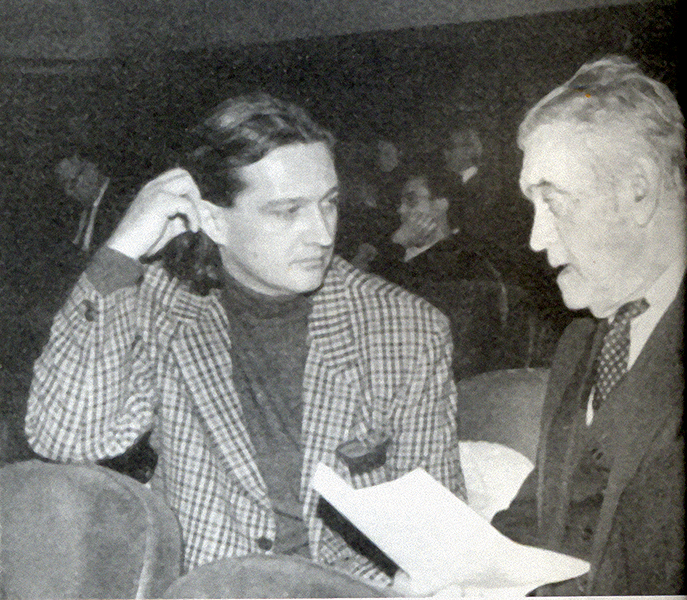
PICTURE BOOK: Marić writes that after the first edition of the book, Đilas, even as a joke, told him that he should be hanged at Terazije, that Koča Popović wrote in his diary how, well, his generation was waiting for its judge to be "the clown Milomir Marić". that he was attacking him and Voice of the Council. Without denying its controversy at the time, today the book reads almost like an idyllic picture book about the miraculous fate of not some Amelia Pullen, but of a country and its people. The attached photos contribute to this "pictorial paradigm", not only those with the heroes of the book, but also those showing the author himself, in the company of Milovan Đilas, Danilo Kish, Vladimir Dedier, Moma Kapor and Igor Mandić, who alone - next to border stone of the SFRY, in uniform, presumably serving his military service. There's something endearing and touching about that kind of ego trip, now twenty-seven years after its first release Children of communism. When it comes to journalism and nonfiction, that book itself has become a kind of symbolic boundary stone of the former SFRY. Here, then, is what that born philosopher said, after all these years, ready for both old alignments and new readings.