

SHOP NOW
Idea about the fate of 6.500 workers after the arrest of Davor Matsura
Idea has spoken out about the business and workers after the arrest of its new owner, Davor Matsura

By signing the agreement on strategic cooperation with the United States, Serbia took a step towards the energy transition. The focus is on decarbonization and transition to renewable energy sources, in accordance with international obligations, including the Paris Agreement
Serbia i United States they signed less than a month ago the first agreement on strategic cooperation, namely in the field of energy. The specific content of the document is not yet known, but officials on both sides claim that it represents an important step towards even closer cooperation between the two governments, as well as the private sectors of the two countries.
Energy expert Željko Marković explains to "Vreme" that it is a common practice for the USA to conclude these types of agreements and adds that they also exist with some neighboring countries.
Speaking about the possible advantages of strategic cooperation in the field of energy between Serbia and the USA, he stated that the greatest probability is that the contract will concern critical mineral raw materials, renewable energy sources and the best digitization and communication, i.e. the introduction of the 5G network.
American aid to Serbia
"The information I have says that this is a comprehensive agreement that concerns both critical minerals, but also energy itself, i.e. renewable energy sources, decarbonization of our space, as well as progress in digitization. According to my information, the American side through that agreement is ready to help us in the future with its expertise and connection with their economy," said Marković.
He adds that decarbonization is a very important goal of our country, since 70 percent of electricity in Serbia is still produced by burning coal, i.e. lignite, and that this will have to change based on our obligations established by international agreements, primarily the Paris Agreement.
In the transitional period, until 2026, companies are obliged to measure and submit reports to European partners on the carbon emissions embedded in the product they export. It is a SIBAM regulation that is valid on the territory of the European Union, which implies control of the carbon footprint of products on that market.

The sectors covered by SIBAM in the first phase make up about 12 percent of Serbia's total exports to the European Union, while the share of iron and steel is as much as 72 percent. These are also the areas where, due to the production process itself, huge investments are needed to adapt to new requirements. Those who are unable to do so will pay the price, i.e. a tax or pollution tax. Therefore, producers with fewer harmful gas emissions will be in a better position. This is all the more reason for domestic businessmen who are export-oriented to be careful.
"Not only will we have to decarbonize the energy sector, but market opportunities will also change, so coal-fired generation will be less and less competitive." We have to take into account the introduction of taxes contained in the EU regulation SIBAM, where the importer of our electricity will have to pay a tax in the future that will be practically equivalent to the tax for CO2 in the electricity industry system of the European Union," explains Marković.
Chance in hydropower, wind power and solar panels
He notes that because of this, international pressure is expected on Serbia to introduce this system of taxation of payment for CO2 emissions, and this can be regulated by increasing renewable energy sources.
"Our country would have to look at new opportunities for hydroelectric power plants, wind power plants and solar panels," indicated the interlocutor of "Vremena".
Speaking about the advantages of solar, he recalled the situation that this summer we imported half a gigawatt of engaged power.
"Bulgaria, for example, has three gigawatts in solar, and we have 100 megawatts. If we only had half the capacity that Bulgaria had, we wouldn't have to import electricity. It was sunny and warm weather, the solar system would produce electricity and we would make up for the energy we needed due to high consumption," specified Marković.

Agreement with confidential content
After the signing of the agreement on strategic cooperation in the field of energy between the USA and Serbia, the American media estimated that this could be a new step towards something that Washington has been promoting and encouraging for a long time - diversification in the supply of energy to Serbia, and thus, in the long term, reducing dependence on Russian gas. .
This agreement was signed in Washington by the Minister of Foreign Affairs of Serbia, Marko Đurić, and the US Undersecretary for Economic Development and Energy, Jose Fernandez.
"This is an agreement that will expand opportunities for American companies to invest in the energy sector in Serbia, including green energy and future energy projects, which is important because it will bring benefits to both American and Serbian companies and workers." It will help Serbia diversify and expand its energy production and support economic development," the American official said at the time.
The head of Serbian diplomacy, Marko Đurić, stated that the agreement is a clear expression of the political will of the two sides. He clarifies that it is a document of a legal nature that creates opportunities for companies from two countries to conclude individual agreements as well.
"It will help energy security, diversification, but also the transition to green energy." So this is a win-win combination for both Serbia and the USA because it will enable companies from both sides, private and our state, to have a stable supply line and access to new technologies. He can count on a reliable source of affordable, I emphasize affordable, electricity," said Đurić.
Serbia is still almost completely dependent on Russian gas, which it receives at a preferential price of between 300 and 420 dollars per thousand cubic meters. Russian President Vladimir Putin, during a recent meeting with Serbian Deputy Prime Minister Aleksandar Vulin, who is otherwise under US sanctions on charges of organized crime, corruption and "the spread of malignant Russian influence", proposed that talks on a new three-year contract for the delivery of Russian gas begin soon.
Idea has spoken out about the business and workers after the arrest of its new owner, Davor Matsura
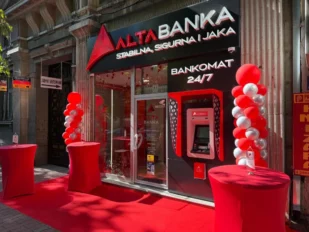
Can Alta bank disrupt the financial system of Serbia? What messages does the introduction of bankruptcy send - should we trust banks and which ones?

The situation regarding Alta Bank does not threaten the regular operations of Belgrade Waterfront

Intesa Invest claims that the impact of Alta Bank's collapse on its money funds is limited and one-time. The funds operate regularly, and the issuance and redemption of investment units take place smoothly.

Which bank, from when and in what period of time, will pay out money to the depositors of Alta Bank, for which the Commercial Court in Belgrade issued a decision on the initiation of bankruptcy proceedings.

Vučić pardoned the batterers and Dijana Hrkalović. The election winners should abolish the sultan's power that allows one man to run afoul of the entire judicial system
Davor Matura's ALTA empire is the transplanted heart of the corrupt regime of Aleksandar Vučić, who was defeated in the October 25 elections. From ALTA Bank, roads lead directly to the top of the progressive government.

Things are unfolding at an astonishing speed, as astonishing as the speed with which Vucic conceded a convincing defeat. Impatience is understandable, but misplaced

The archive of the weekly Vreme includes all our digital editions, since the very beginning of our work. All issues can be downloaded in PDF format, by purchasing the digital edition, or you can read all available texts from the selected issue.
See all



