

SHOP NOW
Idea about the fate of 6.500 workers after the arrest of Davor Matsura
Idea has spoken out about the business and workers after the arrest of its new owner, Davor Matsura

Why are Hungarians afraid to put passengers on the Soko high-speed train? Through countless tests, the new government is increasingly showing that it does not trust the Chinese, nor the Serbs
Travel Sokol, but without anyone leaning out of the window - this is how the willingness of the Hungarian authorities to launch a high-speed passenger train between Budapest and Belgrade could be explained.
The most rigorous in the history of rigorous testing has been going on the railroad on that route since the change of government in Hungary in the spring, so there were suspicions that the work was not done properly. There were too many non-transparent parts of Orbán's people with Chinese contractors and the Serbian regime.
Seven months after the high-speed train was supposed to start between the two capitals, this October, Budapest is still testing safety, stressing that the trains they let down the track - have not yet accommodated a single passenger.
After the fall of the canopy in Novi Sad i a wave of political and social rebellion which followed and upset the elections in Serbia, it is understandable that Hungarians are afraid of any similar scenario.
The Hungarian Minister of Transport and Investments, David Vitezi, announced this October on social networks that the "most comprehensive" testing of the Budapest-Belgrade railway, which was carried out during the night, had just been completed.
"Trains were running as if passenger service had already started, running for hours on the scheduled daily schedule for peak periods," Vitesi wrote. "There was only one significant difference: there were no passengers on the trains."
The train control system, which is crucial for the handover of the track and necessary to guarantee safety at the maximum speed of 160 kilometers per hour, which was the problem, worked well, he pointed out.
Vitezi said, for the umpteenth time, that the basic principle remains that safety comes first and that the transportation of passengers on that line will begin when it is determined that nothing threatens the safety of passengers.
"This is precisely why rigorous tests have been carried out on the railway since the summer, and that is why the simulation performed last weekend was such an important step. After the official evaluation of the test, we will also inform the public about it, because we believe that passengers should be informed in a timely manner, and not withhold information from them," Vitezi said.
High-speed freight trains in between Belgrade and Budapest they started on February 27, ex-President of Serbia Aleksandar Vučić boasted. Together with the former Minister of Construction and Transport of Hungary, Janos Lazar, he announced the speedy establishment of passenger traffic on this section.
The passenger train was supposed to leave by March 15, a those 15 days are left to complete all technical and security checks.
How 15 days turned into seven months is not entirely clear, but it is evident that after this announcement, elections were held in Hungary in April, where Viktor Orbán, a longtime ally of the progressive regime in Serbia, lost power.
After the change of government in the neighboring country, the Minister of Construction, Transport and Infrastructure of Serbia, Aleksandra Sofronijević, said in a guest appearance on RTS: "Serbia is ready to establish passenger traffic to Budapest and the date of the opening of the railway line depends exclusively on the Hungarian side."
What is "appeared as a problem, is a problem of a technical nature", she added. However, they admitted that they were then Hungarians noticed a mistake that affects the safety of traffic at a speed of 160 kilometers per hour.
"That means that Hungary side, above all MAV, their national carrier and operator, is checking and doing safety checks of the so-called ETCS system, bearing in mind that some error has appeared and has been observed that affects the safety of traffic for speeds of 160 kilometers per hour," said the Serbian minister.
She stated that the Serbian Soko trains were already in Hungary and received a type permit, i.e. a certificate, and when all safety systems are operational and they receive all the necessary certificates for safe traffic, then Soko will also receive an individual permit.
Months passed, and then the new Hungarian Minister of Transport openly said in June that "one often hears the claim that the Chinese didn't know what they were doing".
He said in the parliament that the question arises whether Hungary and Serbia really managed to direct the development of the railway connection between Belgrade and Budapest in the right way. According to him, permission should be sought from the Chinese authorities to make contracts, their amendments and all accompanying documentation publicly available, as well as data on costs and invoices.
"The situation has not yet been fully resolved. Although the completion of the railway works has been delayed due to certain problems, numerous technical and safety issues remain open. As already mentioned, the insurance and railway traffic management systems have not yet been fully operational," Vitezi revealed.
It is certain that the system cannot be put into operation, nor can it be fully paid for, until it is proven that it meets all prescribed safety standards, Vitezi said.
"I don't want to defend anyone, but the contract clearly states that certain technical solutions were known in advance. It is true that the railway was designed for speeds of up to 200 kilometers per hour and that is why it was built almost as a completely new route. However, a large number of level crossings remained, which is a serious drawback. Therefore, in practice, the designed speed cannot be fully used."
In other words, they built the railway for 200 kilometers per hour, but on some sections the speed will be limited to 160 kilometers per hour precisely because of those unresolved crossings, he explained.
Election time! And someone has to report to you independently. That's why it's in October annual subscription the digital edition of "Vremena" even 2.500 dinars cheaper. Choose now!
Idea has spoken out about the business and workers after the arrest of its new owner, Davor Matsura
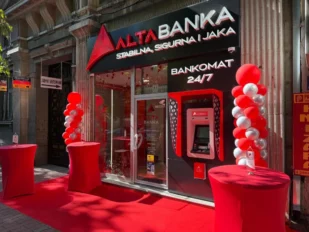
Can Alta bank disrupt the financial system of Serbia? What messages does the introduction of bankruptcy send - should we trust banks and which ones?

The situation regarding Alta Bank does not threaten the regular operations of Belgrade Waterfront

Intesa Invest claims that the impact of Alta Bank's collapse on its money funds is limited and one-time. The funds operate regularly, and the issuance and redemption of investment units take place smoothly.

Which bank, from when and in what period of time, will pay out money to the depositors of Alta Bank, for which the Commercial Court in Belgrade issued a decision on the initiation of bankruptcy proceedings.

Vučić pardoned the batterers and Dijana Hrkalović. The election winners should abolish the sultan's power that allows one man to run afoul of the entire judicial system
Davor Matura's ALTA empire is the transplanted heart of the corrupt regime of Aleksandar Vučić, who was defeated in the October 25 elections. From ALTA Bank, roads lead directly to the top of the progressive government.

Things are unfolding at an astonishing speed, as astonishing as the speed with which Vucic conceded a convincing defeat. Impatience is understandable, but misplaced

The archive of the weekly Vreme includes all our digital editions, since the very beginning of our work. All issues can be downloaded in PDF format, by purchasing the digital edition, or you can read all available texts from the selected issue.
See all



