Chronicle
Terrorist attack in front of the Embassy of Israel in Belgrade: One attacker killed
One person was killed when he attacked a member of the Gendarmerie with two knives in front of the Israeli embassy in Belgrade

Experts say that such data are not surprising, since alternative forms of partnership compared to marriage are generally accepted. The family and partner relationship is no longer a matter of the state or institution, but a personal choice, so it is one of the reasons for the decrease in the number of marriages.
Gordana Bjelobrk, Head of the Department of Demography of the Republic Institute of Statistics (RZS), said that in 2022, 32.821 marriages were concluded in Serbia, which is 2.987 less than in 2011.
On the other hand, there is an increase in the number of divorces, so in 2022 there were 9.813 divorces, that is, 1.562 more than in 2011, when 8.251 marriages were dissolved, Bjelobrk stated for Tanjug.
According to the data, the average age at marriage for grooms was 34,1 years, and for brides 31,1, and couples in the Belgrade region have the highest average age at marriage, while those in Šumadija and western Serbia have the lowest.
Bjelobrk also said that according to the number of marriages in relation to the number of inhabitants, the best "ranked" was the Belgrade region, Šumadija and Western Serbia with 5,1 percent, while the lowest rate was recorded in southern and eastern Serbia with 4,5 percent.
The largest number of divorced marriages lasted up to four years, while every fifth marriage lasted from five to nine years.
"Third on the ladder of divorced marriages are marriages that lasted 25 or more years. Every second divorced marriage is with children, 52,5 percent, and most of them, somewhere around 27 percent, had one child in the marriage union", she stated and added that the data show that the lowest divorce rate was recorded in marriages lasting between 20 and 24 years old.
Bjelobrk stated that when we look at divorce rates by region, the lowest rate is recorded in Šumadija and Western Serbia, with slightly more than one percent, while the highest rate is in Vojvodina with almost two percent.
"Then follows Belgrade with one and a half percent and Southern and Eastern Serbia with 1,2 percent," she said.
Only 13 percent of citizens decide to remarry after their first marriage, said Bjelobrk and specified that men, rather than women, decide to take this step.
"When it comes to men, in 2022, 3.697 of them entered into a second marriage, and 481 into a third." "On the other hand, 3.680 took their marriage vows for the second time, while 386 women got married for the third time," she said.
Bjelobrk also stated that according to the data from 2022, 277.140 people live in extramarital unions, and 76.238 decided to have children in extramarital unions.
"The data is not surprising"
Assistant Professor at the Department of Sociology at the Faculty of Philosophy in Belgrade, Milica Vesković Anđelković told Tanjug that such data are not surprising, since alternative forms of partnership compared to marriage are generally accepted.
"Marriage and the family as an institution can be understood as the basic unit of society, but on the other hand, the family itself and the partnership relationship are no longer a matter of the state, it is not a matter of institutions, but a personal choice and a matter of personal individuality," Vesković Anđelković said.
She also believes that the percentage of those who get married in the future can be expected to be even lower because there are alternative forms of partnership compared to marriage and that they are one of the causes of the decrease in the number of marriages.
Vesković Anđelković clarified that during the period of the coronavirus pandemic, the number of weddings fell, and then increased in 2021, but that this trend did not continue in 2022.
"Many couples already had weddings scheduled in 2019 and 2020, which they canceled when gatherings and festivities in restaurants were banned. It was postponed for some other better times, so everyone, as the corona measures were lifted, rushed to reschedule weddings and book restaurants. But after some time, when those intentions have come true, we return to the old trends, which are completely expected," said Vesković Anđelković.
Tanjug's interlocutors agree that Serbia is in a better position in terms of the rate of marriages and divorces, compared to the countries of the European Union, while in comparison with the countries of the region, the percentages are almost at the same level.
More marriages than in the EU
Bjelobrk points out that in Serbia the rate of marriages per 1.000 inhabitants is about 4,8 percent, while the rate in Montenegro is slightly higher - 5,2 percent, and in Croatia it is slightly lower - 4,6 percent.
"It is higher than the rate in the European Union, which amounts to 3,9 concluded marriages per 1.000 inhabitants." "Also, the rate of divorced marriages in Serbia is 1,4 percent per 1.000 inhabitants, while in the EU it is 1,7 percent per 1.000 inhabitants," she said.
Vesković Anđelković assessed that it is evident that all European countries that have gone through the demographic transition and the process of starting family planning are experiencing the same thing.
"We are part of that world, we accept the same values, we turn to individualism and individual plans, and we are expected to be in the same trends and on the same path as our neighbors," she said.
Vesković Anđelković, however, states that what worries more than the number of marriages is the trend of fewer births, as well as the demographic picture that indicates an increasingly elderly population.
One person was killed when he attacked a member of the Gendarmerie with two knives in front of the Israeli embassy in Belgrade

The Gymnasium in Čačak announced that the Ministry of Education is expected to accept Katarina Majstorović's resignation without delay and to appoint teacher Irena Simović as acting director.

Two television stations close to the outgoing authorities today told all employees to stay at home - allegedly for fear of threats, "Vremen" confirmed.

Citizens broke into the newsroom and interrupted the Informer television program, and threw eggs at the Pinka building. The police intervened at both locations, but "delayed" at Informer. These actions have nothing to do with the Student List and the Student Movement, which have expressly declared against any street justice.

Everything that happened on RTS in the last two years did not happen because of a "handful of čats and loyalists", stated a group of employees at that media.

The citizens of Serbia have pronounced a political verdict. Violence, persecution, abuses, embezzled money must be decided by freed institutions based on the law
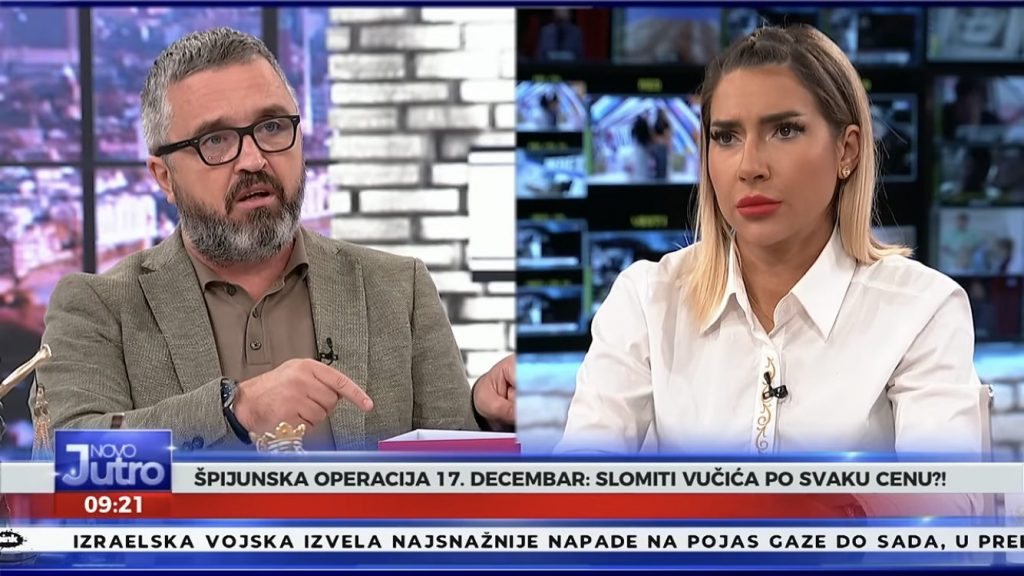
Requiem for evil does not have to be solemn. Sometimes it sounds like a shaky voice on a morning program and like a story about winter tires.

It is necessary, first of all, to somehow get to the act of handing over power, if there is anyone from the Essenes who would hand over power. We want to say: Vučić and his team must not be trusted for even two seconds until the government is constituted

The archive of the weekly Vreme includes all our digital editions, since the very beginning of our work. All issues can be downloaded in PDF format, by purchasing the digital edition, or you can read all available texts from the selected issue.
See all