

News
Batut: In Serbia, 220.000 people do not know they have diabetes
On the occasion of World Diabetes Day, Batut warns that a large number of people have this disease and are not even aware of it, because diabetes can go without symptoms for years.
 Photo: Milovan Milenković
What is planned on the site of the current Fair? Apparently, a large number of buildings and Hall 1, unique in the world, which of those buildings would not even be seen
About the fate of the Belgrade Fair, although there is a lot of talk about it, little is actually known, except that it should be moved to Surčin to the place where the complex for the International Specialized Exhibition EXPO 2027 will be built, which the government persistently presents as the "World Exhibition EXPO".
And what is planned on the site of the current Fair? Apparently, a large number of buildings and Hall 1, unique in the world, which of those buildings would not even be seen.
The professional public warns that the only reason for the relocation of the Belgrade Fair is the expansion of Belgrade on the water.
At the end of October, the Urban Project for the Belgrade Fair, whose investor is Belgrade on Water, was presented, but the project could only be seen, but not commented on.
Specialized portal Beobuild, who follows urban planning in the capital, states that the plans for the conversion and demolition of the Belgrade Fair are far advanced, and this ill-advised action should not go without public reaction.
"And in this case, there are no institutions that would protect the public interest and stop another rush of 'investor urbanism' before irreparable damage is done." The announcement that the Fair will be demolished left many in shock, and there was no discussion of such a dramatic move, nor could the public in any way give their opinion on a first-rate important decision that concerns everyone. Not only is a valuable public space in the heart of Belgrade being privatized, but there is also an intention to demolish the fair complex, which in itself is a world-class construction project and part of the cultural and historical heritage of high importance."
Unique in the world
Hall 1 holds the title of the largest prestressed concrete dome in the world, with an incredible diameter of 109 meters, which ranks it as a true engineering marvel. The Institute for the Protection of Monuments therefore placed protection on Hall 1, but its separation from the complex, as stated by Beobuild, is completely wrong and fundamentally unacceptable
"The fair currently consists of 12 exhibition halls, of which three buildings should be saved from the announced demolition (Hall 1, Hall 2 and Hall 3). This is not about preserving the existing fair functions, but about preserving the material historical heritage. The idea of building a new fair in Surčin, which would meet some modern needs, cannot be placed in the context of the demolition of the existing Fair. Whether the authorities will build a new Fair is a matter of investment criteria and development priorities, and whether the City Government will demolish the existing Fair and why is a completely separate topic."
Two decisions of the Government
As "Vreme" previously wrote, by the decision of the Government of the Republic of Serbia, the Belgrade Fair was declared a cultural monument as a whole in the "Official Gazette of the RS" number 4/2009.
The explanation states that this "cultural monument was built between 1954 and 1957, according to the project of the project team consisting of architect Milorad Pantović and engineers Branko Žeželj and Milan Krstić." It was conceived as a modern urban complex, whose compositional emphasis is placed on three exhibition pavilions under domes, interconnected by footbridges.
As measures for the protection of cultural monuments, "preservation of the authentic appearance of the complex, horizontal and vertical dimensions of buildings, constructive elements of architecture, original materials, functional characteristics and integrity of the space of the cultural monument" and "any change of the architectural whole" were determined.
Already in "Official Gazette No. 16/2009" that decision was changed, so that since March 2009, only Hall 1 of the Belgrade Fair is considered a cultural monument.
"Occupation" of Hall 1
The land on which the Fair is located was sold for an unknown amount to the company "Beograd na vodi", an investor who has already shown his reach in our city in a greedy way.
As Beobuild writes, according to the same matrix, we can also expect the realization of mass housing in a settlement with regressive urban planning parameters and characterless architecture in the area of the Fair.
"Renderings of the future settlement announce that Hall 1 is actually disappearing as a recognizable part of the city's vision, because the construction of a large number of residential buildings that closely surround Hall 1 from all sides is planned, and all of them are, as a rule, significantly higher than it." This means that in the future, Hall 1 will only be able to be viewed from exclusive positions, and as in the case of 'Belgrade on the Water', residential buildings are placed in the foreground."
Where did the plan go?
On the website of the Irish architectural office "Niall Montgomery + Partners" (NMP), a landscape architecture project for the area where the Belgrade Fair is located today was published. However, that plan cannot be found on their website at the moment.
How he looked can be seen in the video on portal N1.
On the visualizations of the project published at the time, instead of the Fair, there are blocks of buildings surrounding Hall 1.
In addition to lavish visualizations, the Irish Bureau also offered a short description stating that "the extension of the Sava Promenade will be a cultural and ecological destination and a world-class promenade that will be decorated with a series of parks, an art center and a ferris wheel next to the revitalized Old Railway Bridge" which, let's remind you, it has not been in operation since the railway traffic in the Sava Amphitheater was abolished.
Former city architect Đorđe Bobić once said that we are witnessing an "illegal action of collapsing the city of Belgrade".
"This is how it is done outside of any institutional actions that are necessary to get the job done. The story is completely unsustainable if we were to stick to the law," said Bobić.
For Božena Stojić, an urban planner from the Ministry of Space, making such strategic decisions without the participation of the public is contrary to the way we plan urban development, which we desperately need in Belgrade.
Prevent demolition
Professional associations ask the authorities to review the decisions, in order to prevent the announced demolition of the Belgrade Fair complex, whose Hall 1 is recognized as one of the reference points for the modern movement in architecture and is interpreted as an architectural heritage of mankind.
They sent the competent institutions an initiative to urgently review all decisions concerning the Belgrade Fair, in order to prevent the announced demolition of this complex.
The initiative is signed by Dokomomo Srbija, the Society of Conservators, and Evropa Nostra Srbija. They referred it to the Ministry of Culture, the Republic Institute for the Protection of Cultural Monuments, and the Institute for the Protection of Cultural Monuments of the City of Belgrade.
On the occasion of World Diabetes Day, Batut warns that a large number of people have this disease and are not even aware of it, because diabetes can go without symptoms for years.

The suspension of the work of the Refinery in Pancevo is considered inevitable, and the only unknown for now is the date when production will be completely stopped.
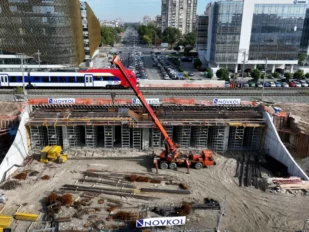
The late joining of Grecia and Surčinska streets, the construction of an underpass between Red Army Boulevard and Art Boulevard, the expansion of Patriarch Pavle Boulevard and many other infrastructure works

Payment of money starts on Friday, November 13, and scheduling is made possible through the website of Poštanska Štedionica

The student movement asks the competent state institutions to examine public procurement, the implementation of contracts, the spending of budget money and the respect of workers' rights in the construction sector.

At the moment when the institutions of the Republic are destroyed, when Vučić's octopus is still alive, when people are disgusted by the injustice and the stench left behind by the Essenes regime, we have, as Machiavelli said, only civic virtue as the fuel with which we can return to the beginning

The four independent members of REM are an example of perseverance and civic responsibility. Rodoljub Šabić even, upon leaving the premises of REM, after the sentencing of the Informer, experienced that the Essenes insulted him, hit him with their hands and feet. But that too will soon be over

Vučić pardoned the batterers and Dijana Hrkalović. The election winners should abolish the sultan's power that allows one man to run afoul of the entire judicial system

Interview: Branko Stamenković, public prosecutor of the Supreme Public Prosecutor's Office
A black picture and the breakdown of the rule of law subscribeThe archive of the weekly Vreme includes all our digital editions, since the very beginning of our work. All issues can be downloaded in PDF format, by purchasing the digital edition, or you can read all available texts from the selected issue.
See all



