

News
Batut: In Serbia, 220.000 people do not know they have diabetes
On the occasion of World Diabetes Day, Batut warns that a large number of people have this disease and are not even aware of it, because diabetes can go without symptoms for years.

There is a possibility of integrating nuclear energy into the existing transmission system of Serbia, but not in the near future, but in 15 to 20 years, says Minister Dubravka Đedović Handanović.
Serbia received the first technical study on implementation nuclear energy for peacetime purposes, and the Minister of Mining and Energy Dubravka Đedović Handanović states that two options are being considered: traditional nuclear power plants and small modular reactors, which are increasingly in focus in the world.
Previously, in May of this year, the general director of Elektroprivreda Srbije (EPS), Dušan Živković, stated that the energy collapse that Europe experienced this spring showed the necessity of large storage facilities that should support the growing amount of electricity from renewable sources.
Đedović Handanović now points out that traditional nuclear power plants provide economic advantages, while small modular reactors offer greater flexibility, the possibility of modular expansion and lower initial investment costs.
"One technology has not been technically and technologically confirmed yet. These are small nuclear reactors that are still under development. We have commercial nuclear power plants that offer economies of scale, while small modular reactors offer flexibility, modularity and offer lower investment costs," Đedović Handanović told RTS.
Integration of nuclear energy into the existing system only in 15 to 20 years
Đedović Handanović pointed out that the study showed that there is a possibility of integrating nuclear energy into the existing transmission system of Serbia, but not in the near future, but in 15 to 20 years.
Construction in phases
Preparation for the construction of nuclear facilities requires the completion of certain stages according to the guidelines of the International Atomic Energy Agency, which last from five to seven years. During that period, it is necessary to conduct additional studies and analyses, as well as to form a body that will manage the development of the nuclear program.
"Those phases last, specifically, the first and second, somewhere between five and seven years. Further additional studies and analyzes should be completed around them, but also a body should be formed that will deal with the development of the nuclear program. We are currently in the process of forming such a body within the Ministry of Mining and Energy, of course with representatives of scientific institutes but also other institutions that can contribute to such an undertaking," said Đedović Handanović.
She specified that this, first of all, refers to the training of professional staff, with an estimate that the entire process will cost around 30 million euros.
Đedović Handanović pointed out that the training of professional personnel is a key part of the strategy.
"At the end of this period, a decision will be made on the choice of technology and partners with whom Serbia will cooperate," she stated.
Intensive cooperation with Russia
In May, Russia pointed out that it is ready to offer Serbia a complete range of solutions: from low-power nuclear power plants to high-power power blocks.
Back in April 2019, at the international conference on nuclear technology AtomExpo in Sochi, Serbia signed two memoranda with Rosatom.
Cooperation with potential partners
Serbia's partners in the development of nuclear energy have not yet been definitively chosen. The French company EDF is working on the first technical study, and Serbia has a cooperation agreement with the French government for the early stages of program preparation.
"France has an extremely large experience, because about 70 percent of its energy is produced in nuclear power plants and it manages a large number of such facilities. This is valuable knowledge that I can transfer to a developing country, such as Serbia. However, when we talk about the construction of nuclear power plants, France has not built them for a long time. South Korea and Russia also have a lot of experience with nuclear energy. We intend to sign a cooperation agreement with South Korea regarding both types of technology in the next two months, so I think we will give ourselves the opportunity to consider cooperation with partners from different countries", said Đedović Handanović.
On the occasion of World Diabetes Day, Batut warns that a large number of people have this disease and are not even aware of it, because diabetes can go without symptoms for years.

The suspension of the work of the Refinery in Pancevo is considered inevitable, and the only unknown for now is the date when production will be completely stopped.
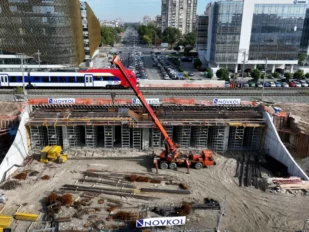
The late joining of Grecia and Surčinska streets, the construction of an underpass between Red Army Boulevard and Art Boulevard, the expansion of Patriarch Pavle Boulevard and many other infrastructure works

Payment of money starts on Friday, November 13, and scheduling is made possible through the website of Poštanska Štedionica

The student movement asks the competent state institutions to examine public procurement, the implementation of contracts, the spending of budget money and the respect of workers' rights in the construction sector.

At the moment when the institutions of the Republic are destroyed, when Vučić's octopus is still alive, when people are disgusted by the injustice and the stench left behind by the Essenes regime, we have, as Machiavelli said, only civic virtue as the fuel with which we can return to the beginning

The four independent members of REM are an example of perseverance and civic responsibility. Rodoljub Šabić even, upon leaving the premises of REM, after the sentencing of the Informer, experienced that the Essenes insulted him, hit him with their hands and feet. But that too will soon be over

Vučić pardoned the batterers and Dijana Hrkalović. The election winners should abolish the sultan's power that allows one man to run afoul of the entire judicial system

Interview: Branko Stamenković, public prosecutor of the Supreme Public Prosecutor's Office
A black picture and the breakdown of the rule of law subscribeThe archive of the weekly Vreme includes all our digital editions, since the very beginning of our work. All issues can be downloaded in PDF format, by purchasing the digital edition, or you can read all available texts from the selected issue.
See all



