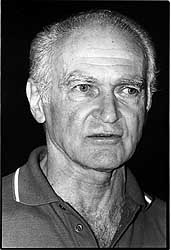
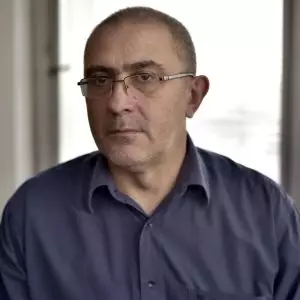
We say goodbye to Sergi Lukač, journalist, founder of the journalism department, old Ninovac, man of wide culture, polyglot and athlete. He was a sprinter in his youth. Until his old age, he cultivated the classic ancient virtue that unites a healthy body with a healthy mind.
He gave away his knowledge gathered in Grenoble, Zagreb, Belgrade, and America where he studied, and he gave away his refinement and that something special from spirit of Mostar, where he spent his childhood.
Belgrade gets a chair of journalism ninety years after the establishment of the first American journalism faculty at Cornell in 1877. It was in the 1953s and it was not easy. Before that, in 1948, for undisclosed reasons, allegedly due to excess staff in journalism, the Diplomatic and Journalist School, which after XNUMX worked in the building of the former elite gymnasium of King Alexander on Topčiderska zvezda, was abolished.
The founder of the journalism department at the Marxist FPN, Sergije Lukač, was struggling at that moment in the clinch between the agitprop activists and their understanding that journalists are socio-political workers, and on the other hand, some traditionalist editors at the time who spoke out against " book journalists". In one text, Sergije wrote that lecturers from the ranks of journalists, those practitioners, were treated as university pariahs in university circles...
Sergije Lukač marked the rise of Serbian journalism in the sixties, seventies and eighties and an important turning point towards journalism of rational analysis. He was one of the old people from Nino who contributed to this weekly accepting the "newsmagazine" formula in the seventies as more appropriate to the circumstances than the earlier "opinienmagazine".
The section he edited in "NIN" was called "Modern Life". His style was lively, and his journalistic language was unusual, concentrated to the point of linguistic dislocation. In Serbian journalism, his texts leave traces of attempts at modernization.
Students loved Sergi's lectures, his liveliness, associativeness, multidisciplinarity, a kind of Renaissance formula in which art, literacy and broad culture are combined, all with research persistence and X-ray illumination of the background. Once, when his Partizan lost to some Germans (as is the rule in the second half), in a journalist's research he even came to the fact that most of the first team members of Partizan did not have a watch in their homes when they were children. He knew he was offering readers more than they needed - he vividly recounted how he watched a man with black nails struggle with his psychoanalytical passages in a sports report on a train, asking only what minute a goal was scored.
Let no one be offended, the anecdote says that Sergiu Lukács differed from most journalists in that he always wore a clean, ironed shirt. Both as a pedagogue and as an editor and as an author, he hinted that the end of journalism as a bohemian profession was coming. Make no mistake, this does not mean that he underestimated the talent. He said that the best journalism schools in the world first rigorously test the talent of the candidates, and then, over the course of ten semesters, they first give them a broad general education from which they can easily move into a specialized field, then they provide them with knowledge of expression techniques, all the way to "acting expression" in front of the cameras and feelings of measure in the emotional dosage of information. Finally, they cultivate intellectually confident personalities who are not afraid to express their views - but only those based on thoroughly researched facts. For him, journalism is responsible public action, based on knowledge and ethics, freed from the veil of excessive moralizing.
He considered the gift and integrity of journalists as an indivisible whole. In recent difficult years, he said that the method of training followers is not too sophisticated - since journalists are stripped of their gift, knowledge and integrity, journalistic mediocrity is retained and selected. There is no need to put drastic pressure on such a personality profile...
Both as a pedagogue, as an editor, and as an author, Sergije cultivated a kind of Arthurian orientation towards the future. It will be quite appropriate to quote here a part of one of his texts ("Universal Omniscient or Non-Knowing", "Time" 395, May 16, 1998) about the coming communication era:
"And what will the next thirty years bring?"
Right around the corner of the year 2000, the world will see a communication Arcadia with a thousand flowers: from journalism to PR and lobbying, from business to artistic, sports, economic, political, scientific, even pornographic communications. It will be proof plus that we are in the middle of the communication era.
The beginning of the third millennium will welcome us with new technical-technological, electronic, impossible possibilities of telecommunications and informatics. According to them, today's miracle Internet will soon look like a fossil from the Paleolithic. The gap between events and reports will melt to zero, and informational globalism will seem like a matter of course to children. The journalist will report at the speed of light, and in his bag he will carry electronic memories about everything and anything. There will be fierce competition!
The twenty-first century will bring a mass of educated and, therefore, more curious media consumers. Consumers of information will demand instant answers to those five basic journalistic questions: WHO, WHAT, WHEN, WHERE and HOW, but they will seek insight into the in-depth dimensions of events. It will be up to that educated audience to give an answer to the question of why something happened and what will happen next. Professionals know that these two questions draw the line between knowing and not knowing, between being and not being fully informed. And all that will depend on the journalist. And, as in all professions, there will be journalists here too - masters and pacers who will be chosen by mature or immature consumers of information. There have always been, and always will be, people who want to be manipulated. Some simply cannot take responsibility for making their own decisions. But there will be fewer and fewer of them. Informing the politically educated breaks down the prisons of mental limitation, fanaticism, bringing communication, tolerance and feelings of solidarity with all people.
In the 21st century, journalists will face even fiercer pressures from political and economic forces. They have always sought to abolish the right to diversity and establish a monopoly of their truth. The least they want are journalists who will be the mouth of the people intended for the ears of the ruler. It is simply cynical and incomprehensible how much tyrants care about good public opinion. Historically, these brutal forces won some battles, but in the end, like any dictatorship of lies, they lost the wars. Journalistic Goebbels and their masters are short-lived."
For our colleague and teacher Sergi Lukacs, journalism is actually a Promethean mission. He asked himself and others that this mission should be carried out with the ease of a sprinter.
You will not blame me for saying something very personal here - I loved him like a father and remain in his great debt.
Goodbye professor, may the heavenly paths be easier for you than the earthly ones.