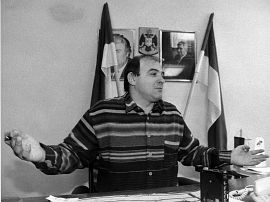
There are situations where all the money in the world doesn't help. Momčilo Mandić, a former policeman and right-hand man of Radovan Karadžić, and later one of the richest people in Serbia and beyond, was arrested in his Budva apartment on Wednesday, August 17, and sent by express to Bosnia. Mandić was not helped by the fact that he is the owner of almost all the most important companies in eastern Bosnia, which is estimated at a hundred million dollars. neither the dual Serbian-Montenegrin citizenship nor the great connections in Belgrade and Podgorica helped him. Thus, after only a few hours of vacation, Mandic found himself in the maximum security prison in Kula near Sarajevo, where he will await trial for organized crime. In 1992, when Mandić was Karadžić's Minister of Justice, about ten thousand Sarajevo citizens passed through the Tower, mostly civilians, who (as Mandić later admitted) were treated extremely inhumanely, and although Mandić can count on much better treatment, there is a certain poetic justice in the fact that his incredible career ends at this very place. Despite all the whining of lawyers and some officials in Belgrade that the arrest and delivery were illegal, and that it was in fact a kidnapping ordered by foreign powers, it is unlikely that any of Mandić's friends, in SCG or in Bosnia, will let him go. a tear. The rise and fall of this professional patriot, who publicly boasted of setting up and overthrowing governments in Banja Luka and Belgrade, speaks volumes about the connections between politics, sports and the dirty money of organized and war crimes.
Momčilo Mandić, born in Kalinovik, the village from which general Ratko Mladić sprang up and escaped, was an ordinary policeman in Sarajevo, employed in the narcotics department, until the war in Bosnia. Later he liked to say that even then he was a wealthy man, and that he owned several bars, although he never explained how he acquired them from a modest police salary. His dizzying rise, however, begins after the first multi-party elections in Bosnia, when the fragmentation of state institutions along national lines begins: Mandić's godfather and friend Alija Delimustafić becomes the Minister of the Interior, and Momo his deputy. Much, much later, it will be known that Delimustafić was recruited by the military Security Administration (so-called KOS); that Mandic was close to Karadzic, and even more so to Momcilo Krajisnik, was immediately known. In the spring of 1992, when the war broke out, Mandić and his friends moved to Pale and soon became the Minister of Justice, while Delimustafić remained in Sarajevo, in his position. The godfatherism, friendship and business ties of these two men continued through the war and after it. By the way, Delimustafić is also currently in prison, in Tuzla, where he is lying because of similar criminal acts for which Mandić "fell".
FIRST A MILLION: Promućurni Mandić did not stay long in Pale, with Karadžić's satraps: he was drawn to Belgrade, the center of real power and money. At the end of 1992, Karadžić appointed him head of the Bureau of the Republic of Srpska at Moše Pijade Street number 8, where two floors were set aside in a large office building for the purposes of the Bureau. At the same time, he was also awarded the villa "Bosanka" in Užička na Dedinje, after several million marks were spent on its adaptation. After all, Mandić did not arrive in the capital empty-handed: he took a couple of million from the coffers of the Ministry of Internal Affairs of the RS, to be found, and during those few months of ministering in Pale, he managed to step deep into the mass theft of golf balls from the factory in Vogošća: disappeared five thousand new cars were sold, plus wagons of spare parts. The RS Bureau was working at full speed, issuing passports to refugees for a thousand marks each, collecting "war taxes"... It was, and it overflowed: somehow, just at the time when Mandić opened the "Aleksandar" bar in Belgrade, the Bureau's coffers inexplicably disappeared million marks. "There was no safe, so the money stayed in the closet, and the security was weak," it was said at the time.
During his stay in Belgrade, which spanned twelve rich years, Mandic expanded his business and connections with influential people, including the family of Slobodan Milošević. He was, if Biljana Plavšić is to be believed, particularly close to Mira Marković and her political party. "He always said that it was difficult for him to forget his KP, and according to his mafia abilities he answered to the president of the Directorate of JUL." Behind the establishment of these connections, the entire former Yugoslavia represented an Eldorado for Mandić's criminal ventures that engulfed the entire region," Plavšić wrote in her memoirs.
Mandić met the end of the war in Bosnia as a respected and successful businessman, perfectly integrated both in the Milošević regime and in post-Dayton Bosnia and Herzegovina. He had certain problems when Biljana Plavšić and Milorad Dodik were at the head of the RS, with whom he had long had bad relations, both for ideological and business reasons. However, that government was short-lived, thanks among other things to Mandić, who, along with financial support for the Serbian Democratic Party, also gained sympathy for the Democratic Party of Serbia and Vojislav Kostunica. "I am a supporter of the DSS because it is a sister party to the SDS," said Mandic in an interview with the Sarajevo-based Slobodna Bosna. "Because of that political love, I overthrew Dodik's government and returned SDS to power."
NEEDLE U GARDENS: Mandić welcomed the end of Milošević's rule carelessly, with friends and sympathizers on both sides of the Drina. Even his friends were not left in debt: thanks mostly to SDS, Mandić became the owner of Privredna banka Srpsko Sarajevo in 2001, by obtaining a loan from the same bank in order to buy it. As established by the investigative authorities of the RS, Mandic gave loans to his companies and spent money for his private needs, among other things, by buying himself, his family members and his friends ten cars worth about half a million convertible marks. A million marks were lost, which the Ministry of Finance of the RS paid to the bank for external debt servicing, 3,5 million marks from the Housing Fund, 2,2 million KM from the municipality of Bijeljina... The bank has since gone bankrupt, and was recently closed by the decision of the High Representative of Bosnia and Herzegovina Paddy Ashdown. Previously, the investigation established that the former SDS leaders Dragan Kalinić, Mirko Šarović, Momčilo Krajišnik and Milovan Cicko Bjelica were involved. With the closure of the bank, several tens of millions of convertible marks, which the bank owes to its depositors, were lost.
By taking over the bank, as well as buying a whole series of companies on the stretch from Foca to Trebinje, Mandić expanded his ties and sympathies even more, but it seems that he failed to find a common language with Zoran Đinđić and his government. Therefore, he invested money in the Belgrade tabloid "Nacional", which attacked the government in an unprecedented way. After the assassination of Đinđić, Mandić was arrested in Operation Saber, and "Nacional" was closed. The second municipal court in Belgrade announced at the time that Mandic is suspected of illegally transferring around six million euros from Serbia and Montenegro to Bosnia between November 2002 and March 2003. It was also said that Mandić, as chairman of the board of directors and advisor to the general director of Privredna banka Srpsko Sarajevo, without the permission of the National Bank of Yugoslavia, from November 2002 to March 31, 2003, engaged in banking business through the representative office in Belgrade. As specified, he ordered the illegal transfer of effective foreign money in the amount of 6,04 million euros from SCG to BiH for the needs of Chinese citizens. And finally, in the yard of the "Bosanka" villa, which Mandić still used for who knows what reason, an anti-aircraft rocket launcher "Igla" was found. It seemed that Mandić was threatened with long-term imprisonment.
However, he remained in prison for only five months, and was released due to "lack of evidence", and all proceedings against him were suspended. It seems that the court of inquiry believed his explanation that he acquired the "needle" during the NATO aggression, in order to shoot down enemy planes. "I still don't know whose prisoner I was for five months," Mandic said after being released from detention and explained that his only sin was sympathy for Koštunica, which he was allegedly informed about by a high-ranking MUP official. At the same time, he announced that he would sue Serbia at the European Court in Strasbourg, which he never did.
In the same year, Mandić's name appeared in another unpleasant affair: his godfather and business partner Delimustafić, under the false identity of Gojko Mitrović, was arrested in Belgrade. Delimustafić was hastily extradited to Bosnia, just like Mandić these days, and it was never clarified what he was doing in Belgrade and who he was associating with. The Sarajevo press claimed that Delimustafić was staying in the villa "Bosanka" all the time.
TROUBLE SA I'm rising: Although he escaped imprisonment, 2003 was in many respects the year in which Mandić's lucky star dimmed. Unlike some other dubious businessmen, he failed to remove his name from the American government's blacklist as a person suspected of helping Radovan Karadzic, and the same year the European Union put him on its own such list. In addition, increasingly loud accusations against Mandić began to arrive from Bosnia through the mouth of Paddy Ashdown, first for protecting Karadžić, and then for embezzlement in Privredna banka, for which a warrant was issued for him. What is even more unpleasant, he received an invitation from the International Criminal Court in The Hague to testify against Milosevic, with a note that if he refused, he could easily find himself among the accused. Mandić testified in The Hague in the fall of 2004 and proved to be extremely cooperative: he spoke the worst about his former friends Karadžić and Krajišnik, admitted that Muslims were ethnically cleansed, and spoke in detail about the murders and mistreatment of civilians in the camps. It seems that the Hague testimony was the main reason that the warrant, which was issued in Bosnia in 2003, was never forwarded to Interpol: the existence of an international warrant would have significantly complicated Mandić's journey and stay in The Hague. However, having escaped the indictment of the Tribunal, Mandic did not solve his problem with Ashdown, who seems to have decided to put him in prison one after another.
At the beginning of this year, the Bosnian authorities arrested Mandić's older son Aleksandar, an official of his father's company "Mani ko" and one of the beneficiaries of his father's Privredna Bank loan. Aleksandar pleaded guilty, apologized to distressed depositors, and received fourteen months in prison. It was a heavy blow for Mandić. "Only when my son is released from prison, I am ready to talk about the business relations of Ashdown and Karadžić", he threatened from Belgrade. Although Aleksandar was released after the trial to await the summons to serve his sentence, Mandic did not fulfill that threat either.
Apart from that, it seems that the sympathy between Mandić and Kostunica stopped being mutual at some point. Mandic often publicly denied that he helped DSS with money in addition to emotions, but it seems that after coming to power, the ruling party found more respectable sympathizers and started denying him protection. By taking out a Montenegrin passport (he had a Serbian one for a long time) and buying an apartment in Budva, Mandic obviously tried to secure a refuge. It would be better for him if he didn't.
Momčilo Mandić fell, as a source from the Bosnian State Investigation and Protection Agency (SIPA) confirms to "Vremen", because of the "blackmailed Milo Đukanović", who, between himself and Mandić, decided to hand over the latter. "SIPA only took over Mandić, while everything was done at the international level, with great political pressure on Đukanović," says our source. Those who these days raise a fuss about the violation of the procedure and shed crocodile tears because of Mandic, have probably already come to terms with the loss of sympathizers and sponsors. Just as, after all, those unfortunate people for whose misery Mandic amassed millions have come to terms with their loss a long time ago.
Besides being a successful businessman, Momčilo Mandić was also a prominent sports worker. Among other things, he was the director of the Partizan Handball Club, a member of the Board of Directors of the SCG Handball Association and the president of the Republika Srpska Judo Association, and his younger son Vladimir is a well-known handball player. "We have a really great president. Mandić helps financially and also acquires sponsors through his connections. I have to point out just a couple of things he did. He got the federal judges new suits. He provided 400 square meters of mats, even 100 kimonos for the work of the clubs. There are almost no competitions that he did not help...", said judoka Milanko Mučibabić about him.
In handball, however, it wasn't always roses for Mandić. In March of this year, the president of the Board of Directors of RK Partizan Vladan Begović accused Momcilo Mandić of driving away Aleksandar Lupšić, the president of the assembly and the main financier of the club, and of insulting the players on religious grounds. It was even heard that Mandić threw a bottle at Lupšić at the meeting of the Board of Directors, while he called SCG representative Alem Toskić a "Turk". Mandić stated that he did not pull the bottle, and that "Begović is frustrated because he will not admit that he is a Muslim." The conflict was resolved with Lupšić's resignation.
D.A.

U books I testify Biljana Plavsic it says o Momchilu To Mandic kao protector robbers group u toku rat, which je enjoyed it full Karadžićeva protection. Next paragraph discloses one theirs meeting:
"In July 1992, I had a meeting in Lukavica with the UN High Representative for Refugees, Mrs. Sadako Ogata. There was always a lot of people at the crossroads, where the roads to Trebević, Grbavica and Lukavica diverge. A group of people just waved at me and I got out of the car. They got straight to the point. They talk about the events in Grbavica, and they are Serbs. According to them, it is dangerous for people of non-Serbian nationality to live in that part of the city. They told me that a certain Batko with several of his ilk breaks into Croat and Muslim apartments at night and takes men away. They rob and blackmail people. The Serbs who opposed it became the target of that maniac and his gang. Nobody knows him. He is not from Grbavica and he is not from Sarajevo. They take the looted things to a motel where they have a warehouse.
Instead of going to Lukavica, at the intersection I turn to Grbavica and straight to the municipality building. There was no president of the municipality, but it didn't matter, others quickly gathered. I tell them why I came and ask them if it is possible that such evils are allowed. They are silent. I look at those faces and wonder why they are so stubbornly silent, and their looks are not friendly at all. I ask them who their mayor is. They mentioned his name. He is a doctor who deals in drug trade, he represents a company, he is Montenegrin.
After that short meeting in the municipality, I go to the Headquarters of the Territorial Defense with the intention of talking to Zoran Vitković. He confirmed everything to me. Batko is a Montenegrin, he has his own gang that robs and has some support from some authority. On that occasion, he told me about the warehouse where they store the looted items. He says that Momčilo Mandić, then Minister of Justice, is in charge of the warehouse. While we were talking, four or five armed young men burst into the room. One of them is short, broad, on his head is a shajak with a cockade, pulled up to his eyebrows. He looks at me with a look full of hatred. I started immediately, and Zoran saw me off and said that it was Batko...
From the meeting with Ogat in Lukavica, I sped away at high speed to Pale, to try to prevent the actions of the crazy Batko. I enter one of the rooms in "Kikinda" and there I find all the relevant people for solving this problem. There are Radovan, Momo, Momčilo Mandić, Minister of Justice, Mićo Stanišić, Minister of Police. I immediately moved on to events from Grbavica. I expect wonder, concern, astonishment, but none of that. Momčilo Mandić grimaced (that's the right expression for his face at that moment) and said: 'Ah, Batko...' Then I told them that I thought they were not familiar with such phenomena and that person, so I intended for them to issue an order to they arrest him. 'But now I see that you know everything and now I am asking the Presidency to arrest you two.'
I turned to Karadžić as the president of the Presidency and asked that these two ministers be arrested, or that they resign immediately. That's when I had my first serious conflict with Radovan and Momo. Radovan's answer, to my repeatedly repeated request for the resignation of these ministers, was always: 'You ask me to cut off my right hand.' Since then, until 2001, but it will certainly be like that for the rest of my life, Momčilo Mandić has been haunting and threatening me. These are not the threats of an ordinary man, these are the threats of the biggest mafioso in this area..."