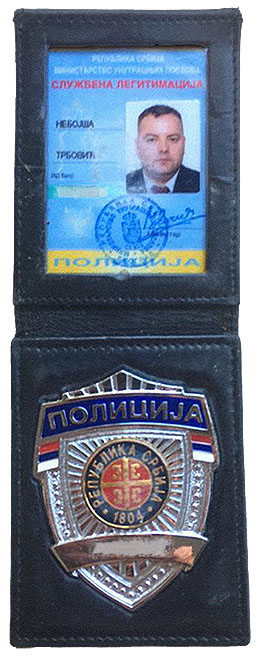
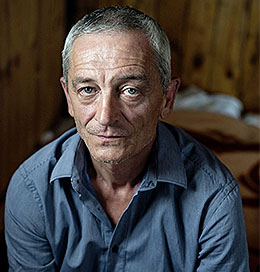
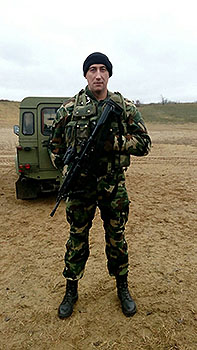
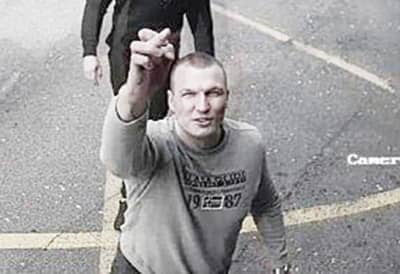
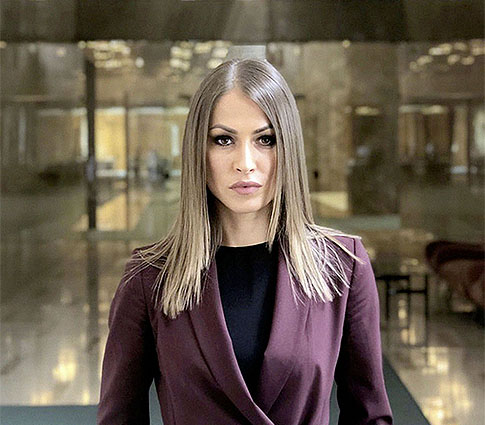
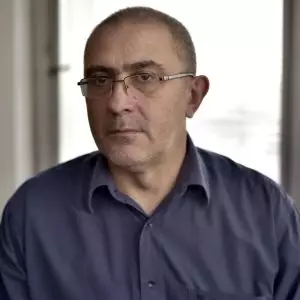
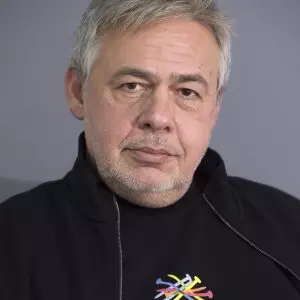
Former inspector Nebojša Trbović is one of the witnesses as well as a participant in the social changes that have befallen Serbia in the past two decades. His professional career in the BIA, the Ministry of Internal Affairs and, subsequently, leaving the police largely reflect the trials that these services and the country itself went through and are still going through.
"WEATHER": How did you end up in the security services??
NEBOJŠA TRBOVIĆ: I graduated from the Faculty of Economics in Belgrade and started working in the Department of State Security after October 5, 2000. I went through the complete procedure: tests, psycho-tests, health examinations, interviews... I started working in the State Security in 2001. This means that you start with the simplest jobs. It is about the Secret Escort Department, and in that year you complete a six-month State Security course, various types of training and become familiar with all kinds of regulations and laws related to State Security. Specifically: what means does it use in its work, what does DB do, what role does it play in the defense system, and so on.
When you switch to operational work?
After a year in the Secret Escort Department and the aforementioned course, I transferred to operational duties in the then Third Department of the Department of State Security, Center Belgrade. At that time, it dealt with extremism and terrorism, and I worked in the Department for Serbian Terrorism and Extremism, whose responsibility, after the Fifth of October, included the fight against organized crime.
How long have you been working in State Security??
I was in the State Security until 2003. Disappointed a bit with what was happening there, at my request on March 5, 2003, I transferred to the Directorate for the Fight against Organized Crime (UBPOK); the head at that time was Boro Banjac, and his deputy was Dragan Karleuša.
I stayed at UBPOK until 2009, when I left for the Criminal Police Directorate (UKP), Department for Counterintelligence Affairs. Only Milutin Ateljević Tinko worked with me there. He also came from the State Security - at that time already BIA - but unlike me, he transferred as an unassigned staff. Namely, in the fall of 2002, Andrija Savić was appointed director of the BIA and a sort of triage was done. It was the first attempt to carry out personnel reform in the BIA following the example of some Eastern European countries. However, with us, everything is relative: people were unassigned for six months, and then - as someone found the connection - they were returned to the BIA or went to the MUP. Then the Department of State Security was abolished. The Security Information Agency (BIA) was formed, the number of employees was reduced... Generally, people who had some affairs behind them were transferred to work in the MUP, which was the goal and meaning of these changes.
The department in which Ateljević and I were was abolished after 2009 and then transferred to the Cabinet of the Minister of Internal Affairs as the now famous Department for Security Affairs where, after the arrival of Nebojša Stefanović, Goran Papić and his company were brought in; they worked on monitoring, eavesdropping, surveillance of journalists and the like.
This Department was actually created during the time of Ivica Dačić: Branko Lazarevic requested that the Department for Counterintelligence Affairs be abolished in the UKP and that it be transferred from the UKP to the Minister's Cabinet as the Department for Security Affairs. Therefore, one operational department - which was not the case until then - should be under the authority and competence of the minister. Later, they expanded its powers to issue certificates for access to secret data, and among other things, it was in charge of counterintelligence protection.
I did not go to that Department, but in 2010 I was transferred to Internal Control and appointed head of the Department for Criminal-Administrative Affairs. Until 2017 and my leaving the MUP, I was in Internal Control.
When your first problems occur?
Already in 2009, my colleague Dejan Tripković and I discovered that the head of the Service for Special Investigative Methods (SSIM), Goran Biorac, was secretly recording his telephone conversations with the leaders of the MUP, as well as with other persons with whom he had telephone contacts. He did not inform the interlocutor that the conversation was being recorded, but without their knowledge, he recorded conversations with, for example, the director of the police or the minister of the interior, Jočić.
Why did Biorac secretly record the conversations?
I don't know exactly. At that moment, it almost became a custom in Serbia for individuals from the world of politics, security services, police, and even business people to record conversations with other people. I assume that some had the intention of protecting themselves, in the sense that the next day, when someone asks them why they did something, they have confirmation that their superior ordered them to do so by attaching a recorded conversation. It is possible that some planned to use those recorded conversations to blackmail individuals in order to advance in the service.
I'm not sure what Biorc's motives were, but I know that he saved the recorded conversations on a server in the Ministry of Internal Affairs. In addition to the Minister of Internal Affairs and the Director of Police, he filmed, for example, the Minister of Defense Dragan Sutanovac and many others. We saw a suspicious file on that server and found those conversations, about which we informed the head of the UKP and the director of the police.
What action did the authorities take after you informed them??
After a year, Biorac was dismissed, a criminal report was submitted to the competent prosecutor's office, which ended up in a drawer. When Tripković and I went to find out what was happening with the application, there was a big question mark on the envelope and the word "agreement".
What it means?
I assume that an agreement should have been made with someone regarding further work on that subject. And then my first problems started. Because of the "Biorac" affair, Tripković and I were transferred to other workplaces - in my case it was the Police Department for the City of Belgrade, Department for Forgeries and Frauds. I worked there for about six months until the "Questionnaire" show on RTS in which Tomislav Nikolić, then president of SNS, asked Ivica Dačić why the two of us were moved from our jobs - what was happening and who is the man recording our conversations . After that, Dacic assigned me to the Department for Internal Control, Dejan Tripković to the Department for Security Affairs at the Minister's Cabinet, and Goran Biorac was dismissed and then left the MUP.
That's another story of how that Service for Special Investigative Methods (SSIM) operated, where the wiretapping system was located. She was always interesting to everyone, especially the minister's cabinet, and in fact, according to systematization, she was in the Directorate of Police and should not have had any contact with the Minister of Police. Everyone wanted to bring their man there in order to know who was being eavesdropped at that moment and what the contents of those conversations were.
What happened in the meantime with SSIM?
Since it was formed, the Service for Special Investigative Methods has had problems. There was no way that a person could be brought into it who would lead it in a legal and professional manner - that Service was supposed to be an operational service, and over time it turned into a source of affairs and criminal acts, which it remains to this day.
Is 2012. with the change of government, something changes with this Service?
After the departure of Biorac, Boris Gara was brought in. However, he was later accused of giving confidential police data to members of Darko Šarić's organized crime group and of giving Branko Lazarević, Ivica Dačić's chief of staff, access to information about who was being eavesdropped and the content of those conversations, despite the subordination system. Both were later released.
In 2012, Gara's place was replaced by two people from Internal Control, Ivan Petković and Ljubiša Puzović, after the conflict between Gendarmerie Commander Bratislava Dikić and Rodoljub Milović over some kind of wiretapping. Although we are talking about professionals, it is still a kind of reward because the two of them worked on the case of Bratislava Dikić. They remained there until 2014 or 2015, when they returned to the Internal Control, and Dejan Milenkovic Bagzi, who was brought in by Dijana Hrkalovic, took their place.
When Dijana Hrkalović actually appears?
I first heard about Hrkalovićeva when a working group was formed for the head of the UKP, Rodoljub Milović, regarding the famous "Papaja" affair. At that moment, she was the deputy chief of staff of Minister Stefanović and, formally speaking, she had no responsibilities in the Directorate of Police. However, that working group was not formed at the level of the Directorate, but by the decision of the minister, it was composed of employees of the Internal Control. Then, at a morning briefing, I heard about Dijana Hrkalović for the first time from the inspectors whom I was in charge of and who were members of this working group.
Hrkalović was in that working group?
As deputy chief of staff, she was the head of that working group. This is incredible, since the head of the cabinet should deal with administrative issues and the organization of the work of the cabinet itself. The fact that Hrkalović is the head of the working group and has the main say in it was a huge surprise for me. In fact, the arrival of Branko Lazarevic already showed the intention to impose himself as the minister's operative.
Both Lazarević and Vanja Vukić, as his deputy, tried to influence personnel decisions as well. The then police director, Milorad Veljović, resisted and did not want to allow people whom he could not control or did not trust to be appointed to certain positions. Although the minister cannot appoint personnel in the Directorate without the consent of the director of the police, Veljović occasionally made compromises.
Therefore, first Branko Lazarević started to influence the appointments, and when Dijana Hrkalović came, no one offered any resistance. Veljović knew that he was going to retire and left Hrkalovćeva to lead the main speech. When he became Vučić's advisor, Stefanović appointed and replaced him however he wanted, at the suggestion of Hrkalović.
Where does Dijana Hrkalović's power come from??

photo: Milan IlićRodoljub Milovic
It is common knowledge that there is formal and informal power. For example, Rodoljub Milović could have said to Hrkalović "who are you to ask me questions", but he didn't. Namely, he knew that Minister Nebojsa Stefanović was behind her and that if she did that, she could end up as an operative in Barajevo. Therefore, Hrkalović's power was drawn from Minister Stefanović. It was as clear as day: she formally has no authority, but if you object to her, she goes to Minister Stefanović and tells him "send this one to Lazarevac". And Stefanović does it. Very simple.
During August 2014. years, The Department for Security Affairs receives the authority to implement the Data Secrecy Law at the Ministry level in terms of conducting security checks for individuals and legal entities in order to issue certificates for access to classified data, as well as for providing the conditions for the formation of the Sub-Registry for the exchange of foreign secret data with the Ministry. What does this department actually do?? Is this the moment when it is created within the MUP? and the department that deals with monitoring and eavesdropping outside of legal procedures?
That Department, which is very important, is not in the Directorate of Police. This is very important because for the first time in the history of the MUP there is an operational department that answers to the minister. In the MUP system, the only operational service that answers to the minister is Internal Control. This is also problematic, but through the Department of Security Affairs, for the first time, you have operatives who can act according to the Code of Criminal Law.
This department was initially limited to ten people, later expanded to twenty and served to house wives, relatives, friends... Only after the arrival of Dijana Hrkalović and Ivan Ristić as chief of staff did the department begin to be filled with their people - sometimes from police stations, and sometimes and from the street, as is the case with Stefanović's godfather Goran Papić or Vladimir Tintor, the minister's fitness trainer. Then these people are given operational tasks that they should not be doing in that Department at all.
Which, for example?
Let's say, covert surveillance. There are two bases for covert surveillance. One is from the Criminal Procedure Code where you have a court order to conduct secret surveillance with or without wiretapping. Another possibility is from the Law on Police when, based on the knowledge that a criminal offense may be committed, you monitor an object, even a person, 24 hours a day. They were undertaking these other actions. Of course, before that you have to write some act, an official note, information from associates, open a case or operational processing, which they did not do because the people they secretly followed were mostly journalists and politicians. Among others, from the Serbian Progressive Party. And they followed, for example, Vojislav Šešelj when he came from The Hague.
Do you know who else they followed??
From journalist Sveta Marjanović when he became an advisor to Zorana Mihajlović, then Minister of Transport, Milinka Veličković from Megatrend, journalist Svetlana Vojinović, among others. We can only guess who was followed and eavesdropped because later all those boards were physically destroyed.
The case of Milinko Veličković is interesting?
When information appeared in the public that Stefanović had plagiarized his doctorate, suspicions arose that Veličković could have disclosed it to the public, and an order was given to monitor him. However, Veličković somehow found out about it and came personally to the minister's office and asked if it was true. Stefanović lied to him and said that he was not monitored.
A Sveta Marjanović, why was he interesting?
I assume that his contacts were interesting because of Dmitr Đurović, then director of the Corridor of Serbia, minister Stefanović's godfather.
To whom were all those reports delivered??
Dijana Hrkalović and Ivan Ristic, Chief of Cabinet of Minister Stefanović.
And to Minister Stefanović?
I think he was informed about everything, because when he was informally informed in 2016 that the law had been violated, he ordered the destruction of all the data on the hard drives.
We'll get to that case., just before that can you tell me who else knew everything about the activities of this group?
They met Nebojša Grujić and Milutin Ateljević. Those people who carried out secret surveillance and escort used assigned official vehicles, since they stayed after working hours, they wrote overtime hours, and all of this was signed by Grujić and Ateljević. They knew about their afternoon activities.
In November 2015, the head of the Department for Security Affairs, Nebojša Grujić, receives a decision on his transfer to the Department of Internal Control, and solutions are given to Milutin Ateljević as the head of this Department and Aleksandar Ljubičić as the deputy head of the Department. What does that mean practically??
As I recall, Grujić came into conflict with Hrkalović or Ristic and was transferred to my service. Ljubičić came directly at the request of Dijana Hrkalović. I've never heard of him. He was brought from some police station.
In that period, excessive and unlawful processing of personal data with a huge number of requests to the information system of the MUP was observed. a?
The information system of the MUP contains data on all citizens of Serbia: addresses of residence, all their changes, motor vehicles they own... You can also see the files of individuals - whether they have been punished for misdemeanors or crimes. In their daily work, members of the MUP use this information system for identification or various types of checks. The increased number of entries into the information system raises suspicion because the Department of Security Affairs should not have contact with the public given its job description.
Did you try to warn Minister Stefanović that the law is being broken in this department?
We did, and through his father Branko Stefanović, whom, due to circumstances, Dejan Tripković knew. At that moment, we were convinced that Minister Stefanović did not know that. And then Dejan Tripković also warned Tanja Santrač, advisor to the minister, about the same things. She promised to inform Minister Stefanović about everything, and the very next day Aleksandar Ljubičić, Dejan Pejić, Dejan Udovićić, Marko Zorica, Darko Luković, Srećko Lazić, Vladimir Tintor and Goran Papić were removed from the Department. Most of them were sent from the Department to other organizational units while keeping higher cabinet salaries.
Were they punished or rewarded??
Awarded, of course. Tintor went to Rome as an attache, Darko Lazić became the head of the corruption department in SBPOK in... Only Ljubičić went to the Department for the fight against terrorism as an ordinary operative, but he also later agreed and got a management position. It was just a smokescreen to show the disaffected that the Department had been disbanded, and they already had a bad reputation in the media anyway. For example, Ateljević was brought into contact with Ratko Romić, with whom he worked in the State Security. However, they were expected to continue with their activities because Papić went to SBPOK and became the deputy chief there.
Did Vučić know what was happening??
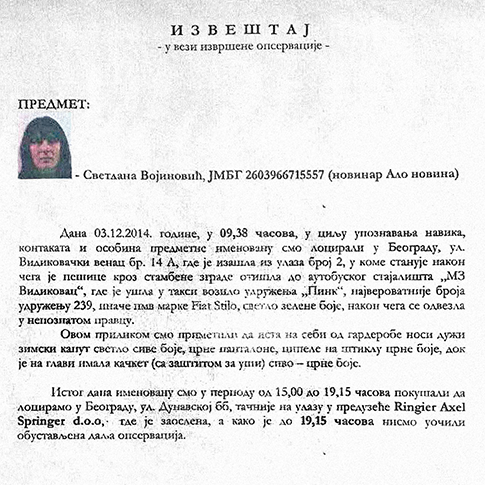
Of course. Veran Matić informed Vučić. After we showed Matić the paper about tracking Svetlana Vojinović, he was amazed. And he just said "well, this is like Slavko Ćuruvija's". He immediately called Vučić and they soon met. Veran Matić showed the paper to Vučić, who immediately called the minister and asked him if it was true. Stefanović said, of course, that he didn't, and that was the end of it. However, I believe that this was one of the reasons that he moved all these people to avoid some future inconveniences. However, Vučić did not take any action.
You think that Vučić did not know what was being done in this Department?
I believe that ninety percent of things he did not know.
What happens after the transfer of a large number of people from the Department?
Things seem to be returning to normal and the Department is starting to deal with, at first glance, normal business. Dejan Tripković was transferred to the Liaison Department, but he has already filed a criminal complaint with the Special Prosecutor's Office because it is considered that the destruction of equipment and data is a criminal offense for which no one was held accountable. The Prosecutor's Office assigns the case to the Security Information Agency. It is an unimaginable precedent. Of course, Tripković is called to the BIA for an interview, he gives a statement and after seven days the application is rejected. They did not take any statement from the members of that Department, so the destruction of the computer and what was on those hard drives has remained unexplained to this day.
What's happening to you??
Based on what Tripković told me, I wrote operational information regarding the activities of the Security Affairs Department and informed my superiors. Specifically - Miloš Oparnica, Head of Internal Control, and Head of Department Dejan Košanin. In that information, I write that according to my knowledge, members of the Department for Security Affairs at the Cabinet of the Minister carried out secret surveillance of persons without a legal basis, abusing the equipment and funds of the MUP and so on. However, according to my information, nothing was ever done, and in the meantime I received a solution for the Department for Emergency Situations.
While the Department was working at full capacity, Are fans mentioned?, for example Aleksandar Stankovic - Sale Mutavi?
Those fan groups were always mentioned and passed over. By chance, although already in Internal Control, I had the opportunity to see how fan groups function. I lived in Miljakovac: Boris Karapandžić, one of the members of the former group "Janjičari", and now "Principi" of Veljko Belivuk, was my neighbor. We were sitting in the betting shop one evening and at some point he went to the toilet. A little later, a crowd of people burst into the betting shop and are looking for Karapandžić. And when he heard them, he jumped out of the toilet window. At that time, it was the team of Aleksandar Vavić, because Karapandžić participated in the demolition of his bar in Karaburma. That was the first time I heard about the Janissaries.
And Velja Belivuk, whom I knew from before through his uncle, I used to see in the neighborhood because he worked in one of the cafes. Those stories about fan groups were in circulation even then, but some other names were mentioned such as Marko Vučković - "Commander Mark" from Crvena zvezda, Dragaš... They functioned like an army.
Nenad Vučković Vučko
The fans are normally dealt with by people from the city's SUP, the Department of Public Order and Peace, who secure the matches. Veljko Belivuk caught our attention when Nenad Vučković Vučko appeared. We knew about him that he was a member of the Army and that he was often seen at the Partizan stand. We started to inquire about Vučković informally, asking for certain security checks to be carried out during his deployment to the Gendarmerie. However, he came without any checks even though he moves from one state authority to another. Basically, he transferred to the Ministry of Internal Affairs, no less than as the deputy commander of the Gendarmerie, the very unit that secures football matches.
How much does it have to do with Dijana Hrkalović?
At that moment, it was rumored that she was in an intimate relationship with him and what we knew, that she wanted to secure a better job, a higher salary for Vučković. However, it later turned out that they were united by some other ties besides emotional ones.
And Aleksandar Stanković aka Sale Mutavi?
I heard about him from my colleagues from Vračar. They took him into custody several times, and some people from the judiciary told me that his going to prison is constantly delayed and that it is done in agreement with certain people from the MUP. I did not deal with it, even though it is a job for the Internal Control, because they did not know how to explain to me which people from the MUP we were talking about and in what way it is urged that a person does not go to serve a prison sentence.
Let's get back to current topics.. Did Dijana Hrkalović have anything to do with wiretapping?
When Hrkalović came from the BIA after completing a six-month operational course, she probably considered wiretapping and secret surveillance to be the pinnacle of her work. Of course, it is important to have information, but it should serve as evidence. When wiretapping came out of the BIA, in June 2002, based on changes in the CPC, serious abuses occurred. It's not from yesterday. Well, after coming to the MUP, Dijana Hrkalović and Stefanović came up with the idea of bringing their people to the police. To begin with, they were introduced to the Department for Security Affairs at the Cabinet of the Minister of Police, because the employment decision was signed directly by Stefanović and they did not have to go through the usual procedures for employment. When that story broke, they decided to assign them to different units where they did the same things. When Goran Papić left for SBPOK, Dijana Hrkalović found herself at the height of her power. Well, since the whole story became public thanks to me and Tripković, Hrkalović directly asked a tabloid to make a feature about me with the basic thesis that I am a "mafia policeman" and that the mafia installed me in the MUP... The text is illustrated with my picture from the identity card extracted from the citizens' records, although this data is classified as an official secret.
At that moment, Hrkalović had her hands free to replace and replace. Rodoljub Milović was the subject of her investigation regarding Šarić. Also, it was suspected that Marko Milićev, who killed a 21-year-old boy on the Brankovo bridge - this is the "Countryman" case - was told by someone from the city SUP to flee from Turkey to China. That's why I was in charge of talking about it with Veselin Milić, the head of the PU for the City of Belgrade. I went to the City SUP and, to my surprise, Milić told me that he had already given a statement to Dijana Hrkalović, even though she had no jurisdiction.
This practice has already taken root in the Ministry of Internal Affairs, because it was believed that if she calls you, it is actually Minister Stefanović doing it. Although it was illegal, people agreed to such a practice fearing for their jobs.
At that time, Rodoljub Milović was also dismissed from the post of head of the UKP a?
Yes, Hrkalović succeeded in that plan. She also replaced his assistant Dejan Radenkovic. In short, she managed to get rid of all the people who were bothering her for some reason and to replace them with her own personnel, even though they did not meet other requirements. Here, for example, Ilija Milačić, who was recently arrested and immediately agreed to a settlement with the Prosecutor's Office, was the head of the City Police Department, the heart of the city police. He never filed a criminal complaint in his life.
At that time, Hrkalović appointed Dejan Milenković Bagzi to head SSIM instead of Puzović and Petković. In general, Dijana Hrkalović established her network in all important positions. This is important to know in order to see what kind of chaos was created in the MUP by bringing in such people.
Yet, Hrkalović remained very powerful?
Hrkalović moved to the post of UKP secretary, but together with Biljana Ivković soon became state secretary. Although it no longer has jurisdiction, it continues with the old practice. The proof is Dejan Milenkovic's recent statement that he delivered reports to her "in white" on her order. This means that those reports did not have a signature, which was not the practice in the MUP.
At that time, there was the murder of Vlastimir Milošević, the famous "murder on the tram tracks", the beating at the JNA stadium, the "assassination in Jajinci", a case for which it was never determined who brought the weapon. There is also an attack on Vučić in Srebrenica. I responsibly claim that it was carried out under the direction of fan groups from Belgrade and Novi Pazar, which could be easily determined by viewing the recordings. That is why the Bosnians could not identify any person who attacked Vučić's entourage.
You mentioned the murder of Vlastimir Milošević. What is Dijana Hrkalović's role here??
According to our knowledge, her role could have been to cover up evidence. We knew that certain persons from Veljko Belivuk's group went to military training grounds and practiced handling firearms there. That was made possible by Nenad Vučković Vučko. I don't know if Vučkovic did it on his own.
Sale Mutavi
Is it possible to locate the moment when the fall of Dijana Hrkalović begins?
Colleagues from the City SUP recounted the scene during the murder of Salet Mutavo. Allegedly, Hrkalović came there, became hysterical, fell on Stanković's body, wailed as if a relative had been killed. At the time, it was also speculated that some kind of phone was taken from the scene, through which he had direct communication with Hrkalović. Then, for the first time, doubts about her direct communications with criminals appear. Until then, most of us had the impression that she was brought there to clean up the cadres of the Democratic Party and that this was her main task. After the murder of Aleksandar Stanković, however, it becomes clear to people that she is there to be a direct link between the police and crime. At first it sounded a little unbelievable. First - a woman, second - few police officers were ready to make arrangements with drug dealers. These are ruthless people whose only goal was to protect their job and they didn't care much if you were a police officer or not.
At one point, quite suddenly, Dijana Hrkalović is leaving the MUP?
I believe that her departure was influenced by the DEA, which has its operatives and undercover investigators based in Belgrade. The British were also there, but they withdrew a few years ago. Their task was to control the work of the Serbian police mainly to prevent the trade and transport of narcotics into the EU. They primarily dealt with so-called "controlled deliveries". For example, if the DEA received information that a shipment was going from Thessaloniki to Western Europe, their task was to ensure, in cooperation with our services, that the shipment passes through Serbia without any problems. In that work, the DEA found evidence of Dijana Hrkalović's contacts with certain drug groups, and they informed our authorities about this. At that very moment, she leaves the MUP, Vučić remains silent, and only Stefanović thanks her for her previous work. She obviously had a personal grudge against Aleksandar Vučić. I don't know if it's these wiretapped conversations or something else, but it's a fact. It is possible that Hrkalović's victim and someone from SSIM, who got scared, informed Bata Gašić about the eavesdropped conversations, and then Hrkalović's position began to seriously waver, and then she was released.
In the next issue, the continuation of the interview with Nebojša Trbović