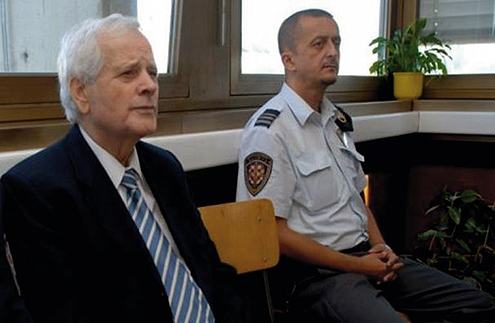
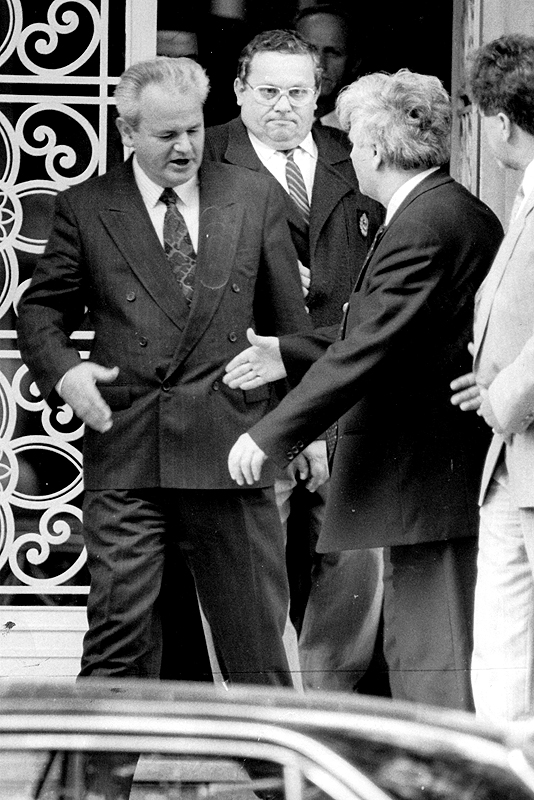
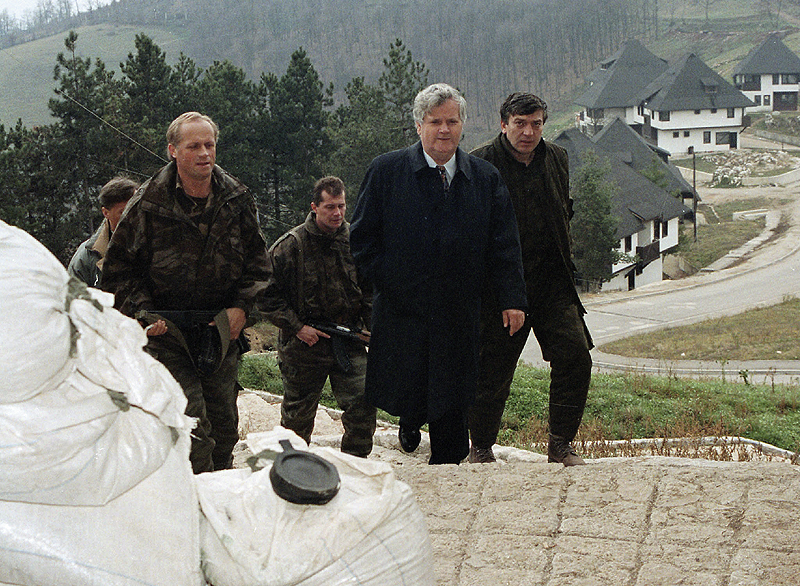
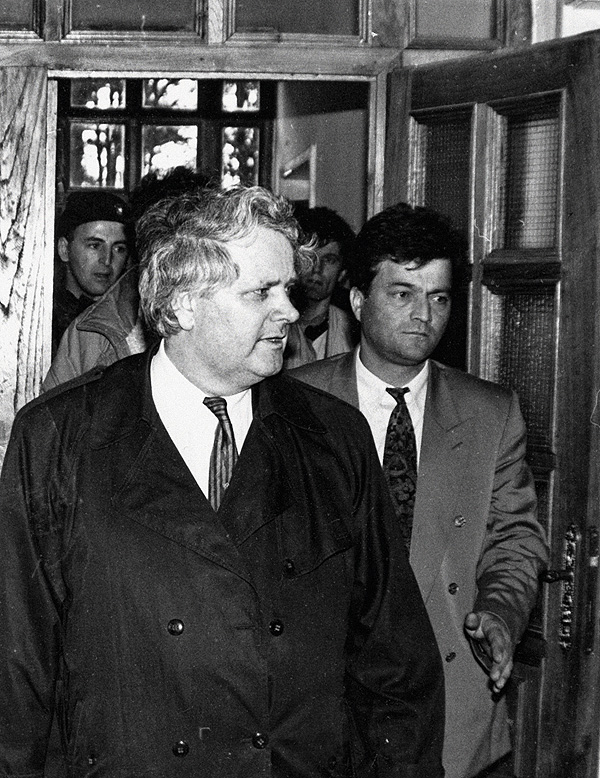
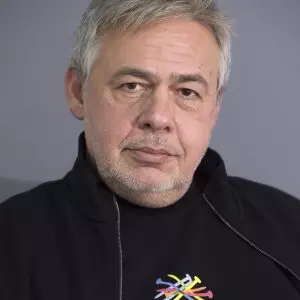
If a feature film is ever made about the life of Fikret Abdić, it could begin with a spring dawn scene, with the date marked: March 9, 2012. It is the day on which the main protagonist of the film, after serving ten years in prison (out of the 15 he was sentenced to), is released from prison. A seventy-two-year-old man wakes up in prison, hoping for the last time. However, nothing is certain, he knows that best. After all, this is not his first imprisonment either. The old man's face is in close-up, the camera then zooms in on only the eyes, lined with wrinkles. Melting follows, and we see the same eyes, but this time on a five-year-old boy. The year is 1944. Word spread throughout Krajina that Huska Miljković had been killed.
BETWEEN THE UN, CORANS AND CLAY: In 1944, Fikret Abdić, the third child of Hašim and Zlata Abdić (who would have thirteen children in total), was five years old. His father is a soldier in Huska. The story of Husein Huska Miljković is important for understanding the story of Fikret Abdić. And for both of these stories, the terrain on which they take place is important. It is a region mostly known as Cazinska krajina, although it can also be called Ljuta krajina or Turkish Croatia. On the map, it is that irregular semi-ellipse in the extreme northwest of Bosnia and Herzegovina. It is the territory bounded by the rivers Una, Korana and Glina, that is, the municipalities of Velika Kladuša, Cazin, Bužim, Bihać and Bosanska Krupa. The territory in question is predominantly populated by Muslims. It is a very specific strain mentally. Mehmed Alagić, general of the RBiH Army, said in an interview: To Krajišnik, even when he is the drunkest, Don't touch the mosque.; that phrase effectively summarizes the philosophy of life according to which belonging to a religious community is primarily an identity marker, and much less something that affects everyday customs and lifestyle. People from that region are often grumpy and short-tempered, and it's easy to recognize them by their accent. They speak harshly and sharply, with a characteristic pronunciation of affricates. There is no region in Bosnia that is further from Sarajevo than Cazinska Krajina. After the war (this last one), students from this region quite often go to study in Zagreb, Graz or Vienna, because these cities are closer to them than Sarajevo. When Franjo Tuđman was alive, the consulate of the Republic of Croatia in Bihać gave the Muslims of Krajina residence cards for no reason, and today there are several tens of thousands of Croatian citizens in this region (and from July of next year, also EU citizens). When it comes to folk songs, Cazinska krajina is more recognizable for heroic epics (songs about Muja Hrnjica) than for Sevdalinka. This small sketch tries to contextualize the appearance of Huska Miljković, a popular commander from the Cazin area who commanded his own militia of several thousand armed men during the Second World War. Huska's army would sometimes cooperate with the Home Guard, sometimes with the Partisans, sometimes with the Germans. Skender Kulenović Krleži used to talk about the negotiations with Huska in which Skender represented the partisans. Once, I guess, they slept in the same bed, and Huska tossed and turned, unable to fall asleep. Skander asked him what was wrong with him, why he wasn't sleeping, and he replied that he was thinking and that he didn't care about Nazism or Communism, Hitler, Stalin or Tito, that he was only interested in "what will happen with to us, with this here Muslim people". In April 1944, in rather unexplained circumstances, Huska was killed. It was near the mill on the Kvrkulja stream in the town of Trnovi. Krleža urged Skender Kulenović to write a novel about Huska, but if Skender did think about it, his death prevented him from writing the novel.
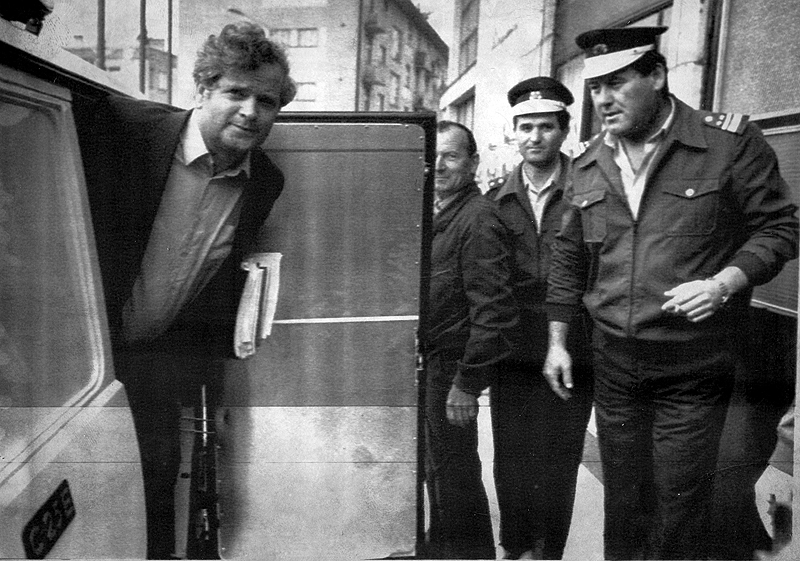
AGROCOMMERCE: After Huska's death, most of his army joined the partisans. Among them was Fikret's father, Hasim Abdić. After the Second World War, Fikret Abdić grew up in his native region. The area is otherwise quite poor, poorly developed and completely unindustrialized. Immediately after the Second World War, this region was also the scene of the so-called Cazin Rebellion. After completing his studies in agronomy, Abdić, as a relatively young engineer, became the director of the Agricultural Cooperative in Velika Kladuša. By creating the Agrokomerc combine and its development, Abdić in a relatively short period of time raised the standard of living of people in Velika Kladuša and its surroundings. A small local company became recognizable in Yugoslavia. From a children's perspective, Agrokomerc was, for example, a producer of Tops biscuits, those biscuits in a long narrow square box, with a series of round biscuits covered in chocolate, with orange filling under that thin chocolate layer. It was a biscuit made as a copy of the Jaffa biscuit, but for a time, at least in Bosnia and Herzegovina, it almost pushed its more famous predecessor off the market, the way Krašov's Columbus had pushed Toblerone. Fikret Abdić as a manager, to put it simply, combined socialist and capitalist methods. On the one hand, he used advertising and marketing extremely skillfully, so Agrokomerc's mascot, a chef with a tall white cap, was at one time almost known as Vučko or Zagi. On the other hand, there were those famous "bills of exchange without coverage" that cost him his first imprisonment. Namely, in 1987, Abdić was accused of "the crime of counter-revolutionary endangerment of the social order of the SFRY under Article 114 of the Criminal Code of the SFRY", and the main crime attributed to him was the issuance of unsecured promissory notes worth around 400 million dollars.
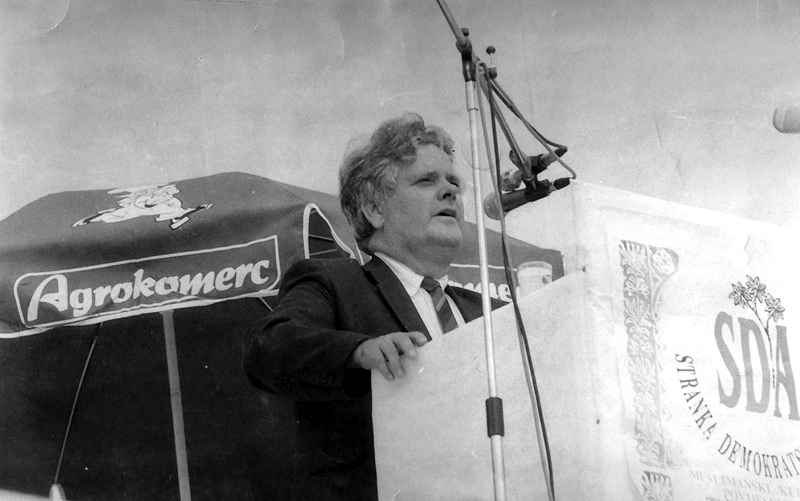
PROCESS AND ELECTIONS: The trial against Abdić was a top media topic. It was the end of the 1990s, when the Yugoslav crisis was approaching its peak. The story about the Agrokomerc affair and the trial against Fikret Abdić, about the political background of it all, is too long and too complicated to elaborate here. The fact is, however, that during the time he was in prison, his charisma in Bosnia and Herzegovina, especially among Muslims, and especially in Cazinska Krajina, further strengthened, and his popularity grew. All this reaches its peak after his release and release from prison. In Bosnia and Herzegovina, the first multi-party elections are being prepared, and several parties are fighting for Abdić's favor. The Alliance of Reform Forces of Ante Marković and the Party of Democratic Action of Alija Izetbegović have the best chances of success. It seemed for a while that Abdić would side with the Reformists, a party for which Emir Kusturica, Abdullah Sidran, Goran Bregović, Nenad Kecmanović, Milorad Dodik and others campaigned for at that time. However, at the last moment, Abdić joins the SDA, which nominates him as a member of the Presidency of the Socialist Republic of Bosnia and Herzegovina. At that time, the BiH Presidency did not have three members as it does today, but seven: two each of Muslims, Serbs and Croats, and one representative of the others. Likewise, unlike today's electoral law, back then all voters had the right to vote for all seven members of the Presidency. According to the agreement of the national parties (SDA, SDS and HDZ), their supporters supported each other's candidates, so, which is not too well known today, in the XNUMX elections in purely Muslim villages, people voted en masse for Biljana Plavšić and Nikola Koljević, while Alija Izetbegović and Fikret Abdić bought votes in Serbian villages. However, instructing sympathizers could not quite get mathematically equal support for candidates of the same party, and among the two SDA candidates who entered the Presidency as representatives of Muslims, Fikret Abdić won more votes than Alija Izetbegović. (Let us mention, at least for the sake of curiosity, that the SDA had its third member of the Presidency; its candidate Ejup Ganić entered the Presidency as a representative of other nations, and was written as - Yugoslav!)
RAT: Although according to the (unwritten?) rule, the candidate with the highest number of votes should have been elected to the position of president, as primus inter pares, that place went to Alija Izetbegović instead of Fikret Abdić. It was said back then that Abdić voluntarily renounced the position of President of the Presidency in favor of the President of the SDA. When the war starts in a little more than a year, there will be those who will claim that Abdić could not forget humiliation that he had to give up the place that belonged to him. Because Abdić had his role, never fully clarified, in the events of the second and third of May 1992, the days in which the JNA arrested Alija Izetbegović at the Sarajevo airport, the days in which the "Dobrovoljačak case" also took place. Speaking directly to a television program from his captivity, Izetbegović authorized Ejupo Ganić in front of, as they say, the entire nation. changes in absence, to be president instead of president. There are widespread and accepted interpretations in Sarajevo that Abdić was already playing the role of a (great) Serbian joker who, after Izetbegović get hurt, should have taken power and signed the capitulation. It is not entirely clear when the man who was portrayed by the same people as a victim of the Greater Serbian conspiracy, became a Greater Serbian player, but war is not the time for subtleties. It is also not entirely clear how Abdić managed to return from besieged Sarajevo, during the bloodiest spring of the war, to his homeland surrounded by a thick ring. What there is no doubt about is that Abdić very quickly canceled his obedience to Alija Izetbegović, that is, to the legal state authority in Sarajevo.
AUTONOMY: It is worth recalling the geography here again. In the series of wars that followed the breakup of Yugoslavia, there was hardly an enclave that was surrounded by a thicker ring than Cazinska Krajina. It should also be added that this is a relatively small territory, but densely populated. Cazinska Krajina, i.e. Bihać District of the Republic of Bosnia and Herzegovina, the area of responsibility of the Fifth Corps of the RBiH Army, was surrounded on one side by the unrecognized parastate Republika Srpska Krajina, and on the other by the western part of the (still) unrecognized parastate Republika Srpska. Therefore, Fikret Abdić is dining there. In the first year of the war, at least from a formal and legal point of view, the war in Bosnia and Herzegovina looks relatively simple, and is somewhat comparable to the war in Croatia. Serbian rebels rebelling against an internationally recognized state are waging war against the legal central government. The Army of the RBiH and the HVO (Croatian Defense Council) were allies at the time, at least formally. In 1993, however, everything changes and a war of all against all begins. On certain fronts, the RBiH Army and HVO continue to fight together against the Republika Srpska Army. On some occasions, the VRS and the HVO attack the RBiH Army together. And in some cases (the Mostar case), which is perhaps the least known, the RBiH Army turns to temporary (commercial) cooperation with the Army of Republika Srpska in a frantic war against the Croatian Army and the HVO. That very year, in 1993, on his own birthday, the fifty-fourth, September 29, Fikret Abdić proclaimed the Autonomous Province of Western Bosnia. In Sarajevo and in the rest of the territory of BiH under the control of the legal authorities, this instantly brings him the stigma of a traitor. The other warring parties, however, could hardly wait for Abdić's autonomy. Hardly a month has passed since he declared his own autonomy, and Abdić already had them signed peace agreements with Mata Boban and Radovan Karadžić. In November of the same year in 1993, they meet in Velika Kladuša prime ministers all three parastates declared on the territory of Bosnia and Herzegovina: the Republic of Srpska, the Croatian Republic of Herceg-Bosna and the Autonomous Province of Western Bosnia. Both Slobodan Milošević and Franjo Tuđman were patrons of Abdić's project, but we should not forget that some representatives of the so-called international community. It would be interesting to illuminate in more detail the connection between the affirmative articles published in the British press about Abdić from the fall of 1993 with David Owen's negotiating pressures on the authorities in Sarajevo, in which Owen referred to Abdić's rebellion as one of the arguments. ¸
CRIME AND PUNISHMENT: War in Cazinska Krajina between the Fifth Corps of the RBiH Army (corps member) and the so-called National Defense. AP Western Bosnia (autonomist) was bloody. Abdić's forces also opened several camps, the most famous of which was the one in Drmeljevo. Abdić's fight against the Fifth Corps is supported by the RSK Army, as well as the Scorpions, Red Berets and other Serbian (para)military formations. All that time, Abdić traded unhindered through Croatia. However, the beginning of the end for Abdić was represented by the negotiations that ultimately led to an agreement between Croatia and Bosnia and Herzegovina and the creation of the Federation of Bosnia and Herzegovina (Washington Agreement from 1994). That is the time when Tuđman renounces Abdić, and the Croatian public is horrified by the joint recordings of Abdić and Milan Martić. After the forces of the Fifth Corps led by Atif Dudaković entered Velika Kladuša in the summer of 1994, Abdić and his units retreated to the territory of the then Republic of Serbian Krajina. Next year, they will briefly manage to recapture Velika Kladuša, but in parallel with the Croatian Army's Storm action, the Army of the Republic of Bosnia and Herzegovina destroys the last remnants of Abdić autonomy. Abdić moves to Croatia with some of his supporters. He is based there in Opatija and tries to do business for a while. The authorities of Bosnia and Herzegovina, however, accuse him of war crimes. Since he is a Croatian citizen, he will not be extradited, but will be tried in Croatia. In the first instance, he was sentenced to twenty years in prison in 2002, and three years later, after the appeal procedure, he was sentenced to a single sentence of fifteen years in prison. This year, 2012, on March 9, after serving ten years in prison, or two thirds of the sentence, Abdić is released on parole.
LOYALTY TO THE GRANDMOTHER: Fikret Abdić was called by his supporters - Babo. The loyalty that thousands of people feel towards him even today, a quarter of a century after the height of his popularity at the time of the Agrokomerc affair, is truly extraordinary. Throughout his imprisonment, every year on his birthday, hundreds of them went to bowGrandma. Their loyalty is also a political fact. Abdić's supporters are gathered in a political party called the Democratic People's Union (DNZ). Since the end of the war, since the elections in Bosnia have been held according to the Dayton rules, the state parliament (actually its house of representatives) has 42 deputies, 28 of whom are elected from the Federation, and 14 from the Republika Srpska. It is a small number of deputies and it is difficult to pass the census. However, on the eve of every election, one thing is indisputable. DNZ will have one representative in the state parliament. Bearing in mind that this is a page whose electorate is concentrated in barely two or three municipalities, that is an impressive result. Also, DNZ is a party with significant political weight in the Federation and in the Una-Sana canton (to which Sanski Most and Ključ also belong, in addition to Cazinska Krajina). One of the two or three key persons in the DNZ is Abdić's daughter Elvira Abdić-Jelenović, who, by the way, has been a member of the House of Peoples of the Parliament of the Federation of Bosnia and Herzegovina for several mandates (as a Croat). These days, on the eve of Abdić's release from prison, the atmosphere in Velika Kladuša and Cazinska Krajina is tense. According to Abdić's daughter, he will live in the vicinity of Opatija after his release from prison. However, she also claims that Abdić's ultimate goal is his return to Velika Kladuša and the re-takeover of Agrokomerc. As much as Abdić is hated by some in his homeland and loved by others, they are almost united in mythologizing his managerial abilities. After the war, Agrokomerc is on its knees, in the Kladuš area, life is mostly poor again, so many still trust in Baba. I used to listen to people from Cazinska Krajina, for whom Abdić is a symbol of a traitor and a criminal, how the dead-serious theorize that the Bosnian government should have agreed with Croatia that Abdić, as part of prison, probably in the form of forced labor, manages Agrocomercial. The idea was for the sergeant to bring him to Kladuša in the morning, to spend working hours there, and for the same sergeant to return him to sleep in the prison later. Unaware of the changing regional and global context, many people clearly believe that Babo can turn Agrokomerc into an economic giant again, and Abdić himself seems to believe that. Of course, none of that will happen, which is perhaps good for him and his supporters, so that they don't lose that last illusion. When a brief overview of Abdić's life and connections is read with a cool head, without too much influence of emotions, from a certain distance, he almost looks more like a character from a South American novel than a Balkan businessman, politician, ruler and criminal. The criminal part of his career is actually the part that makes him similar to other Yugoslav war leaders. Namely, all of them were either tried for war crimes or natural death stopped the investigations leading to indictments. What is different, what is literary, is the fact that Abdić never hid behind pompous national and nationalist demagoguery. Abdić did not refer to King Tomislav, Prince Lazar, Ban Kulin, or any "glorious historical tradition of our people". Like some dictator from Latin American prose or one of those bizarre rulers from some post-Soviet state, he chose his own birthday for the day of the declaration of the Autonomous Province of Western Bosnia, and he himself somewhat identified himself with the epic folk hero Mujo Hrnjica. No other leadership-wartime career shows as clearly as Abdić's that he is actually at the very centerhearts of darkness the wars of the nineties hide economic motives, robbery and the desire for profit. It is a bit ironic in this context that today the fighters of the Army of RBiH, the fighters of the Army of Republika Srpska, and the fighters of the Croatian Defense Council are paying for their participation in the war from various levels of government of the state of Bosnia and Herzegovina. They are the only ones who do not pay for their participation in the war Abdićevci. Even that, however, does not stop their loyalty to Baba.
CONSENT TO EVERYTHING: There is one statement by Fikret Abdić that perfectly sums up his political "philosophy", a statement that is worth quoting and briefly analyzing: I am not advocating either option, I have no idea and I agree to everything. That larpurartistic desire for power, that love of power or lust for power, that will to power, devoid of any ideology, of any gum about the "common good", that is the key feature of all local politicians in the last twenty years, a feature that they more or less skillfully hide. Let's be clear, this does not mean that the famous mantra is correct - they are all the same. They are not the same, they differ in their abilities, in their characters, in many things, but they all have the larpurartistic desire for power, it is, as they say, the smallest common element. Because behind that one I am not advocating either option, I have no idea and I agree to everything, followed by a comma, and after the comma stands what does not have to be pronounced: only if I stay in power. Fikret Abdić will never again be a political leader whose word will have a greater reach than the local one, but the spirit of his politics has taken over not only Bosnia and Herzegovina but also the popular region. It is the spirit that evokes two phrases of Duško Trifunović. There is one Bab's bad legacy, and the second is the title of the song set to music by Goran Bregović. I agreed to be whatever he wanted, it is actually a condensed and somewhat poeticized version of Baba's political program: I am not advocating either option, I have no idea and I agree to everything. Beloved among his supporters like little Tito, Abdić actually closes the Yugoslav political circle: From the historical point of view - I agree to everything.. From the historic AVNOJ to the refugee convoy, it is the melody that plays as the closing credits of the imaginary feature film about Fikret Abdić; closing credits, so to speak.