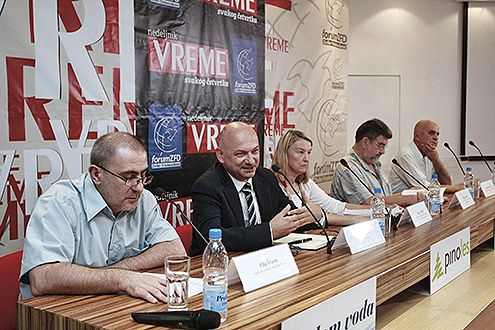
While Serbia marks August 5 as the Day of Remembrance of the Victims' Suffering and Persecution, in Croatia it is an opportunity to celebrate Victory Day with a military parade in Zagreb and the return of Franjo Tuđman to the Knin Fortress after 20 years. The monument to the first Croatian president will be unveiled by the current Croatian president and member of the party he founded, Kolinda Grabar Kitarović. The media from both sides report on these events daily from two completely different angles. Filip Švarm assessed that by looking at the reporting and statements of politicians in Croatia and Serbia, one can get the impression that the war ended yesterday, not twenty years ago, and Dejan Jović that since the end of the war, relations between Serbia and Croatia have been "constantly in some of the worst phases". .
"You have the recent statement of Vesna Pusić, the Minister of Foreign Affairs of Croatia, which did not differ much from the HDZ and Tudjmanist interpretation of what August 5 actually means. She said that Croatia was then territorially united and that we were celebrating peace, but that is not the case. The storm does not mean reintegration, and the Erdut Agreement, which really represents it, is not mentioned, because it symbolizes peace. The storm is not the reintegration of people, but only the territory. Marking the Storm sends a message that Croatia wants a territory without people," said Jović and added: "Croatia constructed itself as a winner and a victim at the same time, that is the only case in the former Yugoslavia where you can credibly claim that. If you look at the Croatian media, there is not a day when the war is not discussed, there are many people who do not want that topic to be closed. They tend to turn Croatia into a conservative country, and for that you need to have a permanent enemy. The memory of the war is maintained because it is difficult to find a new enemy, so the war is always alive. This hinders Croatia and its liberal development. It is amazing that even twenty years after the war you have this topic in the news every day and that war is not allowed to stop. These are specific interests, many people in Croatia still have income from that war".
Vesna Teršelic believes that we are very bad at ending wars, first the Second World War, and then this homeland war, and says: "We are not good at documenting what happened to us and researching the facts." We are not used to multifaceted interpretations, it is strange for us to trust factography even when it is investigated. We trust word of mouth more than facts determined by researchers."

PLAN Z4: The question remains whether operation "Storm" could have been avoided, because negotiations in Geneva were ongoing until its very beginning. Also, there was the Z4 plan (Zagreb 4 for short), which was prepared as a peace agreement by the USA, Russia and the European Union (via France and Germany). According to this plan, the autonomous Serbian Krajina would have a legislature, president, government and courts. It would have a police force, but not an army. There would also be a Special Constitutional Court. Foreign affairs, defense, citizenship, international trade, and finance would remain under the jurisdiction of the Government of Croatia. Krajina would have its own special currency, its residents would have the right to dual citizenship, and there would be the possibility of maintaining international ties and concluding international agreements.
Drago Kovačević, as the then mayor of Knin, also participated in some of the informal discussions about this plan during the visit of the then US ambassador Peter Galbraith. Remembering that, Kovačević says: "The former Prime Minister of the Government of Serbian Krajina Boris Mikelić and the then President of Serbian Krajina Milan Martic did not want to participate with some stupid excuses. A week later, that plan was officially adopted. It was our last chance, Martić rejected the plan before the plan was even offered. No official body of Croatia rejected the Z4 plan, but Serbia rejected it with the explanation that they will not reject it, but they will not accept it either. Of course, that's nonsense. Behind that rejection comes the pain, and after the pain 'Flash' and 'Storm'."
Petar Lađević's position is that this plan could never succeed. "Serbs from Krajina were threatened by the motherland to make sure what the content of the plan was, while Croats certainly did not like it. Today, it seems to me that everything was not done by the international community to make that plan succeed, Croatia was not demanded persistently enough to consider it. This plan was made with the aim of seeing if Croatia can be forced to do something and to see if Serbia will accept it unconditionally. "There was simply not enough desire from the international community," explains Lađević. However, Jović believes that it was a good opportunity: "Nothing in history is inevitable, there is always an alternative." We had an attempt with the Z4 plan, the day before there was an idea to accept it. Very often, such plans seem useful to local politicians from a further perspective. Those who were the biggest opponents today understand the importance, we do not see a step ahead and overestimate our power, we do not appreciate the circumstances and events in the world."
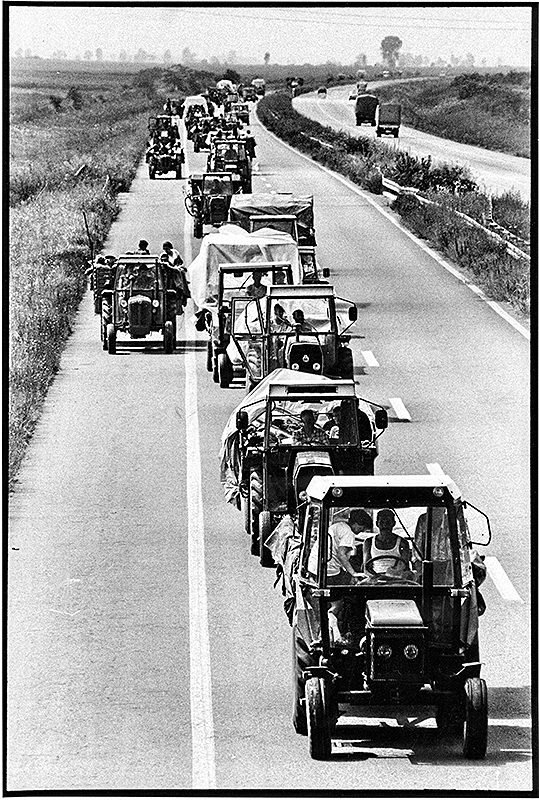
After the majority of the Serbian population fled Croatia after the military operations "Bljesak" and "Storm" on November 12, 1995, the Erdut Agreement was signed, which provided for the initiation of the process of peaceful reintegration of Eastern Slavonia, Baranja and Western Srem into the constitutional and legal order of the Republic of Croatia. As many as seven of the fourteen provisions of the Erdut Agreement referred to various aspects of human rights protection. On the basis of the agreement, two organizations of Serbs in Croatia were founded, namely: the Joint Council of Municipalities and the Serbian National Council. "This plan did not come to life, just as the envisaged status of the community of Serbian municipalities in Eastern Slavonia was not realized. During the peaceful reintegration of Krajina, it was constantly mentioned. Until recently, the mayor of Osijek, Ivica Vrkić, then, for example, advocated for the Erdut Agreement, and two months ago he said that the Cyrillic alphabet cannot be introduced until the Serbs in Vukovar respect Croatia," says Lađević.
NON-GOVERNMENT SECTOR INSTEAD OF THE STATE: "Research by the Helsinki Committee for Human Rights of Croatia shows that 677 civilian victims were killed in 'Storm'," says Vesna Teršelic. "These are very sad numbers. In the data on refugees from Croatia after and during the 'Storm' and 'Lightning', 250.000 Croatian citizens, mostly of Serbian nationality, fled. UNHCR has very accurate data that there are still many registered refugees in Serbia, Bosnia and Herzegovina, Montenegro and Kosovo. The consequences of the war are experienced not only by registered refugees, but also by those who are no longer refugees, because they too have difficult life situations. First of all, because they did not recognize the rights of civilian victims of war, the states did not respond to their needs and realize their rights at the time when the crimes were committed until today. Even today, Croatia and Serbia do not have a law that would regulate the rights of all civilian victims of the war, I see political responsibility on those who will mark the anniversary these days in one way or another. In our countries, research on the victims is done by human rights organizations because scientific institutes and government institutions do not want to do it. As long as there is no will to write down all the information about the killed and the circumstances of the suffering of all the missing, until then we will have problems with the past and acknowledging the suffering of those who suffered. For them, the victim and the man are in some tenth place, they deal with symbolic manifestations, without actually doing anything to establish the facts. The judiciary did nothing to effectively prosecute war crimes, and museums and cultural institutions did not do their job in terms of objective presentation. If they were to receive the marking as it should be, it would reflect this complexity of war, thus the element of aggression and the element of crime. And we are getting an unbearable situation in which Croatia will officially commemorate something where human rights were massively violated," says Vesna Teršelic.
HOW TO DEFINE WAR IN CROATIA: Petar Lađević raised the topic of historical circumstances and defining the term, what kind of war it was actually about, what kind of victory did he bring to whom and what were the results of that victory. "It was a civil war with the victory of one side resulting in the worst ethnic cleansing of the other side." Somewhere between 1000 and 2500 people were killed in 'Storm', mostly civilians. Therefore, it is a victory in which no soldiers were killed. Another thing, since 1995 in Serbia, it has been perceived as a tragedy and caused the victims to feel that it is impossible to move towards something that would solve the real problems of Serbia and Croatia. Therefore, there is nothing to celebrate the victory, nor to mourn. Work should be done to enable the establishment of normal relations between the two neighboring states, and with some exceptions, those relations were non-existent. The storm is a consequence of the civil war in the territory of the former Yugoslavia, it is certainly in the minds of most Croats some act of liberation, but are they aware that this act of liberation resulted in the persecution of 250.000 people. That is an issue that needs to be worked on. Should Serbia only whine and talk about the problems of the expulsion of its compatriots from Croatia, or should Serbia as a country also help the exiles? I believe that both countries must have a more active neighborhood policy, without that we will constantly be talking about something that is factually unsolvable," said Lađević.
Vesna Teršelic did not agree that it was "only" about the civil war: "We strive for simple interpretations. That war is much more complex than the civil war. The crimes in Vukovar and Dubrovnik can only be characterized as aggression. As for Croatia, it was a war of aggression and a civil war. Our societies find it all difficult, we are so far from the situation to accept a multi-layered interpretation that it has to be measured in light years."
Drago Kovačević also believes that the war in Croatia was layered: "I would still characterize that war as an agreed war. Cooperation on ethnic engineering reached its peak precisely in the territory of Krajina. The masters of the war were Franjo Tuđman and Slobodan Milošević, they defined that policy and agreed. Ethnic cleansing happened only in Krajina and Knin. The goal was to divide Bosnia and Herzegovina and settle accounts through ethnic engineering."
Jović joined the discussion about the terminology, regretting that the terminology had been politicized. "It seems to me that it is a war of words." If we are interested in peace, we will avoid some words, so it is best to say 'conflict within the state'. It is an uncontaminated word because it has no political context. Civil war sends a political message and irritates. The problem is that most of the arguments come about defining terms. For example, are Serbs a people in Croatia or are they a minority. Introducing the politically incorrect term 'minority' is a degradation. The purpose is to reduce rights by such definition. I am not sure that everyone wants peace and is satisfied with the results of the war. If we want peace, we have to move, we have a lot of good ideas that will not cause us to quarrel", says Jović.
Lađević then said that there must be some sort of consensus around each term, and that changing the term will not solve the problem of its content.
ETHNIC CLEANSING: According to Kovačević, the goal of Operation "Storm" was to expel all Serbs from Croatia. "The most tragic result of the war is ethnic cleansing." As the final act of ethnic cleansing comes colonization. So you drive some away, and you settle others. No one supports the argument of the Report on the State of the State and the Nation, which Tuđman submitted in February 1997, and with that document he declared the ethnic cleansing the greatest success because the Serbs were reduced to three or four minor percentages. There is no more literal recognition than that document. Nobody mentions the abolition of Serbs as a constituent people in Croatia anymore," said the former mayor of Knin.
Teršelic recalled the crimes committed against Croats in 1991: "I believe that ethnic cleansing was also carried out by the army of the Republic of Serbian Krajina." In Tenja, for example, at the beginning of July, 11 civilians were taken to the Partizan cinema and killed, their remains were never found. By the end of 1991, more than 30 people had died in Tenja. The proceedings for these crimes are conducted before the Special Court. Peacemaker Josip Reihl-Kir also died there. In October 1991, at least 56 people were killed in Bacin. The proceedings before the County Court in Rijeka for this crime have ended, but without the presence of the accused. There is also the crime in Škabrnja where the soldiers questioned who was a Croat and who was not, here we can clearly speak of genocidal intent. Of course, I do not dispute that 'The Storm' is ethnic cleansing. Both events were discussed by the International Court of Justice," says Teršelic.
Kovačević responded to this by saying that he does not deny the crimes that happened against Croats, but that does not change the character of "Storm" as ethnic cleansing. "This is starting to look like the one who started it first, let's remember that in Bjelovar, where there was never a war, 700 Serbian houses were demolished and set on fire." On the Adriatic coast, over 100.000 people left because of the atmosphere that was created. The goal of my engagement is to show the relationship that existed and the crazy combinations," Kovačević adds.
THE POSITION OF THE SERBS IN CROATIA: Although twenty years have passed, many Serbs have not returned to their homes, and those who did still do not have all their rights in Croatia. "The problem of the Serbs in Croatia is not only that we were exiled, but also the prolongation of the 'Storm' by other means, because Croatia does not respect the laws it passed. The human rights of Serbs in Croatia today are at the same level as the situation of Croats in Republika Srpska Krajina. It is an unsustainable situation, it will not be resolved by symbolic acts of reconciliation. The 'Storm' is not just an expulsion, but a political process that is still ongoing. In the 2001 census in Croatia, there were 201.000 Serbs, while in the 2011 census there were 116.000 Serbs. So it turns out that Serbs have the highest mortality, which is not exactly true, but some returnees returned to Serbia again. This is a serious issue and Serbia must address such specific issues. There were short-lived attempts to move these things along without either side dealing with symbolism, but that period was short-lived. Return is not a completed process, it is necessary for Serbia to insist that Croatia respects its laws and what guarantees minorities, for example property rights," says Lađević.
A CULTURE OF MEMORY OR A CULTURE OF FORGETTING: Every year when there is a commemoration or commemoration of suffering, we live in fear of what will be said, says Jović: "Actually, we have reason to fear, because the messages that are sent are more directed against others, than commemorating the war. There is too much war and too little commemoration, we have no feeling for other people's sacrifices. I don't know if we should give supremacy to memory or forgetting, I think we should create a balance. The policy we are pursuing in this regard is wrong. You can't live in cemeteries. We are a society in which the celebration of war has a long tradition, we learn that in elementary school. We also learn that sacrifice is desirable. There is also a culture of violence associated with the past, and we shy away from talking about what we have done to others in the past. We constantly remember and do not open up questions, thus constructing a past that was not. I don't think we will ever agree on a common narrative of history, otherwise, in my opinion, that is against liberal democracy. But it is important that we challenge national myths that are one-sided and that by challenging them, we leave the possibility for new generations to have more narratives so that they can clarify them themselves. We are far from that today. "Freedom and pluralism with multiple parallel narratives is the only way, not to live in a false past that has been constructed," added Jović.
Lađević expressed his understanding of this attitude: "Will the truth ever be able to be communicated through the political public?" No politics lives on the truth. Nor is truth a category that has a place in politics. Politics, as far as I know, is about using the truth, not establishing the truth. And for that very reason, I would never reject this idea of forgetting. Because science will not forget if it keeps to itself, the numbers will remain, the records will remain."
Agreeing with Jović about the problem of education, Teršelic continued: "Young people who have the right to learn history based on facts cannot do so. It is deeply rooted in our country to strive for a single-mindedness. It is important to consider the culture of memory in the context of education. When they reach their 90s, teachers don't do that, because in their classes there are children who always sit at home and listen to the elders about what happened. It is important to look at factography from different sides, it is an important level because we all need facts. In Croatia, we don't even have education for human rights, that's a heavy legacy of the past."
Jović also referred to the young generation born after the wars of the 1990s: "For this generation in Zagreb, I can say with certainty that they have no feeling for the war, no memory of it." This makes the nationalists a little nervous, because they are not sure that those generations are following them and whether they are ready to fully accept the narrative that is being served to them. Another thing is that these students are a product of their time. It happens to me that journalism and political science students are not sure whether Yugoslavia was a state or not. They look at that space through learned phrases."
The common conclusion of all participants is that it is important to have more interpretations, that both Serbia and Croatia must start working on factography, as well as that better conditions and a greater degree of human rights should be created for the exiled, so that they can return to their homes.
"I want to send a message that we must not forget that even before the 'Storm' there were victims and that those victims are no less valuable than these others." I would also like to say that I was frightened by Professor Jović's opinion regarding memory and forgetting. If the memory goes into the private sphere, then sometimes the same problems follow us, let's remember what happened after the Second World War. This is how fears are created. I don't understand why he is exaggerating on this occasion instead of calming down."
Natasa Kandic
"I have to say that the big problem is that we cannot agree on some key things. We can agree that the government of that time in Serbia bears a certain guilt, which is not small, for accepting refugees. We can talk about the culture of memory, I think that memory must never become outdated, because forgetting partly led to what happened during the nineties. Twenty years after 'The Storm', each of us stands by our point of view. I appreciate Mrs. Teršelic a lot because she has done a lot for the Serbian people in Croatia, but she speaks quite clearly from the Croatian point of view, and that's fine. But I think that the Serbs should act from their point of view and look at their own interests. We cannot agree on the number of dead, not even on what happened in 'Ulja'. We cannot even agree on whether it was an agreed action, regardless of the fact that we have transcripts where Tuđman said on July 31 from Brion that the Serbs must disappear from Croatia."
Sanda Raskovic Ivic