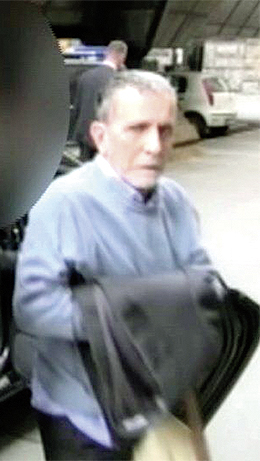
After eight years spent on the run, a first-degree sentence of five years for accepting bribes and several years of announcements that he would return to the country and prove his innocence, the former director of C market Slobodan Radulović arrived in Serbia from Moscow and surrendered to the police on Friday, April 11. , after which he was placed in custody. In May 2013, Radulović was convicted in the first instance as part of the "Bankruptcy Mafia" trial on suspicion of having damaged C market for 30 million euros, and he fled Serbia immediately after the privatization of this company, in April 2006.

photo: fonet / tv fonet…and arrest in 2014.
The former director of the trade chain has repeatedly announced that he will come to Serbia, and the last time he did so was in December of last year, when he participated in TV Pink's show. At the time, he stated that he wanted "to be allowed to present his defense in court", as well as to "prove that Mišković is behind the political indictment against him". At the same time, he said that he did not return to Serbia "because the judiciary was under the control of Mišković, former Minister of Justice Snežana Malović and former President Boris Tadić, which is why he could not count on a fair trial", and he also noted that he life was in danger in Serbia. "Miškovic was the most powerful man in Serbia at that time and I had no chance to prove the truth in such a Serbia," said Radulović at the time. On the occasion of his client's arrival in the country, Radulović's lawyer Marko Kljajević accused Miroslav Mišković, Milan Bek and the government of Vojislav Koštunica of "prosecuting completely innocent people only to cover up their own robbery", and that the opposition in Montenegro was financed from the money obtained from the privatization of C market It burns during the independence referendum. In Kljajević's words, "it was a political criminal activity initiated by the then state leadership of Serbia." Thus, after Šarić, another long-term fugitive from the police surrendered, this time with an explanation similar to the one we could hear back in 2004, during a much more famous surrender - because he has confidence in the new government. By the way, in the "Bankruptcy Mafia" trial, one of the arrested was the then president of the Commercial Court, Goran Kljajević, the brother of the current Radulović's defense attorney. Goran Kljajević is accused of having prevented the Slovenian Mercator from buying the shares of C market, and the privatization of C market is on the list of 24 disputed privatizations, whose clarification was requested by the European Parliament.
CHRONOLOGY: The key date related to the privatization of C Market was August 19, 2005, when at the invitation of Danko Đunić, and at the initiative of the then Prime Minister Koštunica, two opposing groups interested in this trade chain gathered - Miroslav Mišković from one, Milan Beko and Slobodan Radulović on the other hand. In the premises of Đunić's EKI Investment, a Memorandum of Understanding was signed between Mišković's Delta M doo, Radulović's C market ad and Bek's Laderna BV, all "in the interest of the development of the national economy and the efficient operation of the national market as a whole, especially the financial market", as stated in the introduction of the Memorandum. The principle with which the document begins, by the way, was: "Both parties will cease hostile activities with regard to the individual takeover of the C market enterprise."
Branko Pavlović, at that time the representative of the small shareholders of C market, in an interview for "Vreme" in January of this year, gave one of the possible explanations for why this Memorandum was reached, and why the Government of Serbia intervened: "The fact that the Prime Minister at that moment messed up, that's good, but he didn't do it because he understood that it was good, in my opinion, but because he was afraid that the fight between these two groups would show how much the state structure is actually in disintegration. That it will be revealed to what extent state authorities are starting to collide with each other because of their influence" ("Time" no. 1202 - "How Mišković bought C market"). With that Memorandum, the joint performance of Mišković and Bek was agreed upon, and after that the Securities Commission enabled all those interested in taking over C market to (again) submit their offers. The Slovenian Mercator is, with the explanation that
"there are two types of trading, one on the stock market, the other through some private lines", gave up on C market, although before the whole story about the Memorandum, she was the first to make a takeover offer, worth 220 euros per share. Along with the offer from Ashmore (who were "completely frivolous", according to Branko Pavlović), the only remaining offer was from Mišković and Bekov, i.e. the company Primer C, in the amount of 300 euros per share - no one else gave a higher one, or any other offer.
Slobodan Radulović would later write in a letter to the Anti-Corruption Council that in the summer of 2005, in the office of the Minister of Police, then Minister Dragan Jočić, General Secretary of the Government Dejan Mihajlov and the head of UBPOK, Mladen Spasić, with the help of good friend, bad cop approach forced him to sign the Memorandum, and that he would never have signed it if Koštunica had not forced him to do so ("we have compromising information, but we will stop the police's interest in C market, and you see that a local company buys C market" - that's about it , read Radulović's description of the event in the office of the Minister of Internal Affairs).
On the other hand, testifying in the Special Court, Milan Beko practically confirmed the allegations of the indictment against Radulović, explaining that Radulović personally issued duplicate bills and bills without cover, that there was no documentation for the transaction of three million euros to Atlas Bank in Cyprus, and that is, although the Memorandum stipulates that Radulović will remain in the position of director for another two years, he left the country immediately after the privatization.
EPILOGUE: Given that he was convicted in absentia at the first instance, according to "Danasa", if the verdict was confirmed at the Court of Appeal, Radulović would have the right to request that his trial be repeated. Also, "Danas" speculates that Radulović's return to the country opens up a new possibility - that the former director "through his testimony will enable a new indictment for the privatization of C market, in which he could have the status of a penitent witness."
The Democratic Party of Serbia, on the other hand, claims that no one from that party had an agreement with Radulović. "The investigation against Radulović was initiated while the DSS was in power, but the proceedings ended in May 2013, five years after we stopped actively participating in the government," said Miloš Aligrudić on Monday, April 14. Aligrudić characterized the Memorandum as a "private, non-binding document", and that the initiative for the meeting was shown by businessmen, not Prime Minister Koštunica.
Branko Pavlović said in the aforementioned interview for "Vreme" that the Prosecution certainly has nothing new when it comes to the C market, regardless of Radulović's announcements that he is bringing new evidence. "It would be extremely strange if, after seven years in the C market proceedings, where Radulović was accused, where all the data related to Radulović was collected, the prosecutor suddenly found reasons for additional prosecution, especially since Radulović himself in public addresses, if we assume that they are credible, he says that his lawyers submitted all that evidence to the prosecution," said Pavlović in January.
Slobodan Radulović was born on January 27, 1943 on the island of Mamula near Herceg Novi. He graduated from the Faculty of Economics in 1968. He was the director of the Directorate for City Commodity Reserves, the president of the City Committee for the Economy and the vice president of SOUR Centroprom, and he became the head of C-market at the beginning of 1990, and remained there until fleeing the country in 2006. He was a member of the Assembly of Serbia in the Second Convocation (1993). In the 1994 elections, he was elected on the list of the DS in the constituency of Belgrade, and because of his entry into the government (he became the deputy prime minister of Mirko Marjanović), he was excluded from the membership of the DS. In September 1995, he joined Dušan Mihajlović's New Democracy, becoming vice-president of that party, and he was also vice-president of the second government of Mirko Marjanović (1998–2000). Due to his closeness to the regime of Slobodan Milošević, he was on the list of persons prohibited from entering the EU. After October 5, again as a member of New Democracy, he was elected as one of the 176 deputies of DOS in the republican assembly, in the elections of December 2000. He was a deputy until 2003.