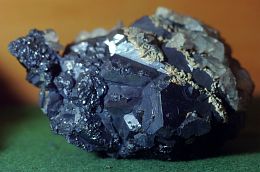
GALENITE UGENDA: A mineral from which lead and zinc are obtained
One of the common points in all attempts to economically "value" Kosovo is its mineral wealth, primarily coal from Trepča. Certain sources, talking about lignite from Trepča, claim that there is "enough coal for the next 200 years, and in Serbia only for 60 years". In January of this year, the director of the then Directorate for Mines and Minerals of Kosovo (later the Independent Commission for Mines and Minerals), Rainer Hengstman, announced that the World Bank estimated Kosovo's mineral reserves at 13,5 billion euros, of which the share of Trepce and the mines there only three billion lead. Lignite deposits near the village of Sibovac near Pristina are estimated at 6,5 billion euros, and Feronikl, with its nickel deposits, at two billion euros. Other mines are worth the remaining two billion and, according to that report, the exploitation of all these reserves would bring at least 35.000 new jobs and considerable income to the Kosovo budget. These figures, at least at first glance, make the conspiracy theories, according to which the war in Kosovo was just a cover for turning the Serbian province into a colony and "putting a paw" on one of the world's richest mining areas, seem at least somewhat more likely.
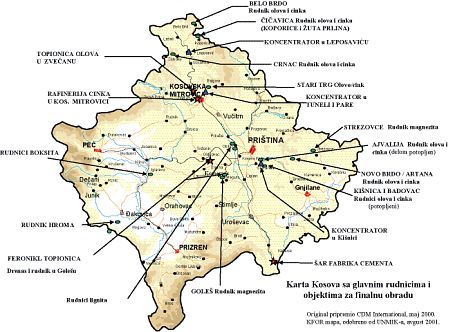
REALITY: In the meantime, UNMIK compiled and published what Kosovo's mines have to offer the world's mining companies. In the first place, as the most important resource, foreign experts put zinc and lead ores. According to these estimates, at the locations of Belo brdo, Crnac, Stari trg, Ajvalija and Novo brdo there is a total of about 21,5 million tons of ore containing lead, zinc and silver, in quantities economically profitable for exploitation. In addition, about 1,7 million tons of bauxite (with a potential four-five million more), the Ferronicle complex with about 14 million tons of ore containing about 1,3 percent nickel and 0,07 percent cobalt, and magnesite are also offered. from Strezovac (2,8 million tons; 38–45 percent MgO) and Goleš (1,7 million tons; 46 percent MgO). Lignite reserves are estimated at 8,3 billion tons with another ten billion potential reserves, which need to be further investigated. Since it is known that the Kosovo lignite is not of the best quality (moisture makes up 42-49 percent of the weight, ash 14-17 percent, the energy value is only 7800 kJ/kg with a high concentration of sulfur), rare minerals are included in the super-secret "trump card" of the Kosovo mines , primarily indium, cadmium, germanium, thallium and gallium. These rare minerals are used in the high-tech industry, which is why many consider these resources to be the main target of "white world" companies. Currently, the most widespread application of indium is in the form of indium-tin oxide, from which transparent electrodes for LCD monitors are produced. Cadmium is used in the production of nickel-cadmium batteries (Ni-Cd) and other electronic components, and germanium, thallium and gallium in the production of infrared spectroscopes, semiconductors, photocells, components in the nuclear industry, as well as in other activities.
Prof. Dr. Rade Jelenković from the Faculty of Mining and Geology from Belgrade explains that these metals have economic importance, but that they are only accompanying mineral raw materials of the basic group of ore elements, in this case zinc and lead. "Lead and zinc are never exploited just for these rare elements, but they are obtained along the way, in the process of processing lead and zinc minerals," he claims. "UNMIK made a concentrated model of future sites, of what could be interesting for the world, namely zinc, lead and silver deposits where zinc is in first place, because it is more expensive than lead." There are currently five mines and a large number of 'occurrences', i.e. localities where the presence of these metals has been determined, but it has not yet been sufficiently explored." According to him, these deposits are currently the most attractive for foreign companies.
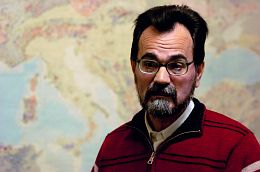
MINE WEALTH OF LOCAL SCALE: Dr. Rade Jelenković
MALA POINT: Until 1990, there were 16 out of 18 lead and zinc mines in Serbia on the territory of Kosovo. Zinc is the fourth most produced and consumed annually in the world, right behind iron, aluminum and copper. Although the most important mineral item in Kosovo's offer, compared to other countries in the world this amount is very small, almost insignificant. "For fifty years, there was a belief that Serbia is rich in mineral resources, but this is not true. When we compare ourselves to Russia or South America, we are just a dot and what exists there is possibly enough for our industry, but it is not so important for the world, and especially not so much that someone would go to war over it," adds Jelenković. As an example of this, he states that the Norilsk company in Russia owns huge deposits of nickel sulphide, where the concentration of nickel is 25-30 percent (compared to 1,3 percent of Kosovo's Ferronickel), and that there are nickel deposits in Cuba and Jamaica that have an area the size of a third of Serbia. they stretch more than 400 km in length. "Compared to the world, we are practically insignificant; one point that everyone will skip," he says. What most people also don't realize, Jelenkovic explains, is that mines are not disjointed points where certain minerals happen to be found. It is possible to guess exactly which minerals can be found in which places, thanks to the type of rocks found in that territory, which exist in certain belts and areas. "For example, copper from Bor is linked to the so-called The Tethys-Eurasian belt that starts in Romania, continues across eastern Serbia, enters Bulgaria, goes under the Black Sea, all the way to the Pamirs and the Himalayas. In that sense, we are nothing special and there are other sites, very similar to Bor. As far as Kosovo is concerned, the mineral resources, except for coal, are not so significant as to represent any comparative advantage in relation to other countries."
COST-EFFECTIVENESS: Lignite, although of very poor quality, is abundant. The greatest economic benefit from it would be if it were used for the production of electricity, which would then be exported to surrounding markets. Currently, Kosovo's power plants do not produce enough electricity even for the needs of the local population, so this shows that, despite the lignite, exporting electricity is not even close to possible. Dr. Jelenković believes that UNMIK's estimate of 8,3 billion determined and about ten billion tons of potential is realistic: "If we talk about the amounts that we have determined, it is a state secret, but 20 years ago it was considered to be about six billion tons , some today believe that there are 13. Thus, those 8,3 billion tons of lignite represent a realistic environment." An additional problem with Trepca and many other mines is that they have not been used or properly operated for a long time. maintained. Of Trepca's former 11 horizons, five are submerged today. The distance between these mining layers is 25–50 meters, which means that today at least 120 meters of the ore layer is under water. "Sulfide ore in contact with water oxidizes, and the corridors that are submerged collapse, so now restoration and creation of conditions for further exploitation is quite expensive. From 1990 until today, there has certainly not been any exploitation," says Jelenković.
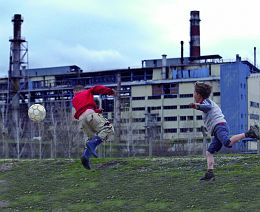
POLJANČE ZA FUCA: "Ferronikl" Glogovac
There are still insufficiently explored deposits of copper, platinum and gold in Kosovo. "The very fact that there are adesites, dacites and other rocks in which there are gold deposits in the world can indicate that there are such deposits in Kosovo as well," says Jelenković and explains that not enough attention has been paid to these metals in Kosovo because they are Eastern Serbia had already had enough.
Although domestic geologists have already explored 95 percent of Kosovo's surface, the question of the validity of those investigations is raised, since some of them were carried out quite a long time ago, with today's relatively outdated technologies. "The answer to this question is quite unfavorable for us and we are quite weak here because we do not have the opportunity for modern laboratory tests of such raw materials." Domestic experts investigated the contents of gold and accompanying elements by chemical means or spectral analysis, and today world companies use induced plasma methods (Inductively coupled Plasma, ICP), which are far more perfect and precise. "With these methods, they obtain precise data on the content of 47 different elements at the same time." We are looking for one, two or five, and they are looking for 47 - the amount of information is initially greater for them." Jelenković concludes that from a geological point of view, Kosovo has been explored at a satisfactory level, but that the quality of the ore has not been examined sufficiently in all cases. Exactly the same is the case with the interest that large companies are currently showing in the exploration of gold deposits in other parts of Serbia. Therefore, it may happen that tests with new methods show that there is something there that our experts did not know about, but even there, according to Dr. Jelenković, no spectacular developments can be expected. "They can be interested in new sites that are located between the old ones." If there is more ore on the line connecting the two old mines, they will find it. What is existing, what is known, is not particularly interesting for them."