WAXED…
The authors of sad jokes about the similarities between Muj, Has, a Serb, an American, an Englishman, a blonde... and who-knows-what else, found a reason to rest their weakened heroes, because the composition of the "Committee to mark the 200th anniversary of the First Serbian Uprising and creation of a modern Serbian state" became an inexhaustible source for questions such as "what do Radomir Konstantinović and Slobodan Rakitić have in common" or "where Dobrica Ćosić and Latinka Perović".
Although these answers cause the discomfort that always accompanies this type of humor, the solutions of these folk wisdoms regularly point to a state body in which there are about sixty politicians, academics, scientists, artists and athletes. The Government of Serbia succeeded, at least on paper, in gathering, among others, pretenders to the throne and sworn anti-monarchists, clergymen and atheists, generals and pacifists, Milosevicians and those who stopped practicing their profession because of Milosevic, advocates of wars for ethnic borders and those who called it Serbian fascism, devotees of Radovan Karadžić and those who knelt on the streets of Belgrade because of the bombing of Sarajevo, academics and hardened opponents of SANU, therefore, almost all those who in recent years turned their heads away from each other when they happened to meet on the street, and that in order to celebrate the anniversary that ends on February 15 of the following year as dignified as possible.
Those who are squeamish about that kind of humor, the corners of their lips will still twitch when they hear that in honor of the great leader Đorđe Petrović, an international big bend, which the Prime Minister of the Republic Zoran Živković has already discussed with the jazzer Dušan Gojković, and that even the police, as the relevant minister Dušan Mihajlović firmly promised, will become European by that date. Thus, the Committee for the commemoration of the anniversary became only a distant flash of that lightning that, as long ago, Filip Višnjić sang in At the beginning good against dahlia, "a son of the Sacred Chains", calling on the Serbs to rise up, because in her shadow, grandiose preparations for celebrating the jubilee have been going on for months, the likes of which have not been recorded since the commemoration of the six centuries of the Kosovo Battle at Gazimestan.
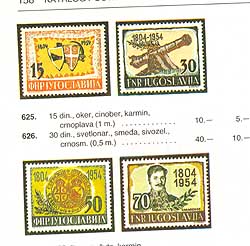
...AND POST OFFICE OF KARAĐORĐE: Stamps on the occasion of the 150th anniversary of the Uprising
MONUMENT: It's hard without peeking in agenda the Prime Minister of Serbia, Zoran Živković, the chairman of the Committee for the Commemoration of the Anniversary of the First Serbian Uprising, to find out what is being prepared in honor of the upcoming jubilee. Only from time to time, depending on inspiration and current mood, the Prime Minister revealed some items of that secret program. So, for example, it was found out by chance that the Historical Museum of Serbia will move into the building of the National Bank of Serbia next year, and that Karađorđev Park in front of the National Library of Serbia will be transformed into the port of the Saint Sava Temple. Museum as a museum, state leaders did not lift a finger for it for the past forty years, letting it languish without a building, exhibit hall and permanent address, if someone had not thought that in its, still non-existent premises, it would be appropriate to celebrate 200 years in Belgrade from The first Serbian uprising. At least that's what was written on the slips of Živković's planner that were flying around, while the prime minister was talking about some other, much more serious matters. For this reason, the central bank will be moved from its premises in Kralja Petra Street to Slavija, where a mammoth, glass building has been under construction for a long time, intended for the central bank of an old, common and large state.
What the Prime Minister said caught the curators of the museum, the managers of the bank, and perhaps even Živković himself, but when it was said, there was no going back. Narodna banka na Slavija, Historical Museum into a bank, which will change the purpose of the old building built at the end of the 18th century according to the project of Konstantin Jovanović. If those who are ready to do anything in the name of their glorious ancestors and bright tradition are at all interested, that building is one of the few public buildings that has preserved its original appearance and purpose from the beginning. In the historical windbreak, where city neighborhoods are more recognizable by their foundations than by preserved buildings, this is not without significance. So, the bank on Slavija, the monument and the bones of Dimitrije Tucović from Slavija, because it is necessary to free up space for the monument to the First Serbian Uprising, which the bronze Karađorđe will look directly at from the church gate, as once upon a time, they say, he watched Belgrade from that place, just before the battle for the liberation of the city.
The jubilee enthusiasm did not spare other institutions either. The National Museum of Serbia is preparing three commemorative exhibitions, Serbian heraldry and traditional costumes will be presented in the Museum of Applied Arts, while the newly revived Historical Museum of Serbia will organize exhibitions dedicated to the uprising, the history of modern statehood and famous Serbian families. The celebratory enthusiasm was not resisted even by local events such as Arandjelovac's "Marble and Sounds", so the participants of the international festival "World of Ceramics" will be proposed to dedicate their works to that theme, while at the same time special souvenirs, evenings of poetry and prose dedicated to the uprising are being prepared. The Opera of the Serbian National Theater from Novi Sad is preparing for the premiere performance of the opera First uprising Svetomir Nastasijević, whose original scores were only recently found, so much thought is being given to who will interpret Karađorđ Petrović, who will play the hajduk Stanoj Glavaš, and who will sing the fateful words of Mehmed Fočić-aga. The challenge of commemorating the anniversary was not resisted by Radio and Television of Serbia. Documentary series On the trail Karađorđe it quickly grew from the planned five to fifteen episodes, although it didn't end there either. A few days ago in Topola, the filming of the features that will make a feature film about Karađorđe began, but that is nothing compared to the discovery of the only preserved copy Life i share immortal leader Karađorđe uncle Ilija Stanojević from 1911, the oldest Serbian film recently discovered in Vienna, which is a pure gift from heaven in honor of the upcoming anniversary. A good voice can be heard far and wide, so the two hundredth anniversary of the First Serbian Uprising will be celebrated in the Dobrun Monastery near Višegrad, for which the unsuspecting pretender to the throne, otherwise a member of the Jubilee Commemoration Committee, Aleksandar II Karađorđević, personally stood up for it.
UPGRADE: However, the main celebration of the anniversary of the uprising will still take place in Orašac, where a monumental monument to Karađorđe, the work of Drinka Radovanović, will be erected. A lot of work is already being done on the figure, which will be three meters tall, but Karađorđe, due to the color of the Venčac marble in which this work is created, will, at least visually, change his mood, becoming in the artistic vision the white Đorđe. In recent months, experts from various institutions for the protection of cultural monuments have flocked to the remote, usually quiet town near Bukulja, announcing the reconstruction and commemoration of historical events related to the First Serbian Uprising, as well as the protection, conservation and presentation of the most valuable objects of folk architecture - the courtyards of Jakovljević and Joksimović. , where an uprising was prepared, and Karađorđe was chosen as the leader.
As always on similar occasions, some in this kind of rapture go a step further, experiencing this heated atmosphere in some amazing way. Thus, an emigrant from America, after a short stay in his homeland, quite accidentally discovered the graves of Karađorđe's uncle Mirko Jovanović and his uncle Milinka's brother. At the same time, fortunately, lonely voices are being heard about the fact that Marićeva jaruga, where the insurgents gathered and swore, is not a very suitable place to celebrate the jubilee, because that name, I guess, is associated with death and decay, and the suggestions to the solemn session of the republican parliament was held in Ostružnica near Belgrade. At the same time, no one thinks about where the two hundred and fifty present and absent members of the republican assembly will crowd.
In any case, the state leaders did more than their predecessors to mark the anniversary of the First Serbian Uprising because that anniversary now has a special significance. In a similar way, the one hundred and fifty years of the uprising were celebrated in the spirit of that time, so the municipal government in Arandjelovac confiscated part of the private, family property in which the Marić ravine was located, in order to place a memorial with a fountain at that place. For the next jubilee, 175 years since the uprising, following the theory of base and superstructure, a plate with a relief image of leader Karađorđe was added to the existing fountain, while at the same time a ritual twinning with a Slovenian municipality was performed. Along with the memorial fountain and verses from The beginning good against dahlia, in recent years the words of Miroslav Krleža spoken to meet that anniversary, that "the Serbian uprising is in every respect a progressive signal of our history, one of the most glorious banners in the long-term battles for the unification of our peoples", have grown into weeds in recent years.
However, it no longer has value for daily use, so it is discarded and forgotten until it is needed again, so that the authorities in Serbia, after everything they have done, have only one thing left to pray to the heavenly saints, about whom Filip Višnjić sang beautifully, because Serbs flock to meet the jubilee without the Constitution and state symbols. In fact, there is a Constitution from the Milošević era and symbols from the time of socialist Yugoslavia, but those who lead this country would prefer that there is nothing, that instead of the coat of arms with the ear of corn, the cogwheel of progress and the five-pointed star, whiteness is gaping, on which the coat of arms of the Kingdom of Serbia will be easily affixed. from 1882. Somehow the verses about the Serbian king in the anthem would have been missed in that package God justice, as, after all, Alexander II Karađorđević himself was smuggled in as "His Royal Highness" in a country that does not have any sign of a monarchy, except for that rude coin that has taken root in the language. There were proposals to let the citizens decide on the coat of arms, anthem and flag in the upcoming presidential elections, but it was realized that celebrating the jubilee without national symbols would be a much bigger problem than welcoming that date without the first man of the country, so the referendum decision is mentioned more and more quietly and quieter.
The question is, of course, who cares about all that today, who still cares about dahis, janissaries, spahis, pashaluks, hatsherifs and nahis, although the members of the ruling coalition clearly need some kind of life belt, when they can't find a solid soil in the electorate that is being stirred dangerously. Emancipation from centuries-old slavery, the beginning of the modern state, the first constitution and the foundations of the civil state already look enough like a place where one can put one's foot firmly. But before that, at least that pile of garbage and all kinds of rot that accumulates at the Kalemegdan gate of Charles VI, through which Karađorđe entered the liberated Belgrade, should be cleared. Thus, without closing your nose and holding your breath, it will be easier to breathe air during that symbolic entry into European Serbia.