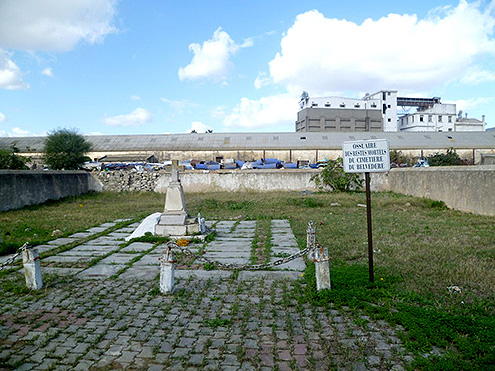
In the city of Tunis itself, on the edge of the Christian cemetery Borjell, there is a dilapidated stone pyramid, surrounded by a neglected lawn and rusty chains. In front of it is a board with the inscription: "The ossuary of the remains from the Belvedere cemetery."
A few days before the centenary of the armistice after the First World War, we only know that around 130 Serbian soldiers are probably resting there, anonymously and completely forgotten. They were buried between 1916 and 1918, and the trace of them is lost after the Second World War, especially after 1977, when the decision of the Tunisian authorities to turn the Belvedere cemetery into a park was implemented. However, in the last few years, the path of the mortal remains of these Serbian soldiers has been traced again, but their names and surnames are not on any plaque. As if they were never there.
SERBIAN BIZERTA: Buried at the Borzhel cemetery, they were among the 61.260 Serbian soldiers who landed in North Africa at the beginning of 1915, based on an agreement with the government of the Republic of France that their fleet transport sick and exhausted soldiers to North Africa, and refugees to Corsica as well as to the south of France . The first ship sailed from Durrës on January 6, 1916, towards Africa and arrived three days later in the magnificent Mediterranean port of Bizerte, then part of the French colony of Tunisia. Later, Serbian soldiers and civilians were transferred there and from Corfu. With the consent of the Serbian government and the French Ministry of the Interior, a reception was organized for Serbian soldiers and civilians in Tunisia as well as in Algeria.
It is remembered how, while the ship "Victor Hugo" was still at sea, several warships came out to meet them, and the sailors, accompanied by music, shouted "long live the Serbs, long live France". Admiral Gepart, together with the population of Bizerte, welcomed the travelers on land with bread, cakes, flowers, candies and southern fruits. During three years, on the soil of North Africa, Serbian soldiers and refugees enjoyed incredible hospitality, recovered, trained and went to war again, on the Thessaloniki front.
Bizerte was a place of gathering and training of volunteers from all over the world, and among them there were Croats, Slovenians, Russians and Czechs. In that period, there were over 5000 Serbs in the city, which meant that every fifth resident in that period was from Serbia. There was a lot of work, trades were learned, schools were founded for children but also for illiterate soldiers, as well as a theater, the printing of the newspaper "Napred" was started, and a church was built. The exhibition "Serbs in North Africa 1915-1919" of the Historical Museum of Serbia, which was shown for the first time in the National Military Museum of Manouba in Tunisia in 2014. testifies to the everyday life of soldiers in that era.
Over 41.000 Serbian soldiers and officers were treated in Tunisian and Algerian hospitals. More than 3000 of them died and were buried in a total of 24 cemeteries in Tunisia and Algeria. Today, you can visit only two in Tunisia - in Bizerte and in Menzel Bourguiba, as well as one in Algeria - in Deli Ibrahim. As for the fate of most of the remains of Serbian soldiers from other cemeteries, it is almost unknown today.

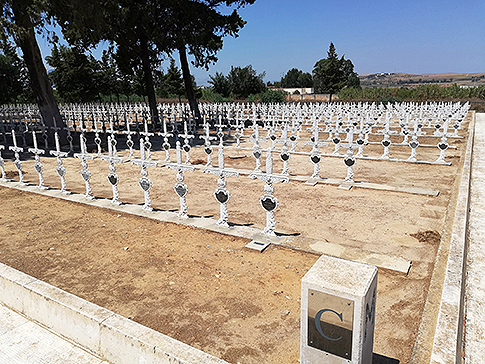
photo: milan smilSERBIAN MILITARY CEMETERY IN MENZEL BOURGIBA, TUNISIA: A place of historical memory
Namely, in Tunisia, Serbian soldiers were buried in a total of five cemeteries - in Bizerte, in Ferryville (today Menzel Bourguiba), Sousse and in two cemeteries in the city of Tunis itself: the Greek cemetery and the Belvedere city cemetery. Thus, over 600 Serbian soldiers and civilians were buried in Bizerte, within the Christian cemetery on a plot reserved for Serbs, whose land the Bizerte municipality ceded to the Serbian army. More than 1700 were buried in Menzel Burgiba. Three Serbian officers were buried in the cemetery in Sus. During the twenties and thirties of the 20th century, there was an initiative to transfer them to Menzel Bourguiba, but there is no evidence that this actually happened. In the Greek cemetery in Tunis, five Serbian soldiers were buried who were moved in 1925 to the ossuary in the Belvedere cemetery (called Beb el Khadra) in Tunis. Their fate, like the fate of the remains of all the others buried at Belvedere Cemetery, was long considered unknown.
However, there are convincing data that point to a different conclusion.
WRITINGS FROM THE BASEMENT: In 2013, a note from the Tunisian Ministry of Foreign Affairs from 1961 was found in the archives of the Embassy of Serbia in Tunisia, located in damp basement rooms that Belgrade, despite all the cries of the employees, has not yet taken over, which mentions only the cemeteries in Bizerte and Menzel Bourguiba. Also, telegrams from the Embassy of Yugoslavia in Tunisia have been preserved in the subject "Data on cemeteries 1966-1969", where it is stated that "we should look for the alleged memorial plaque located in Tunisia".
Research shows that Serbian soldiers in Tunisia were buried in individual graves in a separate part of the cemetery, on the same plot where French soldiers were buried, as was often the case.
"The French had feelings of deep respect for the Serbs and believed that they were something more than their allies," says Nenad Leibensperger, historian of the Republic Institute for the Protection of Cultural Monuments, adding: "During 1922, the French authorities decided to transfer all their soldiers in one ossuary. They also planned for Serbian soldiers there. For this work, they received the approval of the Serbian embassy in Paris. In total, the remains of 130 or 131 Serbian soldiers were placed in the ossuary. 125 or 126 of them were exhumed from the cemetery where the ossuary was, and five from the Greek cemetery in Tunisia. The names were written according to the principle: first letter of the name, full stop, last name. However, there were mistakes, so in some places the first letter of the surname and the full name were entered. Petar Gavrilović, the official custodian of the Serbian cemeteries in North Africa (held the position in the period 1924–1937), requested that it be corrected and a new plaque was then made. Although it was agreed that the plaque would be completed with five names of soldiers transferred from the Greek cemetery, only 125 names remained on the plaque."
A telegram from 1970 was also found in the archives of the Serbian embassy in Tunisia, which reports on the funds spent on cemeteries and mentions the cemetery in Tunisia as an item. In the same year, in the report of Eduard Ile to the Commission for Foreign Relations in the Field of Culture, Education and Science of the SFRY, it is written that "he was informed by the first secretary of the embassy in Tunisia, Comrade Simić, that another cemetery of Serbian warriors is located in the city of Tunis" and that "Comrade Ambassador informed him that efforts were made by the Embassy to regularly ensure the maintenance of these cemeteries (...), however, no answers were received and no material resources". Eduard Ile therefore concludes that it is necessary for the state to intervene as soon as possible.
Already in 1971, the Tunisian state authorities informed the public through written media that all tombstones from the Belvedere cemetery must be removed by April 1 of the same year, which could not have escaped the attention of the SFRY embassy. However, there is no reaction from the Yugoslav authorities. According to the note of the embassy from 1973, entitled "Cemeteries of Yugoslav soldiers from the First World War - what needs to be done most urgently", it is stated that "four years ago it was learned that a cemetery exists in Tunisia, and that nothing has been done." The French exhumed the remains of their soldiers and grouped them all in one cemetery."
Indeed, informed that the Belvedere was becoming a park, the French authorities in the period from 1966 to 1968 exhumed the remains of all their soldiers who were buried on Tunisian soil and moved them to the Gamart cemetery, today an elite suburb of the city of Tunis, near ancient Carthage.
After a number of years without any concrete reaction from the Yugoslav institutions, a new note from the Tunisian Ministry of Foreign Affairs was sent in 1977. It shows that the remains of Serbian soldiers who were in the cemetery in Tunis were moved to the Boržel cemetery in a special ossuary. Until 2013, the soldiers buried at the Belvedere were no longer mentioned, and then the historian Nenad Leibensperger sent a request to the Embassy of Serbia in Tunisia to investigate what happened to the remains of the soldiers buried at the Belvedere. After reviewing the archives, as well as the documentation obtained from the Tunisian and French authorities, the Serbian embassy in Tunisia learned that they were moved to the Borzhel cemetery. Based on the death register from this cemetery and the list found in the basements of the embassy, it was established that these are the remains of soldiers buried in the Belvedere cemetery between 1915 and 1918. The names are written in neat handwriting: Avramović Avram from Veliko, Vuličević Svetolik from Azanja, Đakula Janko from Grenica, Ešukić Dragi from Banija, Selaković Andreja from Borvija, Mitrović Cvetko from Žarkovo... and so on.
IGNORING CULTURAL HERITAGE: It would be logical if the Serbian authorities accepted the proposal of the embassy and included Boržel in the cemeteries where Serbian soldiers who died in Tunisia during the First World War are buried. It would be logical if, for example, the then president of Serbia, Tomislav Nikolić, who was on an official visit to Tunisia - the first at that level after the visit of Josip Broz Tito in 1960 - appreciated the new knowledge, discovered a board made for that occasion with the names of fallen soldiers... But it didn't. He visited, in turn, the cemeteries in Bizerte and Menzel Bourguiba.
It is assumed that the reason for the current official position of the state is that the fate of the remains of these soldiers is unclear, the book Serbia, mother and stepmother, authored by Luka Nikolić, published in Čajetina in 2010. According to the claim of this retired lieutenant colonel, but without any concrete evidence, when the French authorities exhumed their soldiers, they also took the remains of Serbian soldiers with them.
Guided by the principle that in such circumstances only documents speak, in 2013 the Embassy of Serbia asked this question to the Service of Veterans and Victims of War at the Embassy of France in Tunisia and received the answer that during the exhumation operation the issue of grouping was raised, as well as the relocation of Serbian and Russian cemeteries. but that the French state did not take that responsibility upon itself. At the insistence of the Serbian Embassy that these statements be checked once again, the Service of Veterans and War Victims contacted the French Ministry of Defense, which conducted extensive research in the archives of war veterans in Tunisia, as well as in the Directorate of Heritage Memorials and Archives (DMPA) of the French Ministry of Defense in Paris, and concluded that "there are no remains of Serbian soldiers in Gamart, (...) and that no Serbian soldier from the forwarded list is in the book of those who died in Gamart." Our documentation related to the closing of the Bab el Khadra (Belvedere) cemetery mentions the transfer to Gamart of 98 French soldiers, but not Serbian ones. Also, the Ministry of Defense, after checking the records of exhumations and reburials at its disposal, established that there are no Serbian soldiers resting in the French military cemetery in Gamart."
From all this, the question inevitably arises, why is the participation of these Serbian soldiers in the First World War persistently ignored, as well as their remains in Tunisia, even though their names and places of birth have long since been saved from oblivion? Why is it a problem to write those names above their final resting place? They were written last year on the wall of the cemetery in Bizerte, but their remains are not there for sure. Is it the negligence of the state that lasts for decades, the dysfunctionality of the state apparatus that is reflected in the lack of communication between institutions or, as often happens, a standstill due to an unprofessional opinion that no official state commission questions?
Some other, more serious countries would have long ago not only erected a board with the names of the soldiers out of elementary respect, but would have included that place in a kind of cultural heritage in the interest of all citizens. Some other, more serious countries, but not ours.