Although there are no reliable statistics on this, it is estimated that tens of thousands of works of art and archaeological objects are illegally exported from the Balkan countries. Paintings, sculptures, ancient coins and other artefacts of Balkan history usually end up on the market of Western Europe, traders and middlemen usually remain unknown and unpunished, and the competent authorities are powerless in the face of this increasingly widespread form of organized crime. The attractiveness of this region for the illegal trade in cultural treasures is caused by many factors: the wealth of archaeological sites and museum and private collections, easily permeable borders, the insensitivity of the police to the smuggling of works of art, the fragmentation of trade routes... In addition to all these elements, the increase in the number of works of art ending up in European auction houses or on the classic "black market" were also influenced by the specific political circumstances in the Balkans in the last twenty years.
Countries that entered the transition process in the late eighties and early nineties of the last century became "sensitive" to various forms of crime. The countries that went to war during the 1990s were devastated in every sense, and it is still not known what was brought out of them and how. Along with the lack of special police forces that would deal with the problem of illegal trade in works of art, the biggest problem of both groups of countries is legislation.
THE LAW U THEORIES
Despite the numerous promises of representatives of the previous and current Serbian government, the Law on Cultural Property adopted in 1994 is still valid on the territory of the Republic of Serbia. This law clearly defines the concepts of cultural property, cultural property of great importance and cultural property of exceptional importance, but at the same time there are no provisions that would clearly define what is actually meant by illegal trade in these objects, there are no provisions that clearly define the concept of illegal archaeological excavation ... In short, there are no elements that have appeared in this domain in the last ten years. On the other hand, the penalties for violators are determined by the Criminal Code of the Republic of Serbia. Article 184 of the Criminal Code stipulates a prison sentence of one to five years for a person who "buys, receives as a pledge or otherwise acquires, conceals or smuggles" objects that he knows are obtained by a criminal act. Concealment, damage, destruction or trade in archival material is punishable by a prison sentence of three months to eight years (Article 184a), while a person who takes cultural treasures out of the country without prior approval is sentenced to three months to eight years in prison (Article 184b). . Since the entry of international troops and administration into the territory of Kosovo, the laws of Serbia are no longer valid in that region - the protection of cultural property in Kosovo is part of the Provisional Criminal Code which, as a document of the civilian mission in Kosovo, came into effect in July 2003. The punishments that this document provided for violators of Article 289 (protection of cultural property) are extremely lenient - the strictest is prison, for a maximum of three years.
Croatia adopted the Law on the Protection and Preservation of Cultural Property in 1999, and in 2003 it was supplemented and partially amended. Fines of HRK 5000 to 500.000 are provided for violators (depending on the type of crime and the national importance of a specific cultural asset), with the fact that the money paid as a fine for misdemeanors can be spent exclusively for the protection and preservation of cultural assets. Apart from this law, some articles of the Criminal Code and the Customs Law refer to the smuggling of works of art - in this case, in addition to fines, prison sentences of one to five years are prescribed, or up to eight years if the crime was committed by an organized group.
The situation is similar in Slovenia. The Law on the Protection of Cultural Heritage there was adopted in 1999, and a new one is currently being prepared. Violators of this law are subject to fines of 10.000 to 100.000 tolars, while the provisions of the Penal Code "cover" more serious offenses, i.e. the export of items of special cultural and national importance: in this case, prison sentences of three months to eight years are prescribed.
Because of the war that was fought in that territory, the situation in Bosnia and Herzegovina is somewhat specific. "The Law on the Protection of Assets Declared National Monuments of Bosnia and Herzegovina by the decisions of the Commission for the Protection of National Monuments" was adopted in 2002. This law establishes measures for the protection and rehabilitation of assets that were designated as national monuments of BiH before the start of the war in 1992 - monuments of culture, architectural heritage, historical significance or natural heritage. In this law, movable cultural property is not explicitly mentioned anywhere, and more attention is paid to restoring destroyed buildings to their original state. Also, the Law does not foresee any punishments for violators - possible sanctions are foreseen in the provisions of the Criminal Law related to smuggling, without explicit mention of art objects. Republika Srpska, on the other hand, does not have any law covering this area - the draft law is still in the process, and sources from Banja Luka state that the illegal trade in works of art is otherwise considered a "minor" offense.
The Bulgarian Law on Cultural Monuments was adopted way back in 1969, and in current circumstances it is completely out of date - a new law has been in preparation since 2002, and it should specifically deal with contemporary trends. According to the draft law, the penalties for violators will be fines (from 500 to 5000 euros), while the Criminal Code of Bulgaria for illegal trade in works of art foresees prison sentences of up to ten years.
The Romanian Ministry of the Interior bases its activities in the field of illegal trade in works of art on international conventions - primarily the UNESCO Convention, adopted in Paris in 1970, and the UNIDROIT Convention adopted in Rome in 1995. In addition, Law 182/2000 covers the protection of movable cultural heritage and for provides offenders with prison sentences of two to ten years.
ABSURD U PRACTICE
On paper, therefore, the situation does not look so bad. There are laws, there are penal provisions, there are competent institutions and bodies. The problem, however, is in the application of all those powerful legal provisions. On the one hand, the problem is the small number of police units specifically in charge of the art trade - catching criminals in the act is, thanks to this, more a matter of chance than systematic action. On the other hand, the problem is the insensitivity of the competent courts to this issue. Even those illegal traders, unauthorized miners and middlemen who are caught are rarely sentenced to more severe sentences. According to the data obtained by the "Vremena" research team, there is no prisoner serving a prison sentence anywhere in the region for violating the law on cultural property.
In this sense, the Bulgarian example is perhaps the most illustrative. This country has a special police unit, it has clear legal regulations, but the prosecutor's office rarely decides to apply what the law allows: if criminals are caught, the practice is to simply confiscate contraband and fine offenders. In the case of a more serious offense (whether it is the amount of smuggled treasure or its historical significance), a more detailed investigation is carried out and the case often ends up in court. Here, however, offenders usually "get away" with a conditional prison sentence.
One of the most famous trials in this area took place in 1986, and the world-famous treasure hunters Zhelyazhko Demirev (known as Tsar), Nikolay Stanishev (known as Crvenokosi) and Mitko Stankov (nicknamed Obraz) were on the dock. A whole eleven years after the beginning of the process, in 1997, this group was sentenced - conditionally. Therefore, it is not surprising that the main actors continued their successful business: Stankov has since been trading in antiques in Vienna, while Demirev's business could only be guessed after he was killed in 2000. Among the items that belonged to him, a collection of ancient coins was found, and is a unique medallion of Emperor Julian the Apostate, which was valued at $400.000 at the London auction house "Sotheby's".
Other countries, of course, do not lack judicial absurdities either. In addition to the most famous case of the Avar Belt (which will be discussed in the next issue of "Vremena"), one of the legendary court processes in Serbia was conducted from 1995 to 2000 and was referred to in the media as a "silver affair". It all started in March 1995, when 33.703 Roman silver coins with the figures of Marcus Aurelius, Antonius Pius and Faustina the Elder and the Younger were unearthed in the field of Ljubiša and Radoslav Mitić from Priboj Vranje. Most of those coins, more precisely 13.942 pieces (then estimated at 357.670 German marks), were found with a total of twenty (!) suspects. The court in Vladičin Han was responsible for the case, which referred the case to the District Court in Vranje, which decided that "there is no room for accusations". The criminal proceedings were then suspended, the main actors were acquitted, but the case was again returned to Vladičin Han. After that, the Republic Public Prosecutor's Office returns the case to Vranje again, new investigations are conducted and a new indictment is written. It doesn't end there either: the District Court in Vranje declares itself incompetent, the case is transferred to Vladičin Han for the umpteenth time, where only in 2000 was the final decision on suspended prison sentences for fifteen defendants and the return of Roman silver coins.
In this entire extremely complicated story, the most complicated and most absurd was the explanation of the decision on the lack of jurisdiction of the Vranje court. Allegedly, it was not disputed that "the object of the theft was old Roman money", it was not disputed "that it was movable property", it was not disputed "that the money belongs to the state". What was allegedly disputed was "whether these things were under the protection of the state". The authorities in the Vranje court explained that the law is clear when it says that the silver coin was found in a locality that was not registered as a cultural asset or as an archaeological site. In translation: what is not registered, probably does not belong to anyone and no one is responsible for protecting it. What the mangoes would say, those who understand will understand.
LOVERS NA POSITION
A special problem related to the application of existing laws is the undefined role of various experts and assessors, as well as the very dubious role of those who should deal with the suppression of this form of crime. Namely, in all the countries of the region, it is an open secret that illegal trade in works of art involves those who are not mentioned in the law at all: experts, curators and art historians, who, by refusing to issue certificates of originality of works of art, lower the price of those objects, in order to in a later arrangement, these same works were successfully traded, but now writing a certificate of authenticity and value of the work. Although the most prominent curators and appraisers will resolutely deny such theses, although it is actually impossible to penetrate into the details of their activities, the "weight" of their role is completely clear: if the expert sets a low price for the work of art, the owner or alleged owner will want to get rid of his property as soon as possible. , and then the relevant expert can do whatever he wants with the purchased part.
The role of the art historian is also important in the context of issuing false certificates about the authenticity and value of the painting - by fabricating the certificate, it is possible to obtain legal permits for export, thus the illegal business becomes a completely legal sale of works of art with "proper" documentation. In addition, when it comes to archaeological objects, professional archaeologists who have decided to make good money from their work also play a big role; in 1998, when a large-scale theft of archaeological treasures was discovered at the Viminacium site, a police operation arrested an archaeologist from Pozarevac, in whose house "a real museum with exhibits whose origin is still unknown" was found. The archaeologist in question is still dealing in antiquities, and how and whether he was punished at all is still unknown.
In this context, state officials, i.e. employees in state institutions, whose tricks are still only rumoured, are also the talk of the town. There are rumors about the connection of this or that inspector with this or that antiques dealer, about gifts in the form of French Impressionist paintings that these same inspectors give to their daughters as wedding gifts, about art artifacts they keep in their homes, about the share they have in to every confiscation of stolen cultural property... There are, however, examples where the whispering is a little louder and more specific. For example, the example of the Slovenian MP Zmag Jelinčič, who was once involved in the affair of the sale of coins of dubious origin, in which various names and "deals" at the highest level were mentioned, is illustrative.
Perhaps even more illustrative and absurd is also the Slovenian example of the theft of paintings from (no less, no more) the Slovenian government building. Namely, as inspector Miran Štupica told the Slovenian media in 2004, a painting by impressionist Ivan Groharj magically disappeared from the Slovenian government building in 1997. Bishop Close which was delivered from Serbia in 1994, and whose value is estimated at 400.000 euros. The case was immediately reported to Interpol, but there was no sign or voice of the painting until 2003, when, as magically as it had disappeared, it magically appeared in its old place.
To this day, it remains unknown how it is possible to take out of the government and then bring into it a work that cannot fit in a pocket or a wallet, who was involved in the whole story and, finally, why it was returned to the exact place from where it was stolen. . What is absolutely clear is that someone employed by the government must have been involved in the theft - the whole thing simply cannot be explained otherwise. Something similar happened in Croatia, when an enviable number of art paintings were stolen from Banski dvor, the seat of the Croatian government; the investigation showed that there was no forced entry into the building, broken doors or signs of a break-in. Therefore, the Croatian government was robbed by someone "from the inside". This, of course, does not necessarily mean that it was this or that minister, but the question arises as to how cultural goods will be protected in some remote location or private collection, if they are not safe in places that are literally right under the noses of the highest state officials.
One of the few names of high-ranking civil servants that surfaced in the scandals of illegal trade in works of art is Dan Josif, adviser to former Romanian President Ion Iliescu; at the moment, he is one of the actors in the affair, which is still being investigated, concerning the illegal archaeological excavation at the site of Alba Julia, where valuable ancient coins and jewelry were found. Josif, of course, is not the only person who used his position to influence art, but the fact is that the specific names and specific activities of those people are rarely revealed. When asked why this is so, Jovan Ristov, director of the Administration for the Protection of the Cultural Heritage of Macedonia, told Skopje's "Dnevnik" on October 12, 2005: "The problem is serious and sometimes for security reasons not everything is made public." Our role is to protect cultural wealth. But, there are already elements to start "thick" checking of the behavior of both professionals and a large number of politicians. There is a lot of gossip, a lot of reports, false accusations. That's why the investigation should be done by a specialized institution... And so the names of people from state structures and public institutions can quickly surface, not just ordinary citizens who are executors for small money." The statement sounds good, but that's where it all seems to end. Namely, it is completely clear that in some cases of illegal trade in cultural goods, someone from the state apparatus was involved. At the same time, it is completely clear that, with a few rare exceptions, the names of those people are never (not even after the end of the investigation) even mentioned. Of course, there is no question of imprisonment or at least fines.
RATNA STORE

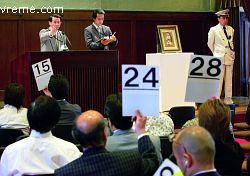
FLEXIBLE LAWS: Auction of works of art
In addition to the problematic application of the law and the still undefined role of experts and civil servants in Article trafficking, the most important factor for the spread of this "activity" in the Balkans are the wars in the territory of the former Yugoslavia. General war destruction, massive paramilitary formations and the misery of the population resulted in a drastic increase in the number of works of art on the illegal market, the disappearance of entire art collections, massive looting of sacred buildings and, finally, the irreversible loss of any inventory of stolen works. In recent years, interstate cooperation has begun in the search for the missing, but only incorrigible optimists can hope that even a tenth of the lost will ever be found and returned to its original place.
Of course, the axiom that says that everything that can suffer in war suffers was established centuries before the last wars in the Balkans. The Romans stole ancient Greek works of art; the Crusaders stole and traded throughout Europe and Asia Minor; the conquistadors unwittingly grabbed the artifacts of Mayan and Aztec culture; enough has already been said about the thefts in the territories of Egypt and Greece by various archaeologists and the lawsuits that are still ongoing on that occasion; the Nazis were by no means squeamish about the works of art found in Jewish apartments, the jewelry found in camp inmates, the archaeological objects they came across during their conquests; Volumes of books have been written about the thefts on the Muslim-Christian line.
In short, war is already proverbially an extremely fertile period for criminals of various kinds. Because of all this, after the Second World War, the Hague Convention on the Protection of Cultural Property in a War Environment was adopted in 1954 - this document, which was later revised, clearly defined the concepts of cultural property and works of art, clearly defined the obligations of the invaders when it comes to these objects and plundering of other people's cultural heritage is clearly prohibited. But with that convention, just like with so many other official documents, the expected happened: nobody respected it and nobody respects it. For that thesis, in addition to the example of the National Museum in Baghdad (from which everything that could be looted was taken), it is sufficient to cite the example of the former Yugoslavia, that is, the wars in Croatia, Bosnia and Herzegovina and Kosovo.
According to the data maintained by the Croatian Ministry of Culture, during the war, around 30.000 objects that are considered cultural property were stolen from this territory, and estimates say that the majority of these objects are mainly located in the territory of Serbia and Montenegro, while a good part has been resold in the meantime to European countries. and overseas countries. A smaller part of those works was returned to Croatia, which primarily refers to goods looted in the vicinity of Dubrovnik, which were located in Montenegro. Competent Croatian institutions are still conducting negotiations with competent institutions in SCG regarding the eventual return of those works of art whose exact location has been irrefutably established. Of course, during the war in Croatia, the cultural assets of the Serbian Orthodox Church, which the authorities of both countries are looking for, as well as the church itself, suffered. In that segment of the story, the biggest problem is that the exact number of cases is still only guessed. When asked about these estimates, the director of the Museum of the Serbian Orthodox Church, Slobodan Mileusnić, explained back in 1998: "If we consider that there are 70 icons on one iconostasis, then add to that that every church inevitably also has kissing icons, liturgical books, church vessels that are used in liturgical life, it is clear that even the number of five thousand missing icons is not final." On the same occasion, Mileusnić stated that persons unknown to the Museum during the war donated "several rare old books" from the Bishop's Palace in Pakrac, known for its rich library that has been collected for more than three centuries. "Croatian soldiers moved into the episcopal palace in Pakrac right at the beginning of the war in Croatia, mercilessly destroying everything they found inside. Old books were kindled for the fire, and many ended up in the garbage. "Some of them made it across the border, where they were bought for two thousand marks each and returned to the SPC as a gift," said Mileusnić.
BOSNIA THE STORY
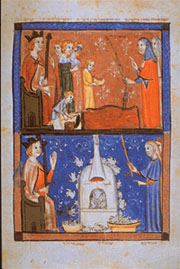
PRESERVED: Sarajevo Haggadah
The case of wartime destruction and looting in Bosnia and Herzegovina is even more vivid. During the war, the Headquarters for the Protection of Cultural Property was established in that area, headed by Josip Pejaković. In addition to this headquarters, the Assembly of the City of Sarajevo formed a commission with a similar task, headed by Azra Begić. Thanks to all that, a part of the goods was saved, above all the Haggadah, the original of which is still in the National Museum in Sarajevo. But, from the galleries, institutions where more than a hundred paintings of Bosnian classics were exhibited (the museums did not have the conditions to keep them, so they gave them "on the reverse side"), the studios of famous masters, the paintings disappeared en masse. 46 Italocritic icons, a self-portrait and a small landscape by Ferdinand Hodler were stolen from the depot of the Art Gallery (according to the estimates of Prof. Dr. Muhamed Karamehmedović, the price of Hodler's works reached several million marks, as he is one of the most valued Swiss painters), as well as two Islamic works of art - two manuscripts from the XNUMXth century. These cases have been reported to Interpol, but to date there is no information on the progress of the investigation.
On the territory of BiH, Franciscan theology may have suffered the most, from which between 400 and 500 paintings of classics from the beginning of the century - by Mica Todorović, Gabrijelo Jurkić and other painters whose works are estimated at approximately 10.000 to 15.000 euros - have disappeared. "The army entered on June 8, 1992. They introduced themselves to us as the White Eagles, after which the friars and nuns were taken to the basement." After three days they let us go and we went to Kiseljak. All the paintings were collected, some were also privately owned, chalices, cibonia... The seminary's library had about five thousand titles. From there, for example, Bosnensia, a collection of the oldest Bosnian books and manuscripts, disappeared," Fr. Mile Babić, Director of Theology, told Vreme. According to unofficial information, most of the more valuable works were taken out of the country, and classic paintings were sold in Belgrade and Zagreb, depending on nationality. So, for example, Jurkić went to Zagreb, and Mica Todorović to Belgrade. "We were contacted by friends from Belgrade who accidentally came across a work that they know was in our possession. Some paintings were also offered for sale to the Franciscans in Belgrade - imagine, they offer you to buy your paintings?" says Brother Mile Babić. By the way, the Franciscan monasteries in Bosnia and Herzegovina have the richest collections of works of art and cultural treasures, and the monasteries in Fojnica, Kreševo and Kraljeva Sutjeska, which have the most valuable collections, luckily managed to preserve them.
As for the stolen items, some works have since been repurchased, while some less valuable ones have been returned as gifts. In addition to paintings, icons, pans, carpets disappeared in Bosnia and Herzegovina, but there is simply no record of this in the museums themselves, nor in the competent government institutions. According to "Dani" magazine, the black market developed during the war not only in the territory of the former Yugoslavia and abroad, but also in Sarajevo itself. Some authors claimed that their paintings were first transferred to the Serbian side, and later returned to the city via Lukavica and appeared on the black market. According to the writing of "Ljiljan" from 1995, Safet Zec's prints were sold on the markets for 50, and Dzevad Jose's for 100 German marks. Otherwise, except for a less valuable part of the collection of Franciscan theology, none of the stolen art objects were returned to their original place. "The police only come when they get an Interpol warrant, to let us know that such and such art is wanted, and to let them know if we come to any information." When I ask them what about our stolen works, the answer is always the same - there is no information," Meliha Halihodžić from the Art Gallery in Sarajevo told Vreme.
BIG KOSOVO ROBBERY
Everything that happened in Croatia and BiH in the early nineties saw its grand finale during the armed conflicts in Kosovo from 1998 to June 1999, ending with the March riots in 2004. The exact number of stolen, resold or destroyed artistic, ecclesiastical and archaeological objects will probably never be established, and chronic misunderstanding on the Belgrade-Pristina line (ie UNMIK) favors that situation.
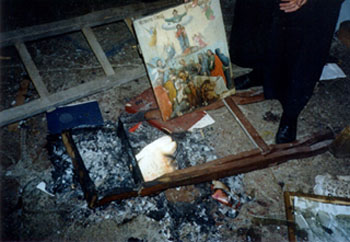
After a series of robberies of SPC property, at the end of 2002, UNMIK representatives asked Bishop Artemi to consider evacuating the entire movable inventory from Kosovo's churches, since "due to the reduction in the number of KFOR soldiers, peacekeeping forces will not be able to secure these churches in the future." . Bishop Artemije then rejected that proposal, demanding that KFOR and UNMIK "fulfill their obligations and protect the property of the Serbian Orthodox Church and temporarily displaced Serbs." This kind of behavior on one side and the other caused a lot of information about this or that church shrine that was found on one of the European antiques markets. During that period, the Greek police arrested four resellers in Thessaloniki, where they found 17 silver-bound liturgical books from the 2002th century, several icons from the XNUMXth century, as well as several other antiquities that these criminals claimed to have bought in Albania from resellers. from Kosovo. Also, the Ministry of Internal Affairs of Serbia was informed that the Slovenian police had arrested several Kosovo Albanians with whom a dozen Orthodox icons were found, while in mid-XNUMX a newspaper announced that Serbian cultural goods were being sold in large quantities on the illegal European market. The Serbian Orthodox Church reacted to all these news with a letter from Patriarch Pavle addressed to the then commander of KFOR, Marcel Valenten, and the then head of the UN mission, Michael Steiner. The letter contained a call to the authorities to "stop the theft and removal of icons, liturgical books and other extremely valuable church-art objects", but there was no real result.
The armed rebellion of the Kosovo Albanians in March 2004 resulted in the almost complete destruction of everything that remained on the ground.
An additional problem in this case is that no one has ever made a complete documentation of the treasures found in churches in Kosovo. "It is realistic to assume that a lot of things were destroyed and disappeared, but the professional services of the Republic of Serbia never bothered to make complete lists and inventories." The only exception is large church complexes whose movable property has been moved," explains Mirjana Menković from Mnemozina, a heritage preservation center that has been working since 1998, even under the administration of UNMIK, for "Vreme". According to her, in Prizren, in 1998, the inventory of works of art began, but the action was not finished, nor was what was done moved to safer territories. "Also, we have a list of icons from Velika Hoča that were transferred to the Provincial Institute for the Protection of Monuments for restoration in 1995 or 1996 and which were never returned. At the moment, we don't know what's going on with them," says Mirjana Menković, emphasizing that without adequate support from the Ministry of Culture, nothing can be done regarding Kosovo's cultural assets.
The realization of the project "Organized crime in the Balkans" was supported by the European Union through the European Agency for Reconstruction, within the program "Support to the professional development of the media in Serbia" implemented by the Media Center.
The Albanian side also has its own problems. According to Hadži Mehmetaj, an archaeologist at the Pristina Museum, during the armed conflicts in Kosovo, the illegal excavation of archaeological objects flared up. "Belgrade neglected the entire Kosovo heritage except for the heritage of the Serbian Orthodox Church, which served to build a myth about the Kosovo Orthodox tradition," says Mehmetaj. He also recalls that in 1998, a collection of archaeological objects dating from 7000 AD to 400 AD was transferred from Pristina to Belgrade; the collection numbering hundreds of items was supposed to be exhibited and then returned, but that has not happened yet. Only the figurine was returned Goddess na the throne, which was symbolically handed over to Michael Steiner during his visit to Belgrade in 2002. "The other 676 exhibits of the archaeological collection are stored in the depots of the National Museum in Belgrade. The ethnological collection is located in the Ethnographic Museum... The museum was involved in discussions with the former Ministry of Culture, Assistant Minister Jovan Despotović was with us, in a very open dialogue we got the impression that a solution is in front of us," said the director on October 22, 2005. of the Arber Hadri Museum in Pristina for the Belgrade-based "Danas", stressing that he still hopes for the "good will of Belgrade". What will happen in the end can only be assumed for now. Bearing in mind the local customs, it is realistic to expect that between Belgrade and Pristina, for years to come, it will be counted who stole what, what is whose and what is not. In the meantime, only those who used the Kosovo tragedy for their own enrichment are profiting.
As far as getting rich is concerned, it is obvious that it is guaranteed to everyone who gathers courage and steps into the wonderful world of Balkan artistic treasures, which are quoted quite well on world markets. In the last few years, this especially applies to the huge corpus of archaeological objects excavated either on registered or unregistered sites: the prices of these excavations sometimes reach truly astronomical figures, so illegal excavation has become a real occupation for many residents of Serbia, Romania, Bulgaria, Macedonia and Kosovo. There are numerous affairs, the imagination and diligence of the diggers is extraordinary, and even special equipment is used. Enough for a whole new segment of the story about the illegal trade in works of art in the Balkans.
Researchers: Svetlana Vasovic-Makina (Slovenija), Ivica Đikić (Croatia), Gostimir Popovic i Slobodanka Dekic (Bosna i Herzegovina), Sinisa Stankovic (Macedonia), Life Xhara i Zana Liman (Kosovo), Paul Radu (Rumunija), Petition Vladimirova (Bulgaria), Gold Raxhimi (Albanija), Slobodan Georgiev, Tamara Through, Dejan Anastasijevic, Miloš Vasic ("Time" Serbia).
coordinator research: Aleksandar Ciric
War trade in works of art in the territory of the former Yugoslavia was also carried out by those who were least expected to do so - representatives of international troops and organizations, first in Bosnia and Herzegovina, and then in Kosovo. According to the interlocutor of "Vremen" from BiH, a part of the missing works of art from the country were brought by representatives of the international community who "mainly bought works from private collections, which was the survival system of the inhabitants of BiH at that time".
As for Kosovo, the problems arose with the arrival of UNMIK. According to archaeologist Hadji Mehmetaj, "many people, including some who were in uniform, were seen digging in the vicinity of Vučitrna where there is a significant archaeological site of Bronze Age objects." On that occasion, it is assumed that four members of UNMIK stole several ancient coins and several medieval silver coins, but witnesses claim that several "metal objects" were taken at the same time. According to the research network of the BCR Institute for War and Peace Reporting, in June 2005, four members of the UNMIK police were caught while excavating at the Novo brdo site. The guardian of this site, Islam Vlasaliu, testified that the policemen dug for three hours and then refused to hand over what they found. The Pristina Museum, of course, never got hold of these items.
As the theft of art objects is not characteristic only of modern times, there have always been laws that sanctioned it in some way. In this sense, the Balkan countries are no exception. The Criminal Code of the Principality of Serbia from 1860 stipulated that theft from churches is treated as "dangerous theft regardless of the size of the stolen object" and that "whoever robs and defaces churches, monasteries and public collections for science, art and art" shall be punished. imprisonment of ten years". This code even provided for a twice as long prison sentence "if there were two or more of them who agreed to that end in the robbery".
And while this code leaves room for somewhat freer interpretation, i.e. it does not cover the sacred objects of other religions, the Canon of Leka Dukadjini is much more specific. Namely, it states that "church possessions and property are inviolable" and that "no one can lay hands on them." This canon states: "Whoever destroys the church will be burned and roasted and thrown out of his banner (administrative unit in northern Albania - ed.) with his household." The culprit - the murderer - is shot by the flag and remains unavenged. The fraternity or the nearest tribe of the criminal buys him land and its price belongs to the church... He who disobeys the church punishment or the canon, the banner will be gathered at his house and everything he has in the fold will be taken from him."
The most explicit, however, is the Code of Montenegrin Prince Danilo from 1855, which in article 81 prescribes: "Any thief caught stealing from a church will be sentenced to death, regardless of whether he was still stealing or wronged the court."
A more interesting case of the participation of state officials in the illegal trade in works of art is the affair with extremely valuable paintings stolen from the brewery in Apatin in 2000. Despite the years-long police search for the images, there was no progress in this case until the representative of Republika Srpska, Krstan Simić, received journalists in his home; in the photographs that accompanied that conversation, Apatin's images were clearly visible. Simić then returned the pictures, just like Ljubiša Kragulj, the owner of a Banja Luka radio station, where the rest of the collection was found.