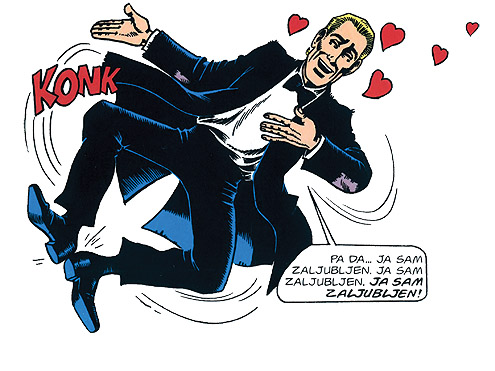
After the jubilee 650th issue of the cult comic Alan Ford was published in Italy, its creator Max Bunker (Luciano Secci) announced that the adventures of the famous secret agent should end with the 660th issue.
"I have to admit I got tired of Alan Ford and we decided there would be another ten issues and then it was over." It's time to be replaced by a new character, this time female. It will be called Petra," Bunker told journalists from the Italian TV station "TGR Lombardia", as reported by Nova S.
For now, he has not clarified whether Petra will be part of the TNT group, which, apart from Alan Ford, consists of characters such as Number One, Bob Rock, Sir Oliver, Grunf, Shef, Jeremiah. There are also unforgettable villains: Superhik, Bepa Joseph, Big Caesar, Gummyflex, Antenamen.
Bunker designed the first issue of Alan Ford in 1969, and his fellow artist Magnus (Roberto Raviola) gave the main characters a cartoonish look.
Comics about Alan Ford are on sale at many newsstands in the territory of the former Yugoslavia. The references, the so-called Fordisms, uttered by the comic book characters are quoted again and again ad infinitum: "Better a living coward than a dead hero", "It is always more important to win than to participate", "We do not make promises and strive to fulfill them to the end".
How an Italian spy became a Yugoslav hero
The comic appeared in Yugoslavia in 1970, and in the following two decades it gained cult status, especially due to the ingenious translation of Vjesnik editor Nenad Briksi.
At first glance, Alan Ford's setting has little to do with Italy or the former Yugoslavia. The main character works for TNT - an intelligence agency that works out of a flower shop in New York.
Nevertheless, the comic enjoyed great success in Yugoslavia, so much so that the Museum of Yugoslavia in Belgrade opened the exhibition "Alan Ford runs the lap of honor", in honor of the fictional character who shaped the generations of that time.
The secret to Alan Ford's success is in his content. The black-and-white caricature comic represented a kind of education for all generations: How to deal with life's troubles in a big city, with selfish fellow citizens, greedy people, politicians, criminals. Criticism related to pro-Western politics and capitalism, but also to communism, racism and other social phenomena.
Communication specialist Lazar Džamić wrote about the way in which Yugoslav readers identified with Alan Ford in the book "The Flower Shop in the House of Flowers".
The book is a reference to Alan Ford's flower shop, but also to the House of Flowers in Belgrade where Josip Broz Tito is buried.
For Džamić, the absurdities of Alan Ford's universe were "a way of life, not an artistic direction" for the citizens of communist Yugoslavia. Džamić went further in claiming that Alan Ford functioned as an accurate image of Balkan society, regardless of which political ideology he followed. "Our natural social system is neither socialism nor capitalism, but surrealism", he writes.