

Election 2026.
REC determined the final number of voters in the elections
The Republic Election Commission (REC) made a decision today on determining the final number of voters in Serbia
 AP Photo/Visar Kryeziu
Pristina officials claim that in two weeks, Serbia violated eight articles of the Basic Agreement, its preamble and one article of the Implementation Plan. After Kosovo Prime Minister Albin Kurti presented the nine-page document to European officials, it is now being published publicly on social media.
Ever since the conclusion of the basic agreement in Brussels, Pristina officials have been accusing the official Belgrade of violating it. Criticism only doubled after the implementation plan was agreed upon in Ohrid in March, he reports Kossev.
After the meeting with the Serbian president, Kosovo Prime Minister Albin Kurti did the same on May 2.
Late at night, he said from Brussels that at this meeting he handed over a document to European mediators about "how Serbia has violated the Basic Agreement since February 27, when it was reached."
"This document clearly shows, factually and documented, that Serbia has violated eight of the 11 articles of the basic agreement. In March and April alone, eight articles were violated. I also submitted a document with three statements by the President of Serbia, where he says that he did not agree with the basic agreement to implement it in its entirety," said the Kosovo Prime Minister.
Meanwhile, this document was published in English by the Kosovo ambassador in Brussels, Agron Bajrami. The same was shared on his Twitter account by the spokesman of the Kosovo government, Perparim Krueziu.
Serbia is accused of reinterpreting, denying and diluting
In the introduction of the document, it is stated that Serbia began to "reinterpret, deny and water down what was agreed upon" even before "the ink on the agreement was dry."
"Serbia's statements and actions show that its leadership is not interested in building good-neighborly relations with Kosovo, which is in complete contrast to what Serbia agreed to," the document says.
It is emphasized that Serbia "continually interferes in the internal affairs of Kosovo to the level of completely undermining the basic functionality" in majority Serbian areas.
Official Belgrade is also accused of the recent boycott of elections in the North of Kosovo.
"Encouraging Kosovo Serbs to boycott and threats of uprising is a clear obstacle that prevents not only the normalization of relations between Kosovo and Serbia, but also preventing Kosovo Serbs from enjoying the benefits they are legally entitled to from Kosovo institutions," it added.
Below is a list of what Pristina claims are violations by official Belgrade, in relation to specific articles of the agreement.
It starts from the preamble of the agreement that was agreed in February in Brussels.
It states that the parties are aware of their responsibility to preserve peace, but also "the inviolability of borders and territorial integrity and sovereignty", as well as that they are committed to overcoming the legacy of the past.
"Serbia continues to deny the well-documented crimes of the past and continues to use the language of defamation against the tens of thousands of innocent people killed during the war in Kosovo and the humanitarian intervention of NATO," it is emphasized.
They also state that Serbia "openly threatens to violate the territorial integrity of Kosovo".
They draw this conclusion from the statements of the Serbian president that four municipalities in the North of Kosovo are "occupied".
"This is also a threat to peace, given that the declaration of a part of the territory as occupied implies the obligation to 'liberate' it," the document added.
The boycott disrupts good neighborly relations
From Pristina, they assess that the first article of the agreement, which mandates "good neighborly relations", was violated by the boycott of the Serbs and their exit from the institutions, "because with it they want to change the conditions of the previous agreements and violate the rule of law, order and the political process within the 'other party'".
Pristina also claims that the second article of the agreement, which mandates the management of the principles of the UN Charter, has been violated, especially those on "sovereign equality of all states, respect for their independence, autonomy and territorial integrity, the right to self-determination, protection of human rights, and non-discrimination."
It is reminded of the statement of the Serbian president from April, that "Kosovo will remain part of Serbia until the end of his mandate".
"It is a clear violation of this article, as well as of Article 6, where Serbia undertakes to be involved in the process until the final solution," the document states, recalling that several Serbian officials publicly claim that they will never recognize Kosovo.
The UN charter is also being violated, with the indication that this is being done by lobbying the Serbian Ministry of Foreign Affairs for certain countries to revoke the recognition of Kosovo.
"This is in direct contradiction to the obligations stipulated in the UN Charter on mutual recognition of each other's sovereign equality, independence and territorial integrity," they added.
The agreement mandates the resolution of conflicts by peaceful means
From Pristina's point of view, the third article, which mandates that disputes be resolved by peaceful means, has also been violated.
They state that the director of the Office for Kosovo and Metohija and the president of the Serbian List called for the release of a person who was recently arrested for allegedly burning cars in the North.
"If this request is not fulfilled, Serbia has promised that the Serbs will respond with barricades in the North of Kosovo, which is a direct violation of the principle of peaceful settlement of disputes." It also represents a violation of the principle of non-interference in the internal affairs of Kosovo", it is emphasized.
As a violation of the fourth article, they state that the Serbian delegation voted against Kosovo's membership in the Council of Europe at the meeting of the Committee of Ministers at the end of April, and at the same time they state that Serbia lobbied against the recognition of Kosovo on several occasions.
Next on the list is Article Five, which mandates that neither side will block the other's progress towards the EU, and that both sides will respect the values set out in Articles 2 and 21 of the Treaty on European Union.
"Serbia still has not withdrawn from its previous position that Kosovo cannot apply for EU membership status," the document states.
While emphasizing that an important element of Article 2 of the EU Treaty is respect for minority rights, it is emphasized that Serbia "has yet to prove that it is willing and open to discuss the elements of minority protection policy for all communities, including Albanians in Serbia."
Criminalization of the peace process
On the other hand, they emphasize that Vučić "openly accuses all members of the Serbian community in Kosovo who hold public positions, including the Minister of Communities and Return, Nenad Rašić, of being traitors."
"It is an indication that Serbia intends to keep the representation of Serbs in Kosovo under the control of the Serbian List, contrary to the values of pluralism and tolerance," it added.
They also claim that Serbian institutions arrested several Serbs from the North for alleged "treason" and cooperation with Kosovo institutions.
"Belgrade's policy effectively criminalizes the peace process and the integration of Serbs into Kosovo's institutions," they emphasize.
Prishtina finds violations of the agreement also in point seven, which talks about self-governance for the Serbian community and the formalization of the status of the SOC.
The document states that Serbia does not respect the decision of the Constitutional Court of Kosovo from 2015 on the Agreement regulating the issue of the ZSO, as well as the letter of the former high representative of the EU, Federica Mogherini, from the same year.
Control over the SPC
When it comes to the issue of the SPC, it is stated that "Serbia exercises full control over the Serbian Orthodox Church in its relations with Kosovo."
"In this context, it is impossible for the Government of Kosovo to start a dialogue with the SOC according to the Agreement. This is a violation of Art. 7(2) to the detriment of the approach that would enable the Government of Kosovo to formalize the status of the Church as a legal entity that has the right to perform functions in accordance with the Constitution and legislation of Kosovo," it added.
They emphasize that Serbia's insistence on representing the Serbian Orthodox Church is "a direct violation of the Agreement and the very nature of the Church as an independent actor."
The eighth article of this agreement stipulates that the parties will exchange permanent missions.
"Serbia insists on not allowing progress in the exchange of permanent missions on the basis of the guarantees and immunities provided for diplomatic personnel," the document states.
Prishtina also sees a violation of point ten, which mandates that the parties will establish a joint committee, chaired by the EU, to monitor the implementation of the agreement, but also that the parties confirm that they will implement all previous agreements that are valid.
The document, however, accuses Serbia of refusing to "plan the derogation and cancellation of all previous agreements that have been replaced by the basic and annex on implementation" with Pristina.
The agreement is respected up to the red lines
Prishtina also believes that Serbia violates the 2nd point of the implementation annex, which states that the parties undertake to respect all articles of the agreement and annex and to implement them quickly and in good faith.
"Serbia continuously violates the agreement itself because its institutional leaders, including the president, declare that Serbia did not accept the agreement on the road to normalization, but that it accepted the concept and is ready to work on the implementation of the agreement up to certain limits," they said from Pristina.
They accuse Belgrade of violating the spirit of the agreement, and because of the allegations that it is not ready to respect the agreement in its entirety, but up to the red lines that include opposition to recognition and membership in the UN.
"Serbia refuses to accept that the Agreement is legally binding and insists that no one else can produce legal consequences for Serbia except its president and in some cases the prime minister and the minister of foreign affairs," the document concludes.
ZS/Kossev
Read daily news, analysis, commentary and interviews at www.vreme.com
The Republic Election Commission (REC) made a decision today on determining the final number of voters in Serbia

A citizen of Belgrade whose polling station in Banja Luka was changed in the voter list without his knowledge claims that the Ministry did not correct his data and that the deadlines have expired. The elections are on October 25 and he still doesn't know where he will vote.

The pardon procedure implies the appropriate role of the Minister of Justice, who should initiate the procedure or submit an opinion on the pardon, says prosecutor Radovan Lazić.
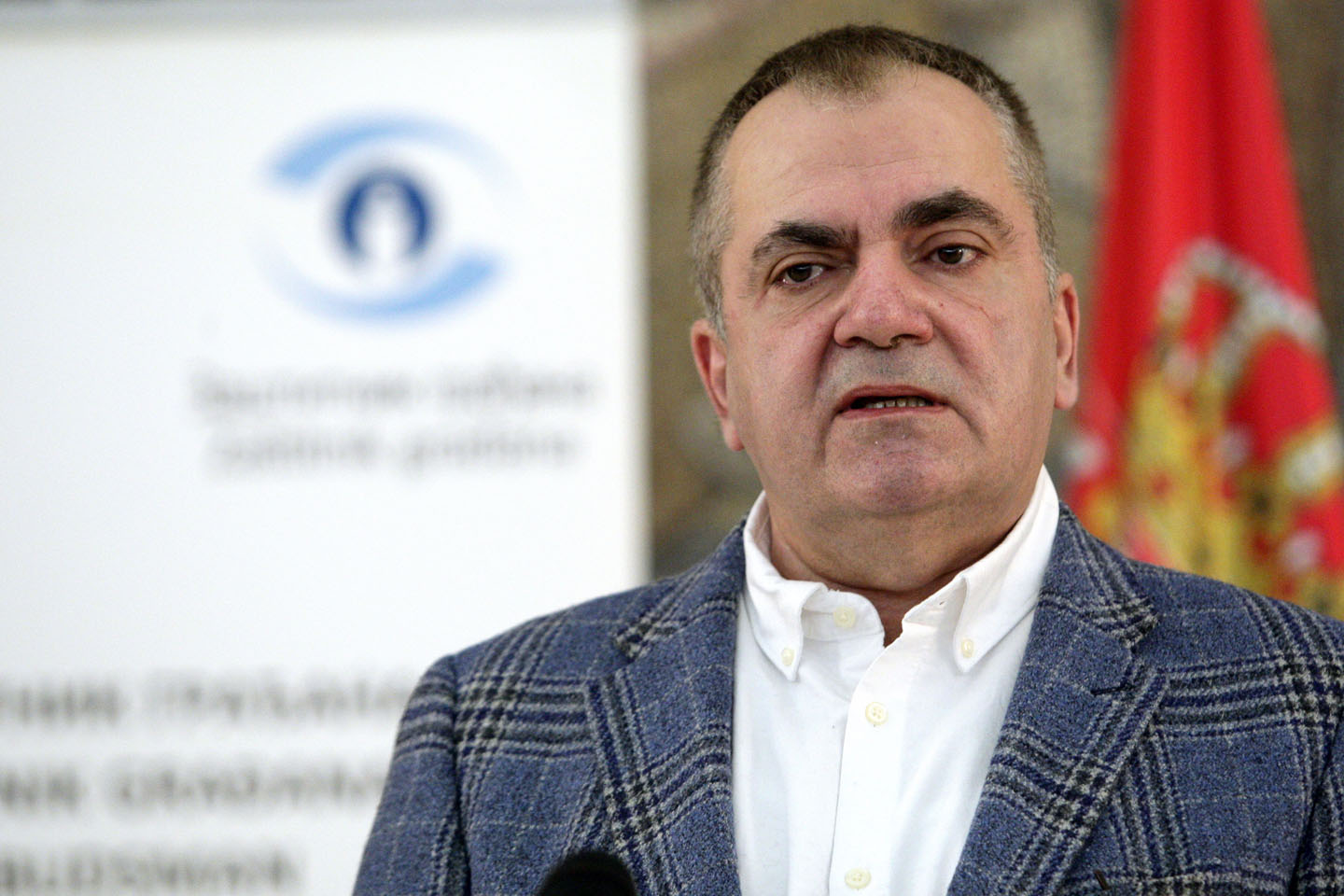
Phone numbers 064 876 85 05 and 011 2068 100 will be available 24/7 for reports and addresses to citizens, and the possibility of direct addresses at the premises of the Protector of Citizens is also provided.

NUNS demands an urgent investigation due to the threats sent to two Radar journalists who wrote about the Sky correspondence in which Aleksandar Vučić is mentioned. The association states that the threats also mention violence against children of journalists and warns of impunity

There is, literally, no difference between the one who claims it is day in the middle of the night, or the one who claims to be a giraffe, from the claims we read on billboards: that Vučić is working to unify Serbs and that Serbia is doing better and better day by day.

The pre-election arrests due to the alleged "overthrow of the state" testify to the regime's panic. The bad news for them is - they can't arrest the whole people who decided to defend themselves from progressive beatings and election theft

The ring that tightens around Ćaciland Student list is getting narrower. Because there are more and more spoiled people who see the false prophet for what he is: a street obscener who is fighting Serbia

The archive of the weekly Vreme includes all our digital editions, since the very beginning of our work. All issues can be downloaded in PDF format, by purchasing the digital edition, or you can read all available texts from the selected issue.
See all


The explosion happened around three o'clock after midnight, near the electric pole on which the surveillance cameras were installed


