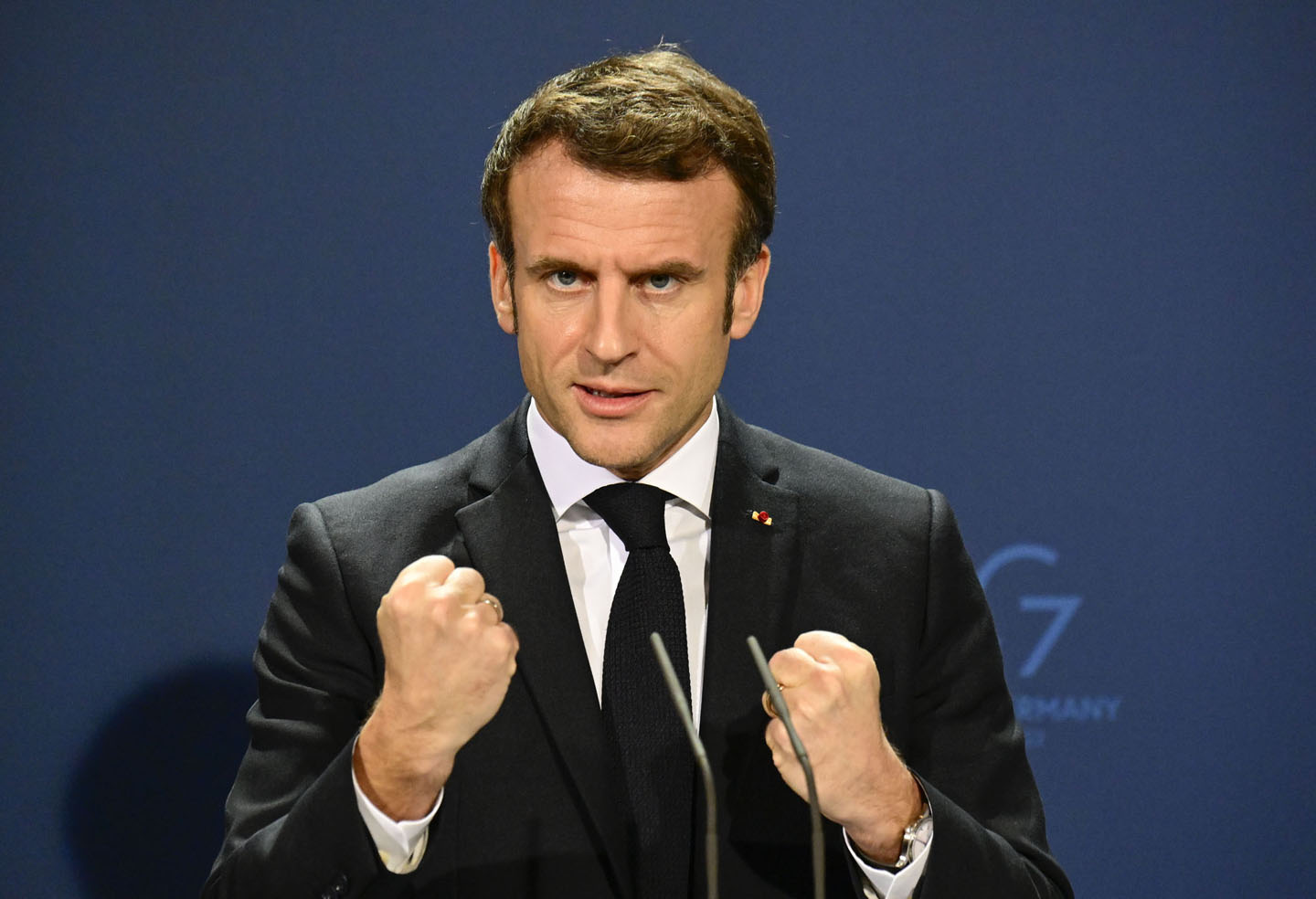
Five years ago, a "republican front" was formed against Marine Le Pen, in which all political forces gathered to prevent her victory, so Macron managed to win with 64 percent of the vote. This time it is certain that such a victory will not happen, because Macron managed to frustrate a huge number of voters with his rule as the "president of the rich". Although at the moment Macron has the advantage according to the surveys, the pendulum can easily turn against him even on the most insignificant occasion.
The results of the first round of presidential elections in France showed that voters overwhelmingly reject the ruling liberal order. The leading candidates of the radical right and left wing of the political scene won over 50 percent of the vote: Le Pen 23,1 percent, Mélenchon 22 percent and Zemur 7,1 percent. To that should be added the votes of other anti-system candidates such as the communist Lassalle (3,1 percent), the "provincialist" Roussel (3 percent) and the "hard rightist" Dipon-Enyan (2,1 percent), as well as two communist-Trotskyist candidates. orientation with a total of 1,4 percent of votes. The forces of "liberal democracy" did not "scratch" even 40 percent of the votes: Macron 27,8 percent, Pekres 4,8 percent, Jado 4,6 percent and Hidalgo 1,7 percent of the votes.
An unexpected debacle was experienced by the republican candidate Pekres, who did not even get 5 percent of the votes, which is necessary for the state to cover the costs of the pre-election campaign, and the socialist candidate Hidalgo got only 1,7 percent of the votes. It well illustrates the depth of the destruction of the political system: until just five years ago, the Fifth Republic was dominated by two large parties, the republicans (degolists) and the socialists, and today their candidates cannot get even 5 percent of the vote.
Deviation of voters from the establishment
The election results show the growing departure of the French from the existing establishment. In the previous elections in 2017, the "systemic" candidates received over 50 percent of the votes in the first round, and now they cannot collect even 40 percent. In particular, the radical right advanced, which in total received over 30 percent of the votes in the first round. Progress was also made by the radical left-leaning candidate Mélenchon, who almost managed to enter the second round.
In the second round of the election, Macron can attract the largest number of voters of the systemic candidates, but this is not enough to win. In order to win, he must attract a good part of Mélenchon's votes, as well as other leftists - communists and Trotskyists.
Macron's hunt for leftist votes
In order to somehow approach that part of the electorate, Macron began to "give in" on the pension reform right after the first round. Although it was intended to raise the age limit from 62 to 65, Macron began to mention that it would only go to 64. The level of panic is also shown by the writing of the respected "Politico" portal, whose journalist was informed from a high place on Monday that there is no "recession" regarding the pension reform, only to receive information just a few hours later that the reforms will be eased.
Photo: APPanic concessions to the left: Emmanuel Macron / Photo: Tobias Schwarz/Pool Photo via AP
How frustrated the voters of the left are with Macron is shown by the answer of the mayor of the city of Trappes (one of the far suburbs of Paris) to the question of the journalist of the British "Observer" what Macron can do to attract the voters of the left. The mayor (who was otherwise an activist in Mélenchon's campaign) replied that it would be best for Macron to keep quiet, since he irritates the voters so much with each of his appearances that they will stay at home, or vote with a blank ballot.
National Socialist Marina
Marine Le Pen has focused on social issues, where she promises significant support to the vulnerable sections of the population, and it can hardly be concluded that she is a far-right candidate. She managed to avoid unpleasant topics and to deal very little with sensitive foreign policy issues; she neutralized the attacks that she is "Putin's man" by saying that she condemns the attack on Ukraine, and in the conditions of falling standards and inflation, one gets the impression that voters don't care.
In addition, she gave up the radical moves she announced in the previous campaign, such as leaving the European Union or the euro, and from foreign policy moves she intends to leave the military wing of NATO, as General De Gaulle did more than half a century ago.
Among the presidential candidates, she was supported by Zemur and Dipon-Enjan, and research shows that she will also receive a share of the votes of the other candidates (Melanchon and Pekres).
What is happening in the country and the world, what is in the newspapers and how to pass the time?
Every Wednesday at noon In between arrives by email. It's a pretty solid newsletter, so sign up!
MPs voted on the Proposal for a Decision on the Election of Members and Deputy Members of the Board of the Assembly of Serbia. The continuation of the session is on Wednesday at 10 am
As reported by the Belgrade media, the leader of the militant movement "Leviathan" was arrested on November 24 for embezzling 22 million dinars. According to the report of the Agency for the Prevention of Corruption, Bihali first transferred the money intended for the campaign to his private account, and then withdrew it without grounds.
Marko Pavlović was released from custody after the decision on pardon came, but it was confirmed to "Vremen" that the former president pardoned him for an act for which he was not charged. The Appellate Court in Belgrade annulled the decision terminating Pavlović's detention
The Deputy Mayor of Smederevo, Vladimir Nešić, made a statement in his capacity as a citizen regarding the report on suspicion of not informing the public about the state of the environment.
The former head of the BIA, Aleksandar Đorđević, was Vučić's staff. Now the BBC has published a strange interview with him in which Đorđević seems to be trying to wash himself, but somehow lukewarm
Why did an unusual group of people led by Aleksandar Vučić, at the constitutive session of the Assembly of Serbia, go berserk because of yogurt spilled on the head of a member of parliament, a "reputable artist" and, of course, a woman?
How Aleksandar Vučić convinced the public that progressives are not worthy of the position of vice-president of the National Assembly and how its president - Aleksandar Čupić - explained to him theoretically and practically what parliamentarism is in front of everyone
The archive of the weekly Vreme includes all our digital editions, since the very beginning of our work. All issues can be downloaded in PDF format, by purchasing the digital edition, or you can read all available texts from the selected issue.