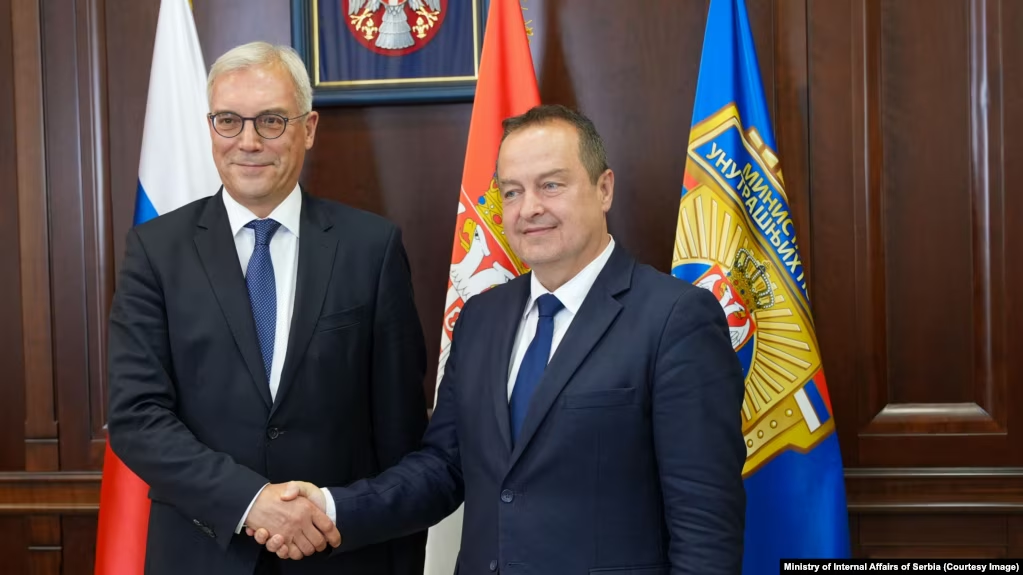
The European Union has again called on Serbia to impose sanctions on Russia for its invasion of Ukraine, after Belgrade hosted the Deputy Minister of Foreign Affairs of Russia Alexander Grushko, writes Radio Free Europe.
On July 2, Gruško met with the President of Serbia, Aleksandar Vučić, and during his stay in Belgrade, he also had meetings with other high-ranking Serbian officials.
"The European Union has been crystal clear with our partners: relations with Russia cannot be normal with Russia's unprovoked and unjustified war of aggression against Ukraine," the EU spokesperson said in a statement to Radio Free Europe.
It is added that the EU Council recognizes Serbia's humanitarian and other aid to Ukraine, but also expects Serbia, as a candidate country for EU membership, to align itself with European foreign and security policy.
The US State Department states that the United States "does not believe that any country should provide Russia with a platform to promote its war of aggression against Ukraine."
"The countries of the Western Balkans, as well as the whole of Europe, have a deep stake in the outcome of the Russian war against Ukraine, which threatens the foundations of the established international order and security. That is why it is crucial that we continue to stand together in the face of Russia's aggression," the State Department stated.
The USA praised the support that Serbia has provided to Ukraine so far.
Who did Gruško meet in Belgrade?
Gruško had a "good conversation" with Serbian President Aleksandar Vučić, as Vučić himself announced on his Instagram account on July 2.
"We considered the overall bilateral relations between Serbia and the Russian Federation and assessed them as very good," Vučić wrote in an announcement after the meeting with Gruška.
A day earlier, Lavrov's deputy met with the Deputy Prime Minister and the Minister of Police, Ivica Dačić.
He also had meetings with Deputy Prime Minister Aleksandar Vulin and Minister Nenad Popović. Both are on the sanctions list of the United States of America (USA) because of their close ties to the Kremlin.
Marko Đurić, Minister of Foreign Affairs of Serbia, is on the list of Serbian officials with whom Gruško met.
The pro-Russian narrative subsided
In the past period, the pro-Russian narrative of the Serbian government has become significantly quieter. It is an exception Alexander Vulin, the Deputy Prime Minister in the convocation of Miloš Vučević without a relevant ministry, who went to Russia on several occasions since the war in Ukraine began in 2022.
The last visit took place less than a month ago, when Vulin, among other things, laid a wreath on Stalin's grave. The Deputy Prime Minister and former director of the Security Information Agency has been on the US sanctions list since July last year. The reason is allegations of corruption and involvement in the drug trade, as well as close ties with Russia.
However, with the exception of Vulin, who is a regular guest in Moscow, it seems that the rest of the government is not so inclined to maintain close ties with Putin's Russia. The last one to visit Moscow - without Vulin - is Ivica Dacic, who did so in March of this year.
At the same time, the media, which is the backbone of the regime's propaganda, softened the rhetoric towards NATO alliance. Thus, on the occasion of the 75th anniversary of the existence of this military alliance, Pink television hosted Media Advisor at the NATO Military Liaison Office in Belgrade, Maria Karasa. As Pink writes, Karasi stated that Serbia, as a partner country, has many benefits from cooperation with the NATO alliance, and that for her the most important form of cooperation is science for peace and security, a program that brings together Serbian scientists and gives them the opportunity to work together with their colleagues from NATO improve the security of Serbia.
It is an open question whether this change of narrative means the end of the policy of "balancing" between East and West, which the Serbian authorities have been trying to implement since the beginning of the war in Ukraine.
Source: RSE