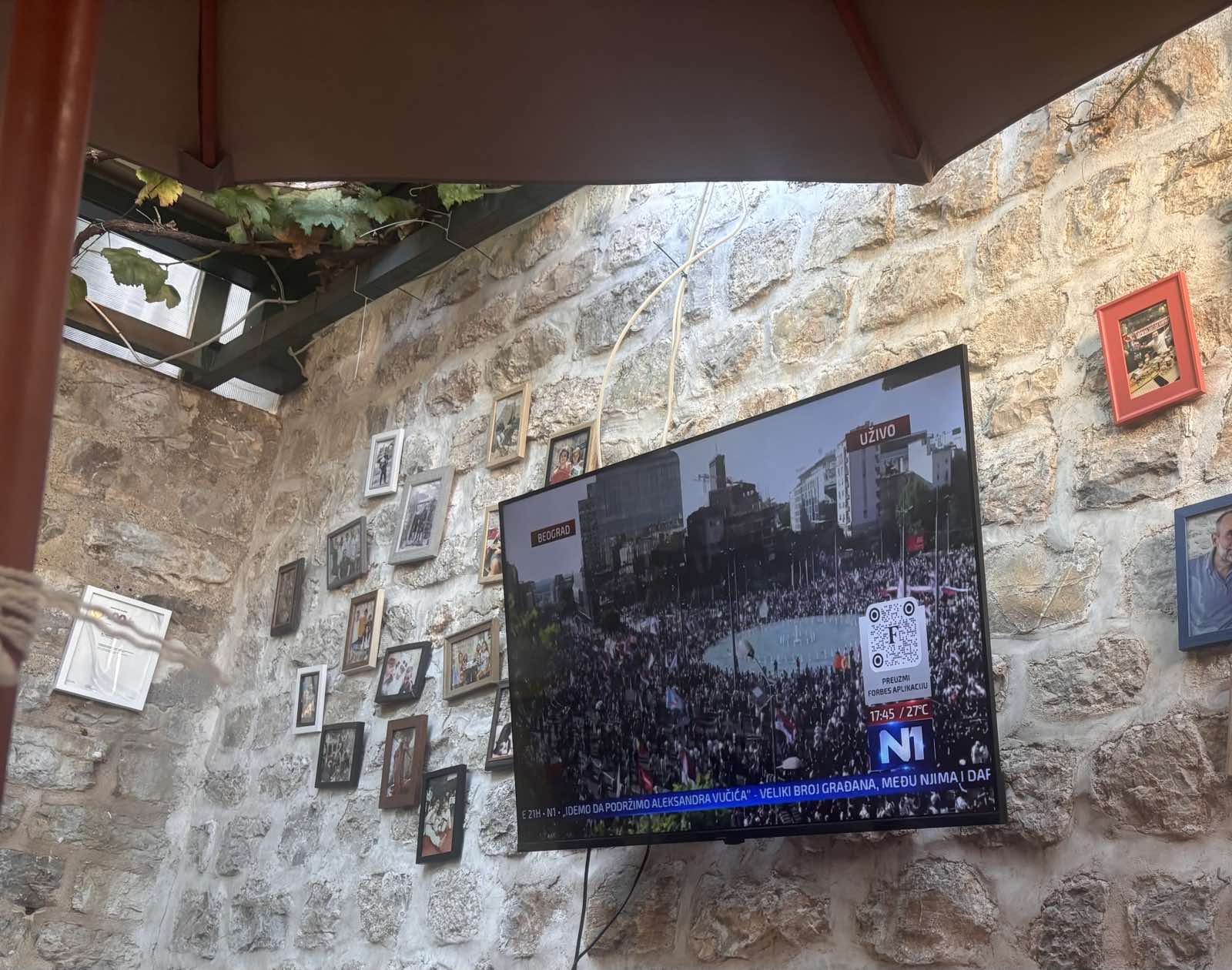
The TV connected to the computer has been on all day since the broadcast of the Vidovdan protest began. The transmission of television N1 is being watched. Several people, waiters and bar owners in the Old Town of Budva, follows every minute of the rally in Belgrade and every step taken by the tens of thousands gathered.
They follow the television program and social networks in parallel.
The wife and children of one of the attendees just managed to meet at Slavia, while he monitors their locations on their phones minute by minute.
It's not a sport
The engrossment in the events is interrupted by the question of a girl who comes to the bar and says confusedly: "What sport is this?". She is probably used to similar scenes when sporting events are followed in the bar.
"It's not a sport, it's a protest in Belgrade," adds one of the attendees.
"Well, it makes sense, maybe the protests could be classified as a new sport," someone quips with a smile.
Someone decides to switch channels and see how the Serbian pro-regime media is covering the protest. Spend a few minutes with Informer and Kurir television, then back to N1.
A new guest arrives and asks: "Why are we only watching N1? Let's see the other side as well."
"We watched it - it's boring", replies the man who previously flipped the channels and left the N1 television on.
Those gathered are commenting on the announcement of the Ministry of the Interior that there are 36.000 people at the meeting.
"And last time they announced that it was three, four times less."
Are there any similarities with the demolition of Milo?
And are there similarities between the years-long overthrow of Milo and the attempt to overthrow the government in Serbia?
Months of protests and liturgies followed the fall of the Montenegrin President of Montenegro, Milo Đukanović, in 2023, who had been in power for more than 30 years. The drop in the bucket full of dissatisfaction were the disputes over the position of the Serbian Orthodox Church in Montenegro.
Protests and liturgies contributed, that is, mixed attitudes about the position of the church in Montenegro.
Commenting that he hopes the protests in Serbia will lead to regime change, one of the guests compares the protests in Serbia with the situation in Montenegro a few years ago.
"There are similarities. We in Montenegro were also determined and persistent, like citizens in Serbia led by students today," he tells me.
The difference is that in Montenegro the church was attacked, he adds.
"But it's the same - Milo attacked the church, Vučić hit the children," replied the gentleman whose children were at the rally in Belgrade.
What will happen after 21 pm?
Everyone is patiently waiting for 21 p.m. to see what will happen.
Many hope that the situation in Serbia will change on Saturday evening, that Aleksandar Vučić, the president of the republic, will admit defeat.
Among those gathered are several Serbs working temporarily on the Montenegrin coast.
There is also a girl, a student, of Montenegrin origin, who studies in Novi Sad.
She also follows the program and comments on the information she receives from her colleagues from Belgrade.
Until today, she had not heard that the "Serbia train" had stopped the traffic.
In the hope that things will change in Serbia, she says ironically: "And I also found when to ask for Serbian citizenship", she comments ironically.
Everyone is hoping for some kind of change, but they are not the most optimistic.
"Everything is the same as every time", says one of them, originally from Belgrade, adding that it annoys him when the speaker reads the speech from the phone, which one of the protest participants is doing right now.
Everyone expects something new and hopes for change.
The students who before Saturday's protest gave the citizens a "green light" and invited them to join the changes are also calling for change.