

New issue of Vremena
How to break a mafia state
The famous Hungarian sociologist Balint Magyar talks about the mafia state for the new "Vreme". How the new election winners can overthrow that system

Even after the latest escalation of violence, the EU continued on the same principle with Serbia and did not explicitly call the government to account. Could the pressure on Aleksandar Vučić's government increase soon?
The situation in Serbia is tense: new reports of police violence against demonstrators, arrests - and accusations that the government hires beatings groups against citizens, writes DW.
Protests, started after falling canopy in Novi Sad in November, they were calm for a long time - but in the last few days violence it escalates. And the populist president of Serbia, Aleksandar Vučić, now wants to deal with the protests even more harshly.
How does Brussels react to escalations in a candidate country for EU membership?
The ambassador of the European Union in Serbia, Andreas von Beckerat, called on "all parties to calm tensions" in a statement. Any suspicion of excessive use of force by the police must be properly investigated, he said.
The European Commission told DW that it is closely monitoring the situation. "The rights to peaceful demonstration and freedom of assembly must be respected, and the authorities must protect assembly participants from injury or violence," said European Commission spokesman Guillaume Mercier.
But such announcements are not enough for some. Critics have been calling for a tougher course towards the Serbian government and President Vučić for months.
Criticism from the European Parliament
One of them is a European MP Tonino Picula, rapporteur for Serbia. The Croatian social democrat criticized the fact that the EU does not show a unified and more critical attitude towards Serbia.
"At the moment, the EU has no motive or capacity to treat the malignant regime differently Aleksandar Vučić. "Unlike Ukraine, there is a missing component of unity in the EU that would represent pressure that would lead to a compromise and perhaps going to the elections," Picula told N1.
The strategic interests of Brussels, but also of Belgrade, could also play a role in this: last year, Germany signed an Agreement with Serbia on lithium.
In addition, Serbia skilfully used friendly relations with Russia, says Antigona Imeri from the Center for European Political Studies (CEPS) from Brussels. For fear of rapprochement with Russia, the EU was too lenient: "That strategy has failed, the EU must now urgently set a different tone."
Loss of trust among people in Serbia
But even after the latest escalation of violence, the EU continued business as usual with Serbia and did not explicitly call the government to account. "It is understandable from a geopolitical perspective, but it becomes problematic if the impression is created that it is being done at the expense of the basic values of the Union," says Imeri.
Such an impression further undermines the trust of many people in the EU - and it is already weak in Serbia.
Several surveys this spring showed that only about 40 percent of citizens support joining the EU, while more than half are against it. Other surveys, however, show a close race.
The EU is the most important economic partner
However, not all experts see Brussels' strategy towards Belgrade as problematic.
"I think it is too early to judge the EU's position on this issue," says Nina Vujanović from the Bruegel think tank in Brussels. The EU has signaled that it is monitoring the situation and should continue to do so, she says.
Instead of exerting pressure, the EU should use economic incentives - so the risk of Serbia getting closer to Russia would be small: "Serbia has a much greater economic interest in implementing EU reforms than in turning to Russia," says Vujanović. The country has long been strongly connected economically with the EU.
How much room for maneuver does the EU have?
Pressure on Vučić and his colleagues could be exerted by economic means: the EU has promised Serbia 1,6 billion euros until 2027 - however, these funds are tied to the implementation of reforms.
"The EU could postpone or reduce these funds if it determines that the country does not fulfill its obligations," explains Vujanović. Currently, it seems that Serbia is far from implementing the necessary reforms.
In the EU report on the rule of law in Serbia, published in July, it is stated that there is still strong political pressure on the judiciary and civil society actors, and that there is growing concern for the safety of journalists in the country.
It is precisely against this that students and citizens in Serbia have been taking to the streets for months - despite the risk of being arrested or injured by the police. If the violence at the protests does not stop, the EU could be under increasing pressure to take a clearer stance towards Belgrade.
Source: Deutsche Welle
The famous Hungarian sociologist Balint Magyar talks about the mafia state for the new "Vreme". How the new election winners can overthrow that system

The message of the last gathering of the Student List before the elections on October 25 is: It's over! It's a little retro, but considering who it's related to, it hits the spot

The "Students are winning" list held a final pre-election rally on Belgrade's Trg Slavija ahead of the extraordinary parliamentary elections scheduled for Sunday, October 25.
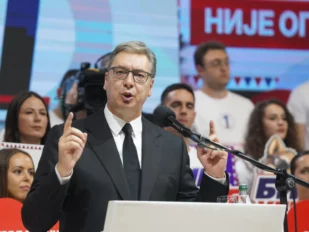
"They tried to destroy our country on an external order. Huge money entered the country and that's why this is the most difficult battle, because they attacked us with billions of euros, and we defended ourselves with purity, our program and love for the homeland," said Aleksandar Vučić at the final pre-election meeting in Belgrade's Hall of Sports

The signatories of the letter "We believe in Serbia that can do much more", more than 190 businessmen and entrepreneurs, publicly supported the Student List

There is, literally, no difference between the one who claims it is day in the middle of the night, or the one who claims to be a giraffe, from the claims we read on billboards: that Vučić is working to unify Serbs and that Serbia is doing better and better day by day.

The pre-election arrests due to the alleged "overthrow of the state" testify to the regime's panic. The bad news for them is - they can't arrest the whole people who decided to defend themselves from progressive beatings and election theft

The ring that tightens around Ćaciland Student list is getting narrower. Because there are more and more spoiled people who see the false prophet for what he is: a street obscener who is fighting Serbia

The archive of the weekly Vreme includes all our digital editions, since the very beginning of our work. All issues can be downloaded in PDF format, by purchasing the digital edition, or you can read all available texts from the selected issue.
See all




